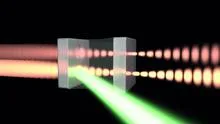
Nonlinearity is a property of a system where the response is not directly proportional to the input. In optics, this means that the polarization of a material responds nonlinearly to the electric field of light, so the light itself can alter the medium through which it passes. This enables interactions between photons, which are otherwise independent in vacuum. Nonlinear effects are responsible for phenomena such as frequency doubling, self-focusing, and soliton formation.
History
The field of nonlinear optics began in 1961 when Peter Franken and colleagues at the University of Michigan observed second-harmonic generation, doubling the frequency of a ruby laser beam passing through a quartz crystal. The theoretical framework was developed by Nicolaas Bloembergen, who won the Nobel Prize in Physics in 1981 for his contributions.
How it works
In a linear medium, light waves pass through without affecting each other. In a nonlinear medium, the intense electric field of light changes the refractive index or other properties of the material, which in turn modifies the light's propagation. For example, two beams can mix to produce new frequencies, or a single intense beam can create its own waveguide. This feedback loop between light and matter is the essence of nonlinearity, and it becomes significant at high intensities or with specially engineered materials like photonic crystals or atomic vapors.
In practice
Nonlinear optics is used in laser frequency conversion, optical parametric oscillators for tunable light sources, all-optical switching in telecommunications, and in quantum optics to generate entangled photon pairs.
Fun fact
The first demonstration of second-harmonic generation produced so little ultraviolet light that the photographic plate showing the effect was nearly discarded as a blank, and the spot was later found to be the desired signal.
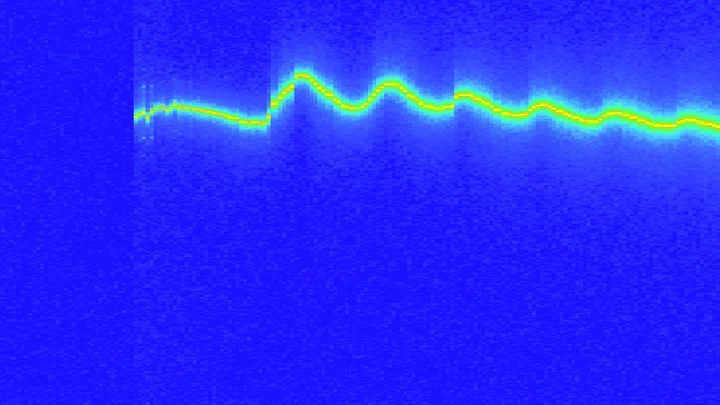
Two connected vessels joined by a tube usually settle at the same water level. Here, the vessels start rocking on their own because each has a leak, and the leaks are different. Light in two dimples of a micromirror behaves the same way: photons flow from one well to the other, but they are lost at different rates. These losses do not damp the motion; they set its rhythm.
Imagine an interferometer as a giant ear listening to the radio whisper of a distant galaxy. Three antennas spread across continents capture the signal, and the difference in their phases combines into a quantity that is immune to atmospheric jitter. This quantity is called the closure phase.
A weather forecaster draws a thick black line across Europe: north of it, frost; south, a thaw. That boundary, the zero isotherm, won't tell you the temperature in Stockholm or Rome, but it honestly marks where winter ends. In recent cosmology, a map has emerged where a similar frontier can be drawn.
A solid under a microscope is not a monolith at all. In glass, polymer, or solidified resin, atoms are arranged randomly, and as a result, the material's properties vary from point to point. On large scales, we are used to describing them with smooth fields, like temperature or pressure in a room. But when you zoom down to a few atomic layers, that smoothness disappears.
A Tesla coil crackles, and a beam of light begins to rotate around it. The medium it passes through is still stable, but the field grows, and the rotation intensifies. This is not a trick but the behavior of special materials that couple electricity and magnetism. For such coupling, there is a fundamental limit — the Tellegen limit.
In the center of almost every large galaxy lurks a supermassive black hole, whose gravitational abyss was first mathematically described by Karl Schwarzschild. When it swallows gas, a dazzling active nucleus is born — a quasar.
An ordinary microwave cavity resembles a music box: it responds only to strictly defined frequencies: its own notes. But what if you could make it sound different? Scientists changed the rules of the game by making the walls "one-way." Inside such a cavity, a wave can only run forward, never reflecting back.
A lone fold runs across a taut sheet — a sharp drop in height that doesn't spread out but moves as a whole. Physicists call such a fold a 'kink'. If you give the sheet a sharp tug in one spot, ripples will travel across it. But in some media, these ripples don't disperse; instead, they gather into a clump and tremble in place for dozens or hundreds of cycles. Such a clump is an oscillon.
Imagine a carousel with two types of seats: some spin clockwise, others counterclockwise. If you push all of them at once, the carousel jerks but stays in place. That's how a Weyl semimetal crystal works: electrons are born in pairs—'left' and 'right'—and their contributions to current cancel each other, like two identical motors running in opposite directions.
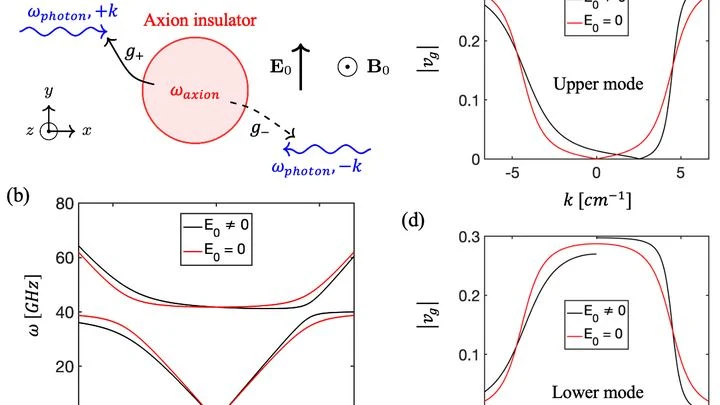
A regular flashlight shines equally forward and backward. But in magnetic crystals, a axion appears — a ghostly excitation, like a wave going around a stadium: atoms pass a magnetic impulse to each other. When light meets an axion, a hybrid forms, whose fate depends on electric and magnetic fields.
Light loves symmetry: in an open channel, it flows equally both ways. To steer it one way, physicists often use magnets. A new approach does without, using rotation — just the speed of a vinyl record — and interference from two atoms. Rotation changes the “pitch” of light for different directions, just as a siren’s tone shifts when a car approaches or recedes.
Two ultra-thin sheets, each just one atom thick, are placed on top of each other and slightly rotated. Like two sheets of colored tracing paper: while they lie flat, the picture is one thing, but give them a twist and a moiré pattern appears. Here, though, the pattern isn't visible to the eye, but it completely changes how the material handles light.
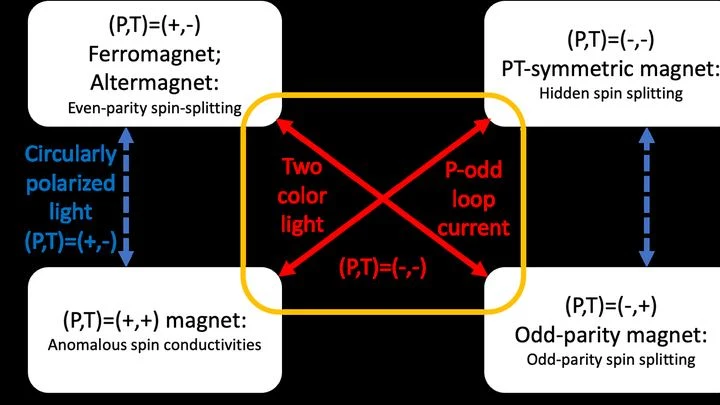
In a piece of ordinary magnet, all electron spins, tiny magnetic arrows, point in the same direction. It's a formation of soldiers facing their commander. This order is called a collinear altermagnet.
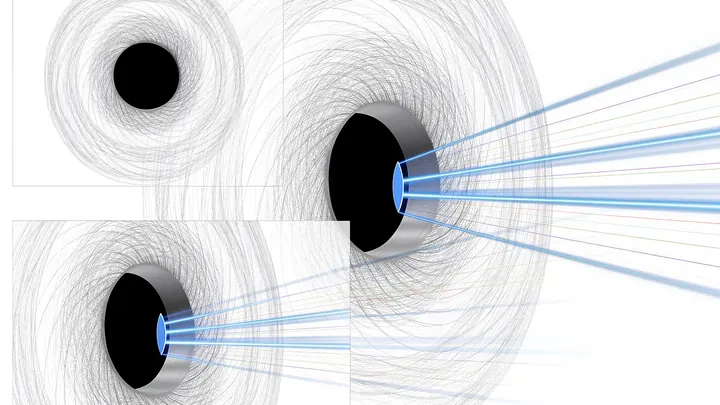
Light usually behaves like a pedestrian on a two-way street: the path from a streetlamp to a camera matches the reverse path. But near a rotating black hole with broken spatial symmetry, this street becomes one-way. Swap the light source and observer, and the hole's shadow changes shape: from an oval resembling a rugby ball, it turns into a teardrop.
Light from thin semiconductor layers can be polarized: its waves oscillate in a single plane. Previously, it was thought that the direction of oscillation was set by how the sample was illuminated.
A stream of electrons enters plasma like a jet of water hitting a calm pond. The jet disturbs the surface, giving rise to waves that grow quickly and mix the water. In plasma, this process is called the Buneman instability: the electron beam excites oscillations that then scatter its energy.
No one has ever seen dark matter, but every galaxy feels its pull. Usually, it's pictured as a sea of identical, silent particles. The new work paints a livelier picture: two kinds of particles, heavy and light, constantly exchanging between them.
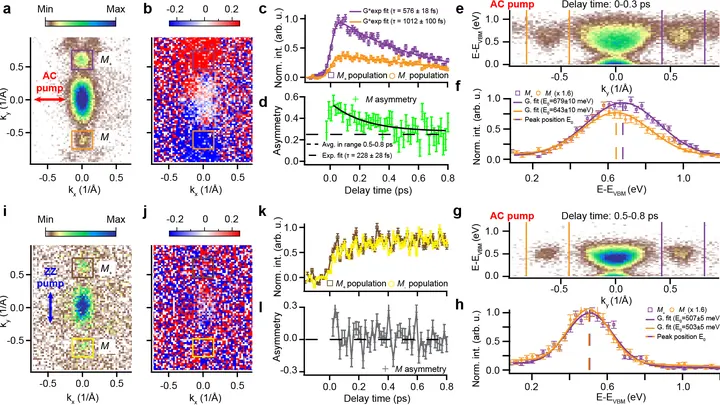
An ordinary sheet of black phosphorus looks like a layered cake of atoms. If you shine a regular lamp on it, nothing special happens: the electrons sit still, like spectators in a dark theater. But a short laser flash lasting millionths of a billionth of a second shakes up that theater.
An ordinary lens always refracts light the same way. Its properties are frozen in glass forever. But now there's a surface that changes the game on the fly.
Scientists made an ultrathin film with resonant elements and infused it with liquid crystals — the same stuff used in phone screens.
Imagine a tap that doesn't pour a stream but releases water strictly one drop at a time: that's the single-photon source the authors describe. In ordinary light, photons travel in a crowd, like water from an open tap.
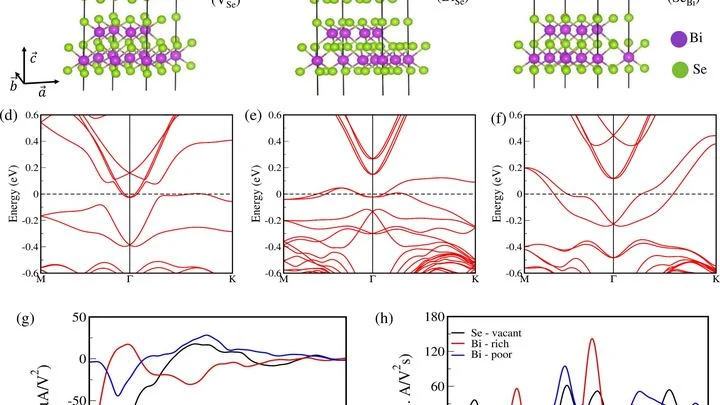
The crystal bismuth selenide (Bi₂Se₃) is symmetric by itself, like a neatly stacked sandwich: flip it over, and nothing changes. But twist one layer slightly relative to the other, and the symmetry breaks. The material begins to 'feel' which side the light comes from and responds with an electric current.
Normally, current flows equally well in both directions if there's no magnet. A magnetic field or magnetic material breaks that symmetry: electrons start to prefer one direction. But in a new study, physicists found a way to do without magnets.
In a crystal, atoms may not sit perfectly ordered but with some disorder.
A tiny diamond bridge vibrates so strongly that it starts to 'sing' at many frequencies at once. Previously, such vibrations would dampen themselves: the harder the resonator swung, the harder it was to add energy. Physicists found a loophole in this rule.
They used light to drive the diamond. Light pushes on the bridge, making it tremble.
In ordinary water, ripples from a thrown stone spread in even concentric circles. But imagine a liquid whose molecules are like tiny screws with a right-handed thread. In such a medium, the surface acts like a one-way street: waves can only travel in a certain direction.
The edge of a magnet works like a guitar fret: a string pressed near the edge sounds different, with a richer set of overtones. Magnetic waves in a thin strip of nickel and iron behave in much the same way.
A neutron star is a city the size of a metropolis squeezed into a small asteroid. Around it, plasma, a gas of charged particles, seethes, and waves ripple through it like ripples on a pond. There are three kinds of waves: Alfvén (A), ordinary (O), and extraordinary (X).
Two tiny emitters, each about the size of an atom, can together do what neither can do alone. We're talking about light scattering — when light hits particles and bounces off in all directions. Usually, a pair of particles scatters light only slightly more than a single one.
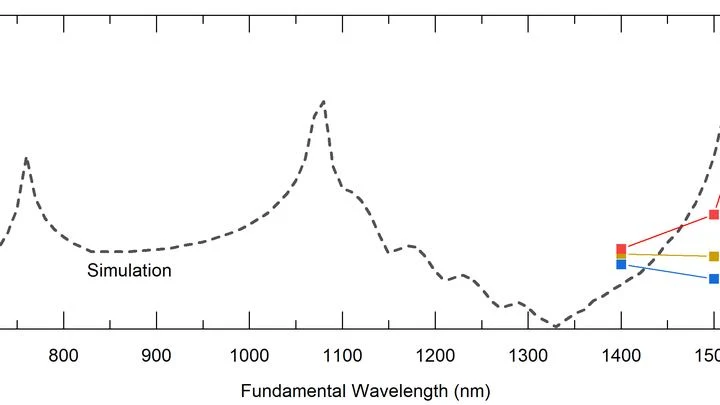
An ordinary piece of semiconductor weakly changes the color of light passing through it. For decades, physicists worked around this limitation by placing the crystal in clever surroundings, but the material itself remained the same.
Now researchers have assembled a "sandwich" of alternating thin layers of gallium arsenide and aluminum gallium arsenide.
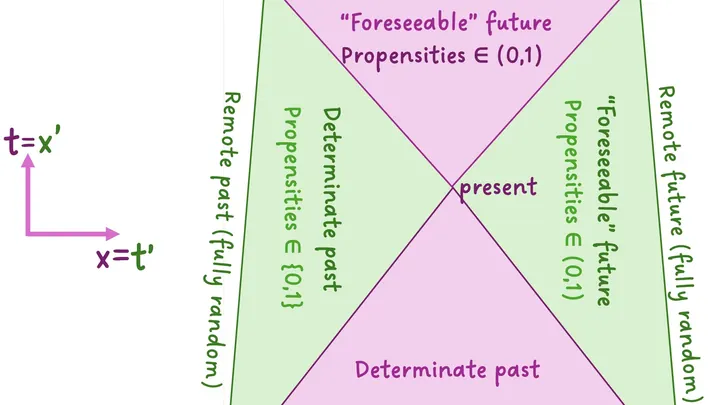
According to the laws of physics, nothing can outrun light, otherwise for some observers the effect would occur before the cause. Artur Ekert and Andrzej Dragan showed that this situation creates an uncertainty resembling quantum indeterminacy.
Two beams of light, red and blue, enter a tiny ring made of silicon nitride. The ring is smaller than the thickness of a human hair. At the input, both beams are equally bright. But inside the ring, one of them suddenly starts to outshine the other, like two equally matched people in a debate where one unexpectedly gains the upper hand.
A turnstile lets you through only forward, and not a step back. Physicists have implemented a similar principle on a tiny semiconductor chip for single photons — particles of light.
Glasses with flat lenses show a symmetric world: rise and fall, heat and cold look the same. For decades, climatologists have viewed El Niño through such glasses, using linear inverse models. These captured the rhythm of oscillations but missed that the warm phase of El Niño is typically sharper and stronger than the cold La Niña.