Nonlinear optics studies phenomena where the response of a material to light is not proportional to the light's intensity. At high intensities, typically from pulsed lasers, the electric field of light becomes strong enough to alter the optical properties of the medium itself, leading to effects like frequency doubling, self-focusing, and four-wave mixing. This field underpins many modern laser technologies, from green laser pointers to ultrafast pulse generation and optical frequency combs.
History
The field began with the discovery of second harmonic generation by Peter Franken and colleagues in 1961, shortly after the invention of the laser. The theoretical framework was developed by Nicolaas Bloembergen, who won the 1981 Nobel Prize in Physics for his contributions.
How it works
In a nonlinear medium, the polarization induced by the electric field of light includes terms proportional to the square, cube, etc., of the field. These higher-order terms act as sources of new frequencies: for example, the second-order term generates light at twice the frequency (second harmonic generation). Similarly, the intensity-dependentrefractive index (Kerr effect) causes self-focusing, where a beam creates its own lens, and can lead to filamentation. The corpus titles illustrate diverse nonlinear phenomena: light breaking symmetry in a ring laser, a layered crystal amplifying light sevenfold, and light and particles becoming entangled in a 'dance'.
In practice
Nonlinear optics is used in frequency conversion (e.g., green and UV lasers), optical parametric oscillators for tunable light sources, supercontinuum generation for white-light lasers, and in quantum optics for generating squeezed and entangled photon states.
Fun fact
The first demonstration of second harmonic generation produced so little ultraviolet light that the spot on the paper was barely visible, and the editor of the journal mistakenly cropped it out of the published photograph, thinking it was a blemish.
A thin film of neodymium nickelate, fifteen nanometers thick, sits on a neodymium gallate substrate. Below one hundred eighty kelvin it behaves as an insulator: electrons are locked inside their atomic cells and cannot move freely.
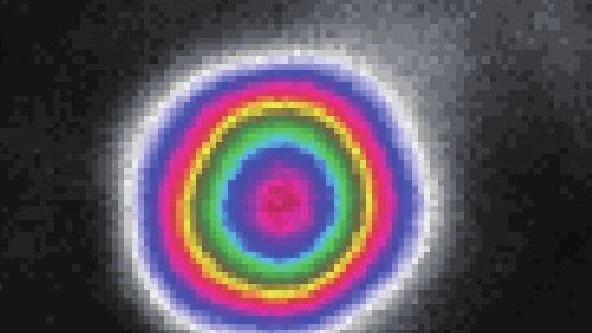
Two connected vessels joined by a tube usually settle at the same water level. Here, the vessels start rocking on their own because each has a leak, and the leaks are different. Light in two dimples of a micromirror behaves the same way: photons flow from one well to the other, but they are lost at different rates. These losses do not damp the motion; they set its rhythm.
A superconducting detector usually works like an honest ruler: absorb a photon, get a pulse whose amplitude is strictly proportional to the energy. This mode is convenient, but it has a ceiling: a weak signal easily gets lost in the amplifier noise.
Now imagine a swing.
In a dark room, a spark jumps between two wires, and for an instant, there is light. Physicists have done something similar, but a million times smaller: at the boundary of two transparent crystals, they drew a conducting path and left a break just a few atoms wide. When a direct voltage was applied across this tiny gap, it began to glow.
A sponge slowly watered from a watering can gets soaked all the way through. But if you dump the same bucket of water on it all at once, the middle gets wet while the edges stay almost dry. That's roughly how a material with nonlinear absorption behaves: the more intense the flux, the more it gets stuck at the point of impact.
A light beam usually travels in a straight line, but you can make it spin around its axis, like water swirling into a vortex as it drains. This 'twisted' light carries more information and is needed for ultra-fast communication and quantum computing.
A weak laser beam falls onto a tiny structure — a hybrid cavity made of metal and glass. Inside is trapped a single light-emitting molecule. Normally, such light only slightly changes color as it scatters off thermal vibrations of atoms.
In 1981, Alan Guth proposed a scenario of cosmological inflation — a lightning-fast expansion of space that stretched quantum fluctuations to the scale of entire galaxies. Since then, cosmologists, like archaeologists, have been excavating this event from the structures of the Universe.
Neutron stars are the ultra-dense remnants of stars, where matter is compressed to the limit described by Subrahmanyan Chandrasekhar. Magnetars are a type of neutron star with a magnetic field a quadrillion times stronger than Earth's.
When light swings past a massive body like a black hole, its path warps — an effect predicted by Einstein. New research has taken into account that near such objects, clouds of hadrons often swirl — the very particles we know from protons and neutrons in atomic nuclei.
A sheet of paper weighs almost nothing, but stack a hundred sheets and you get a noticeable pile. That's roughly what scientists did with a material that excels at converting one color of light into another, but only when it's just one atom thick. A single layer is like a single sheet: it works beautifully, but it's too thin to produce much light.
A thin film for a solar cell or display is like a dense crowd in a square: each person faces a different direction, and whether light passes through the crowd or gets stuck depends on which way everyone is looking. In organic electronics, molecules play the role of passersby. Until now, instruments could only measure the crowd's overall direction — the average head tilt and its spread.
No one has ever seen dark matter, but every galaxy feels its pull. Usually, it's pictured as a sea of identical, silent particles. The new work paints a livelier picture: two kinds of particles, heavy and light, constantly exchanging between them.
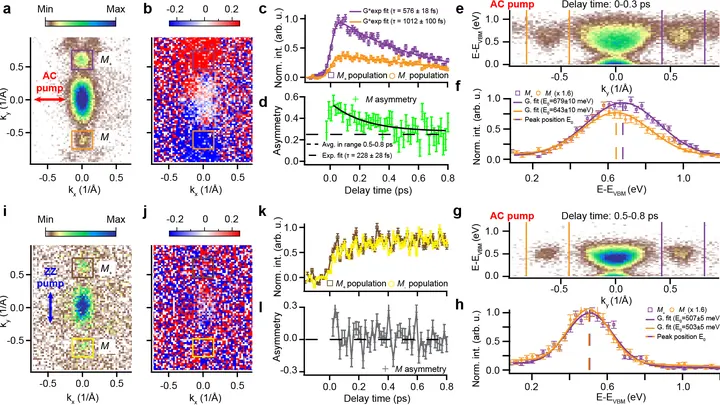
An ordinary sheet of black phosphorus looks like a layered cake of atoms. If you shine a regular lamp on it, nothing special happens: the electrons sit still, like spectators in a dark theater. But a short laser flash lasting millionths of a billionth of a second shakes up that theater.
An ordinary lens always refracts light the same way. Its properties are frozen in glass forever. But now there's a surface that changes the game on the fly.
Scientists made an ultrathin film with resonant elements and infused it with liquid crystals — the same stuff used in phone screens.
A laser flash lasting 50 femtoseconds is like a shot that lasts one billionth of a second. In that time, light travels only 15 micrometers — less than the thickness of a human hair. But if you send such a flash through an amplifier, it starts to stretch like a rubber band and loses its sharpness.
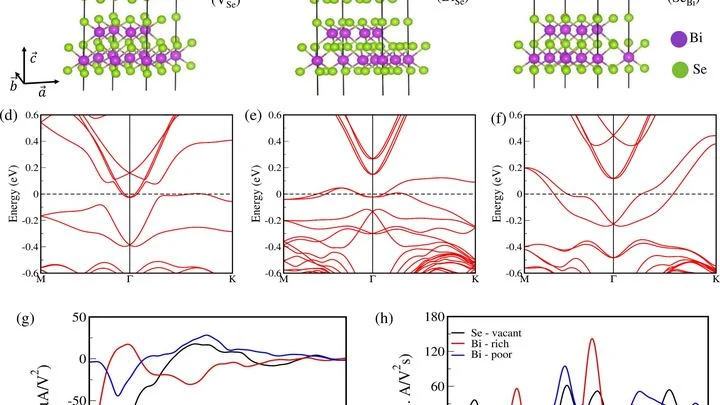
The crystal bismuth selenide (Bi₂Se₃) is symmetric by itself, like a neatly stacked sandwich: flip it over, and nothing changes. But twist one layer slightly relative to the other, and the symmetry breaks. The material begins to 'feel' which side the light comes from and responds with an electric current.
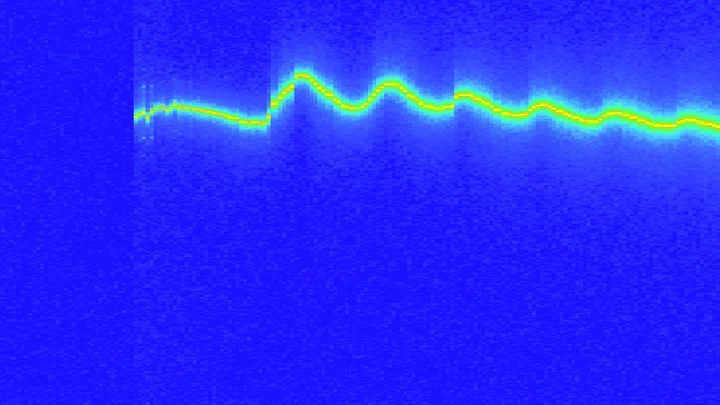
A tiny diamond bridge vibrates so strongly that it starts to 'sing' at many frequencies at once. Previously, such vibrations would dampen themselves: the harder the resonator swung, the harder it was to add energy. Physicists found a loophole in this rule.
They used light to drive the diamond. Light pushes on the bridge, making it tremble.
A river flows in one direction, but a wave on its surface travels in the opposite direction. The same splitting happens in hyperbolic materials: the energy of a light wave and its fronts diverge, preventing a sharp lens from being created.
A neutron star is a city the size of a metropolis squeezed into a small asteroid. Around it, plasma, a gas of charged particles, seethes, and waves ripple through it like ripples on a pond. There are three kinds of waves: Alfvén (A), ordinary (O), and extraordinary (X).
An ordinary piece of semiconductor weakly changes the color of light passing through it. For decades, physicists worked around this limitation by placing the crystal in clever surroundings, but the material itself remained the same.
Now researchers have assembled a "sandwich" of alternating thin layers of gallium arsenide and aluminum gallium arsenide.
A random fiber laser is a thin glass thread through which light travels, but instead of reflecting off mirrors, it reflects off the tiniest irregularities in the fiber itself. Such a laser doesn't produce a steady beam: its light flickers and flares like a candle flame in a draft.
Two beams of light, red and blue, enter a tiny ring made of silicon nitride. The ring is smaller than the thickness of a human hair. At the input, both beams are equally bright. But inside the ring, one of them suddenly starts to outshine the other, like two equally matched people in a debate where one unexpectedly gains the upper hand.