Limit Cycles in a Photonic Dimer with Tunable Dissipative Interactions ✛
Context
In open quantum systems, dissipation usually destroys order, but here it acts as a constructor. Alongside this work on the archive lie studies of quantum algorithms, error correction, and quantum information, yet this paper stands apart: it is not about computation but about fundamental light dynamics in microresonators. Neighboring works explore coherent effects and synchronization, but no one before has made dissipative interactions independently tunable or observed them generating limit cycles on their own.
Methods
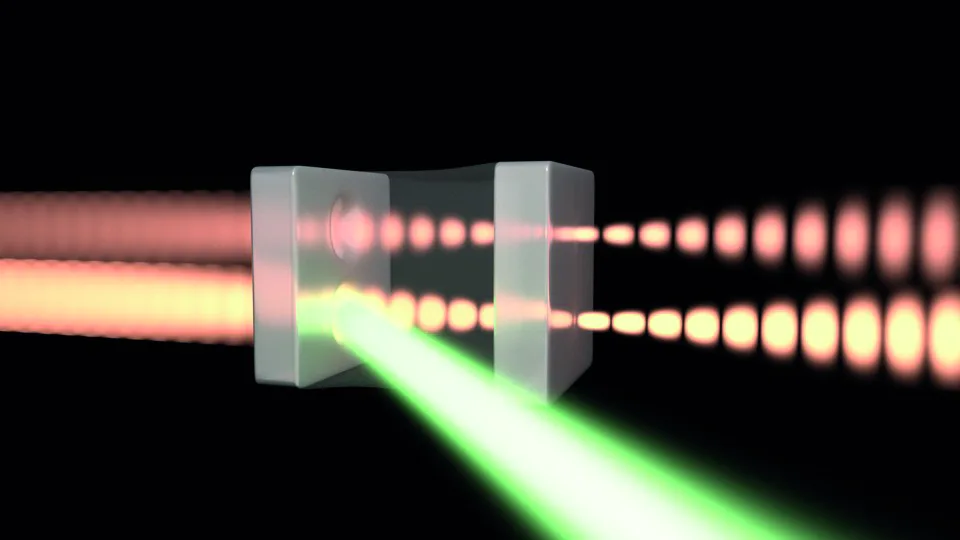
The experiment is built on a double microcavity filled with rhodamine 6G dye. Two dimples on one of the mirrors, laser-cut at a distance of 10.9 μm, create a double well for photons. Pumping with a 532 nm laser excites the dye molecules predominantly in one well, while coupling between wells is provided by tunneling at a frequency of 3.6 GHz. The molecules act as local reservoirs: they absorb and emit photons, creating an effective non-Hermitian interaction whose strength can be adjusted by tuning the cavity cutoff wavelength. To observe the dynamics, photons from each well were recorded by two fast photodetectors with a time resolution of 0.52 ns.
Results
Above the condensation threshold and near resonance between the wells, self-sustained oscillations emerged with a frequency of about 313 MHz, an order of magnitude lower than the tunneling frequency. On the phase diagram in the coordinates of cutoff wavelength versus pump power, limit cycles occupied an island surrounded by regions of stable fixed points. The transition between regimes occurs via a Hopf bifurcation: in the supercritical case the limit cycle appears smoothly, while in the subcritical case bistability arises, with a fixed point and a limit cycle coexisting. Numerical simulations confirmed the experimental data and revealed hysteresis and noise-induced switching between attractors.
Implications
This work demonstrates for the first time that purely dissipative interactions, without any conservative nonlinearities, can build complex attractor landscapes. This contrasts with neighboring studies where limit cycles in optics always relied on Kerr nonlinearity or slow feedback. Here, the non-Hermitian interaction is tuned directly through coupling to a molecular reservoir, opening a path to controlling nonequilibrium dynamics in many-body systems.
Future development
The topic may evolve toward the quantum-classical transition in limit cycles and stochastic thermodynamics. Already, class II excitability with a finite frequency has been predicted, which is relevant for neuromorphic architectures. Combined with recent Bose-Einstein condensates of photons in semiconductor microcavities, this promises a new class of computing devices based on reservoir dynamics.
Impact
The results will influence the physics of open quantum systems, nonlinear dynamics, and optical computing. They provide a universal platform for studying nonequilibrium phase transitions and dissipative structures.
Next steps
The next step is to measure entropy production and fluctuation relations in the limit cycles. It is also worth investigating quantum fluctuations near bifurcations and the possibility of controlling switching for neuromorphic applications.
Key open problems
For the physics of open systems, the question remains open how dissipation shapes collective states without external synchronization. This work provides the first experimental answer but does not solve the problem of quantum noise near bifurcations nor describe the thermodynamic cost of self-sustained oscillations.
The knowledge machine's view
This section is addressed to the author of the paper and their colleagues. Neighbouring works were found by meaning-based search across our archive, not by word overlap. We do not review: we show the field around the work.
What the work does
The work demonstrates tunable dissipative interactions in two coupled light condensates in a dye-filled microcavity. Local coupling to molecular reservoirs gives rise to effective non-Hermitian photonic interactions that, when competing with coherent tunneling, stabilize limit cycles. A phase diagram is constructed in the coordinates of cutoff wavelength versus pump power, revealing supercritical and subcritical Hopf bifurcations with hysteresis, bistability, and excitability.
Where its strength is
Showing that purely dissipative interactions, without any conservative nonlinearities, can generate limit cycles and complex attractor landscapes opens a new route to controlling the nonequilibrium dynamics of many-particle systems.
Where it could go next
- It might be interesting to see how analogous dissipative interactions manifest in disordered systems, where they could stabilize quantum memories or other ordered states.based on: Disorder as an Ally: Quantum Memory in Diamond arXiv:2511.07785
- Closely related is work on the emergence of order from losses in the quantum dance of photons; it may offer insights into how dissipation shapes collective states that could be transferred to multimode condensates.based on: Loss Creates Order: The Quantum Dance of Photons arXiv:2604.05422
- Our archive also features a full analysis of an experiment with a dodecagonal quasicrystal, where light and matter form complex spatial structures; dissipative interactions might help create similar ordered phases in condensates.based on: Dance of Dipoles and Light: The Birth of a Dodecagonal Quasicrystal arXiv:2607.10141
Worth trying
- Try extending the system to three or more wells to see how dissipative interactions shape more complex attractors, such as chaotic or synchronized states.
- Use the cutoff wavelength tuning technique to modulate the strength of dissipative interactions over time, thereby probing dynamic bifurcations and transitions between regimes.
- Compare the observed limit cycles with theoretical models of non-Hermitian physics, including exceptional points, to uncover the role of topology in attractor dynamics.
Why this may matter
The results could lay the groundwork for a new class of devices that exploit dissipative interactions to manipulate light, for instance in optical computing or sensing, where self-sustained oscillations serve as information carriers.
Nearby works in our archive
- Atomic String and Harmony of Frequenciessimilarity 0.53
- Loss Creates Order: The Quantum Dance of Photonssimilarity 0.53
- Disorder as an Ally: Quantum Memory in Diamondsimilarity 0.52
- Dance of Dipoles and Light: The Birth of a Dodecagonal Quasicrystalsimilarity 0.52
- The Light That Gives Away Symmetrysimilarity 0.51
- Quantum Waves in the Macroworld: A Hair-Thin Wiresimilarity 0.51
The archive is sparse around this work: the closest review is only 0.53, against a usual 0.64. It looks like few have drilled nearby.
The limit cycles in this system oscillate 11 times slower than photons tunnel between the wells. That is like two communicating vessels exchanging water within seconds while their levels oscillate with a period of minutes.
The idea of controlled dissipation as a constructor of order echoes Stanislaw Lem's novel 'Solaris', where the ocean organizes complex structures from chaos on its own. Here, light in a microcavity, losing energy, does not die but spins into a stable dance.
Key numbers
- limit cycle frequency: 313 MHz
- tunneling frequency: 3.6 GHz
- distance between wells: 10.9 μm
- detector time resolution: 0.52 ns
- trap depth: 504 GHz