Nonlinear interaction is a fundamental concept in physics where the response of a system is not directly proportional to the input. In quantum systems, this often manifests as noise or unexpected behavior, because the superposition principle—which underpins linear quantum mechanics—breaks down. This nonlinearity can lead to phenomena such as frequency mixing, where two waves combine to produce new frequencies, and amplitude-dependent effects that are absent in linear systems.
History
The concept of nonlinearity has roots in classical mechanics and electromagnetism, but its quantum significance was highlighted in the mid-20th century with the development of nonlinear optics and quantum field theory. No single inventor; it emerged from studies of anharmonic oscillators and wave mixing.
How it works
In a linear system, if you double the input, the output doubles. In a nonlinear system, the output can saturate, oscillate, or even become chaotic. For example, in a laser ring, nonlinearity can break the symmetry of light propagation, causing it to split into different modes. In gravitational wave astronomy, nonlinear interactions of spacetime itself produce 'overtone' frequencies that carry information about the source.
In practice
Nonlinear interactions are exploited in frequency conversion (e.g., second-harmonic generation in lasers), in quantum computing for creating entangled states, and in gravitational wave detectors to extract subtle signals from noise.
Fun fact
In a nonlinear optical crystal, two photons can 'merge' into one photon with twice the energy, a process that is strictly forbidden in linear optics.
Two connected vessels joined by a tube usually settle at the same water level. Here, the vessels start rocking on their own because each has a leak, and the leaks are different. Light in two dimples of a micromirror behaves the same way: photons flow from one well to the other, but they are lost at different rates. These losses do not damp the motion; they set its rhythm.
Sound enters the ear and hits a thin membrane inside the cochlea, the spiral organ in the inner ear. This membrane doesn't just vibrate like a string; it actively pushes the vibrations when they are weak and stops when they are strong. That's how the ear hears both a whisper and a loud conversation.
Scientists built a model where each piece of the membrane is a tiny pendulum with a spring.
A drop of water on glass trembles and shimmers: it seems to have a life of its own. Similar behavior can now be observed in the world of colloids: tiny particles suspended in a liquid. Researchers simulated particles that emit chemical signals. These signals, like scents in the air, spread around and cause neighbors to either draw closer or move apart.
$$10^{-35}$$ seconds. A tiny instant during which the Universe manages to expand by a factor of $$10^{26}$$. Immediately after, it goes through thousands of rapid transformations — like a ball bouncing along a chain of tunnels. This cascade is the essence of chain inflation, first proposed by Alan Guth.
A cloud of waves collapses under its own gravity. While it's loose, everything goes by the book: the field oscillates gently in nearly flat space, and approximate formulas work perfectly. But add just a bit more energy, and the picture changes.
Physicists used a numerical model to catch the moment when simple calculations stop describing reality.
In the microscopic world, noise, random fluctuations, usually destroys fragile quantum states, much like ripples on water break the reflection in a puddle. However, in some systems, collective, coordinated noise from many particles produces the opposite effect: a stable unidirectional flow emerges.
An ordinary microwave cavity resembles a music box: it responds only to strictly defined frequencies: its own notes. But what if you could make it sound different? Scientists changed the rules of the game by making the walls "one-way." Inside such a cavity, a wave can only run forward, never reflecting back.
A single particle can be in two places at once — that's superposition. But any interaction, like a shout, instantly 'collapses' this uncertainty. It was long thought that even gravity could interfere.
Light loves symmetry: in an open channel, it flows equally both ways. To steer it one way, physicists often use magnets. A new approach does without, using rotation — just the speed of a vinyl record — and interference from two atoms. Rotation changes the “pitch” of light for different directions, just as a siren’s tone shifts when a car approaches or recedes.
Three twins on the run constantly change clothes. That's roughly how neutrinos behave — nearly elusive particles that pass through us by the trillions every second.
Drop a stone into a pond — ripples spread across the water. The most visible ripple comes from the strongest splash. That's roughly how physicists picture the growth of perturbations around a black hole: if a system has an instability, its 'loudest' component, the one that grows fastest, should show up first.
A thrown stone arcs along a clean trajectory, but an electron's position in an atom is smeared out like fog. The transition from one to the other is a puzzle. New work shows that the fuzziness disappears not because of an observer, but because of the particle's own gravity.
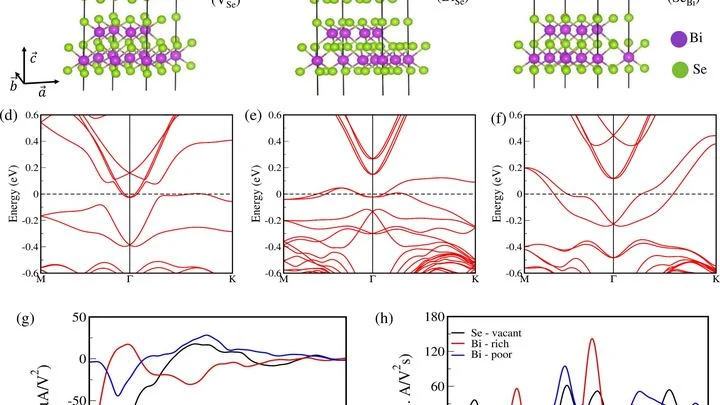
The crystal bismuth selenide (Bi₂Se₃) is symmetric by itself, like a neatly stacked sandwich: flip it over, and nothing changes. But twist one layer slightly relative to the other, and the symmetry breaks. The material begins to 'feel' which side the light comes from and responds with an electric current.
A Network That Decides When to Stop
A crowd grows: each new person joins the group with a probability that depends on how large the group already is. If the group is small, joining is easy; if it is huge, people start to hesitate, and growth slows down. This mechanism, called feedback, changes the entire behavior of the network.
In the quantum world, there are rules that seem to be broken. One of them is the conservation law: if in classical physics symmetry guarantees the conservation of charge, then in the quantum description this guarantee can disappear. This phenomenon is called a quantum anomaly.
Normally, current flows equally well in both directions if there's no magnet. A magnetic field or magnetic material breaks that symmetry: electrons start to prefer one direction. But in a new study, physicists found a way to do without magnets.
In a crystal, atoms may not sit perfectly ordered but with some disorder.
In ordinary water, ripples from a thrown stone spread in even concentric circles. But imagine a liquid whose molecules are like tiny screws with a right-handed thread. In such a medium, the surface acts like a one-way street: waves can only travel in a certain direction.
Normally, electric current is the same in both directions, like water in a straight pipe. But at the boundary between a normal metal and a superconductor, this rule breaks down. Two waves on water, going around a wide obstacle from different sides, can arrive with different delays and meet ‘out of step’.
Drop a stone into a pond — the ripples spread and fade away. A black hole, after colliding with another hole or a star, also 'rings', but its oscillations are not simple. Near the hole, 'overtones' sound — secondary waves born from the nonlinearity of spacetime itself.
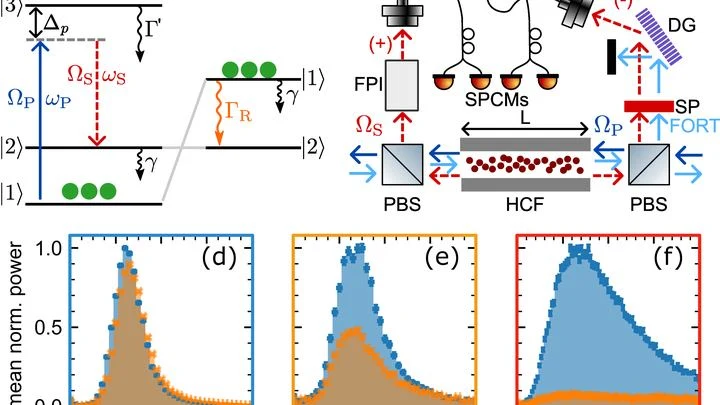
A swarm of fireflies in a night forest flashes randomly: each beetle blinks on its own, and the light scatters equally in all directions. Now imagine the fireflies agreeing to blink so that their combined light goes only north — even though they stay put and none of them turns. That's roughly what physicists did with atoms inside a thin glass tube.
An ordinary superconductor loses resistance when cooled, and current flows through it without loss. But in ultrathin films, things are different: the material fluctuates between normal and superconducting states, and in this transition zone, strange resistance waves emerge. Resistance rises and falls as if someone were turning a volume knob.
Quantum sensors are like an orchestra where musicians play in unison: their entangled states let them pick up signals that ordinary instruments can't. But as soon as you start accumulating the signal, the nonlinear interaction, like a conductor who suddenly starts beating time erratically, ruins the music.
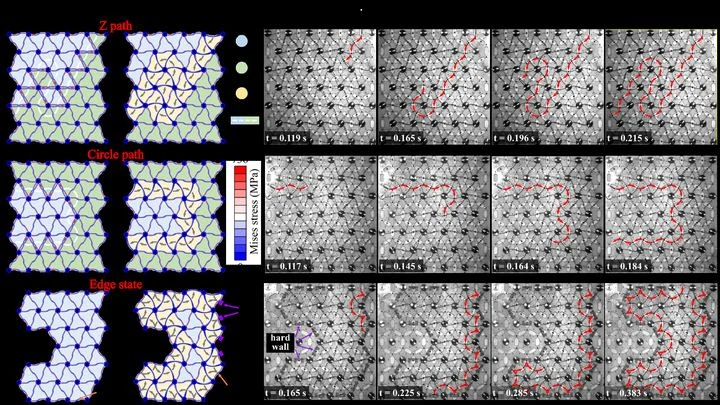
The popping lid of a jam jar is the hero of this story. Press it, and with a loud click it flips from a convex to a concave shape. Exactly the same happens with a hinged beam inside each cell of a new mechanical lattice.
Scientists assembled these snapping beams into a hexagonal grid, like honeycomb, but made of elastic plates. When one beam is sharply compressed, it snaps and pushes its neighbor.
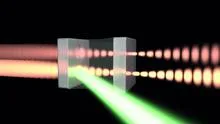
Two beams of light, red and blue, enter a tiny ring made of silicon nitride. The ring is smaller than the thickness of a human hair. At the input, both beams are equally bright. But inside the ring, one of them suddenly starts to outshine the other, like two equally matched people in a debate where one unexpectedly gains the upper hand.
In the quantum world, an object can be in several places at once. Yet in everyday life we see things strictly in their places. The reason is gravity. A massive star under its own weight inevitably collapses into a black hole or a neutron star, but it can't be both at the same time.
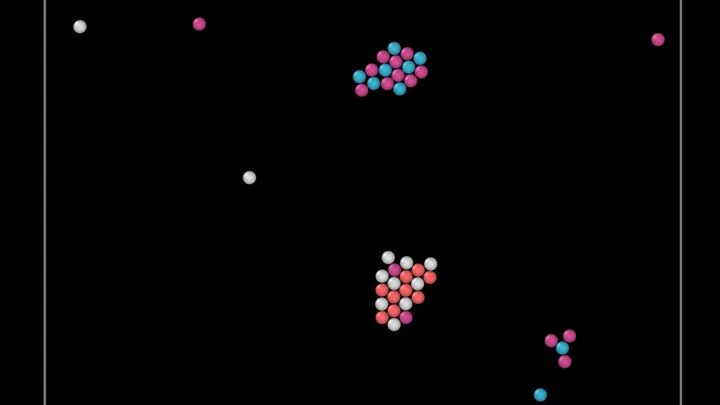
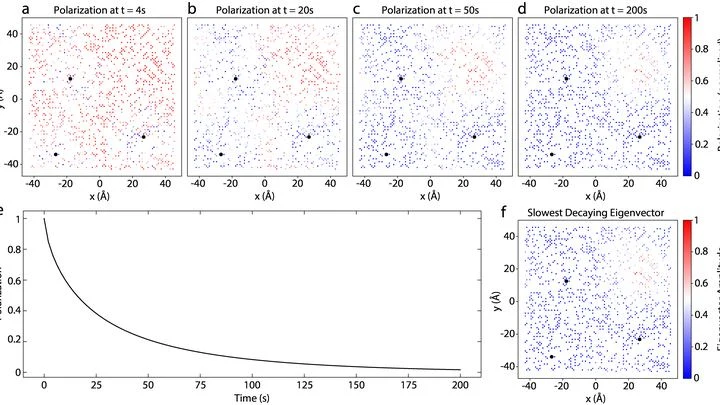
In the everyday world, order preserves and disorder destroys. But in quantum computing, this logic is turned on its head. Consider a diamond: carbon atoms with their nuclei and electrons behave like tiny magnets capable of storing a quantum "whisper"—information encoded in the orientation of their spins.
The Penrose tiling, assembled from two types of tiles, covers a plane without a repeating pattern — a mathematical marvel discovered by Roger Penrose that has found physical embodiment in the quantum world. Researchers modeled a chain of particles interacting according to a rule reminiscent of Fibonacci numbers and the golden ratio.
A turnstile lets you through only forward, and not a step back. Physicists have implemented a similar principle on a tiny semiconductor chip for single photons — particles of light.
A guitar string after being plucked produces not only the fundamental note, but also quiet overtones. A similar phenomenon appeared in the gravitational waves from the merger of two black holes (event GW250114).
Quantum mechanics is a linear theory. This property is so fundamental that violating it would mean losing the superposition principle and, consequently, the possibility of superluminal information transfer. But physicists have long suspected that at a deep level, where gravity meets quanta, linearity might not survive.