Wavelength is the spatial period of a wave — the distance between two consecutive crests (or troughs) measured along the direction of propagation. In visible light, wavelength determines the color perceived by the human eye: red light has a longer wavelength (around 700 nanometers), while violet has a shorter one (around 400 nanometers). The concept applies to all waves, from sound and water waves to electromagnetic radiation and quantum matter waves.
History
The wave nature of light and the concept of wavelength were established in the 17th century by Christiaan Huygens, and later quantified by Thomas Young's double-slit experiment in 1801, which measured wavelengths of visible light.
How it works
For a wave traveling at a fixed speed, wavelength is inversely proportional to frequency: shorter wavelength means higher frequency and more oscillations per second. In electromagnetic waves, wavelength and frequency together determine the photon energy — shorter wavelength corresponds to higher energy. In quantum mechanics, the de Broglie wavelength of a particle is inversely proportional to its momentum, linking wave-like behavior to mass and velocity.
In practice
Wavelength is fundamental to spectroscopy, telecommunications (fiber optics use specific infrared wavelengths), and medical imaging (X-ray wavelengths for radiography).
Fun fact
The wavelength of a typical Wi-Fi signal is about 12 centimeters — roughly the width of a human hand.
Rotation measure, proportional to integrated electron density times magnetic field along the line of sight — rotation measure= varies (e.g., 0.812 rad m^-2 for typicalradian per metre squared
$$f_\lambda \propto \lambda^\beta$$
Spectral flux density follows a power law in wavelength.
What is in the formula
f_λ
variable
spectral flux density per unit wavelength — spectral flux density watt per metre cubed
Two electrons that leave a metal needle tip almost simultaneously start to repel each other, like two people trying to squeeze through a narrow door at the same time. The closer they are, the more they get in each other's way.
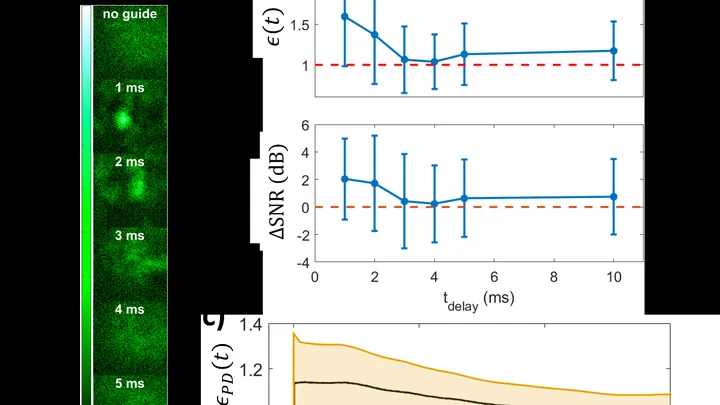
An ordinary flashlight shines in all directions, and after just a couple of dozen meters its beam fades so much it barely lights a wall. The atmosphere scatters light, and wind and heat currents distort it even more. But if you lay an invisible pipe for light right in the air, the beam will travel through it like water through a hose.
Long-period radio transients (LPTs) are a mysterious class discovered only recently. Their pulses last minutes or hours, and their nature was completely unknown. ASKAP J1745-5051, caught by the Australian telescope ASKAP, became the first to get a full explanation.
A stone falls into water, and ripples spread in all directions. Throw a handful of stones at once, and the ripples overlap: you can no longer tell which ripple came from which stone. A neutron beam hitting a detector looks much the same: a bright spot blurred by many causes.
The cosmic microwave background is the afterglow of the Big Bang, which we see at millimeter wavelengths. But it also has a long-wavelength tail extending into the radio range.
A stone drops into a pond, and ripples spread across the water. If a protruding branch blocks the ripples' path, part of the wave reflects, and part bends around the obstacle. Gravitational waves, ripples in spacetime itself, behave similarly when passing by galaxy clusters or black holes.
A pebble tossed into a pond sends ripples spreading in all directions. Now imagine the pond itself suddenly turning into jelly — instantly, faster than the wave can complete a single crest. Some ripples would keep spreading but change their spacing, while others would unexpectedly turn around and run back toward the point of impact, as if time were flowing backward for them.
When light passes through a turbid medium, like a glass of milk or frosted glass, it scatters in all directions. But sometimes, instead of spreading out, it gets trapped in tiny 'pockets' inside the material. Physicists call these pockets localized modes: light falls into them as if into a trap and cannot escape.
Above the Sun's surface hang long ribbons of glowing gas — streamers. They look like giant harps stretched across the corona. When a wave runs along such a ribbon, it trembles and bends like a string after being plucked.
For a long time, it was thought that only a very fast ejection of material, one traveling at more than 500 kilometers per second, could launch such a wave.
If a supermassive black hole lives at the center of a galaxy, it heats the infalling gas to incredible temperatures. That gas glows, and we see it as a quasar — the brightest beacon in the universe. But how do you measure the size of the light source itself?