Light That Rocks Itself ✛
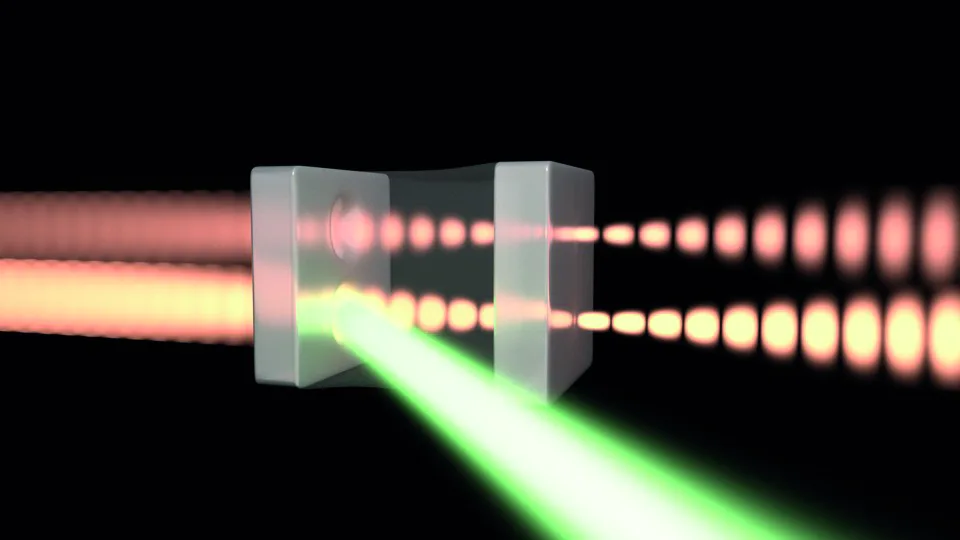
Two connected vessels joined by a tube usually settle at the same water level. Here, the vessels start rocking on their own because each has a leak, and the leaks are different. Light in two dimples of a micromirror behaves the same way: photons flow from one well to the other, but they are lost at different rates. These losses do not damp the motion; they set its rhythm.
In the experiment, the two wells were carved with a laser at a distance of 10.9 micrometers, filled with dye, and illuminated by a green laser. The dye molecules absorb and emit photons, but they do so differently in each well. The coupling between the wells thus changes only the gain and losses, not the energy directly. Such coupling is called non-Hermitian, and it turned out to be capable of driving light into a stable dance.
When the pump exceeded the threshold, the photons in the wells began to oscillate at a frequency of about 313 megahertz. That is eleven times slower than their tunneling between the wells. It is as if water between the vessels sloshed over in seconds, while its level swung with a period of minutes. On the phase diagram in the coordinates “cutoff wavelength—pump power,” the limit cycles occupied an island surrounded by regions of stable fixed points. The transition between regimes occurs via a Hopf bifurcation: in a supercritical bifurcation, the limit cycle is born smoothly, while in a subcritical one, bistability arises, where a fixed point and a limit cycle coexist.
Before this work, it was unknown whether purely dissipative interactions could give rise to limit cycles and complex attractors without the involvement of conservative nonlinearities. Now it is proven: non-Hermitian interactions, tunable through coupling to a molecular reservoir, autonomously stabilize limit cycles, bistability, and hysteresis. The photonic dimer created here, with two coupled light condensates, has become a platform where dissipation arises from the local exchange of photons with dye molecules, and the dynamics can be traced as the pump and cutoff wavelength are varied.
Today this is fundamental knowledge with no immediate applications. But the platform could become a basis for neuromorphic computing and the study of nonequilibrium thermodynamics. Two connected vessels that rock themselves because of leaks turn out to be not a curiosity but a universal mechanism: losses can not only destroy but also build rhythm.
The limit cycles in this system oscillate 11 times slower than photons tunnel between the wells. That is like two communicating vessels exchanging water within seconds while their levels oscillate with a period of minutes.
The idea of controlled dissipation as a constructor of order echoes Stanislaw Lem's novel 'Solaris', where the ocean organizes complex structures from chaos on its own. Here, light in a microcavity, losing energy, does not die but spins into a stable dance.