Water Conducts the Magnetic Orchestra in Prussian Blue Analogues ✛
A Prussian blue analogue crystal is like a frame house with empty rooms: metal ions sit at the corners, and cyanide bridges stretch between them. Water molecules can live inside these rooms, and how many there are determines the behavior of the whole house. In this study, the researchers filled the rooms differently for several compounds and watched how the magnetic order changed.
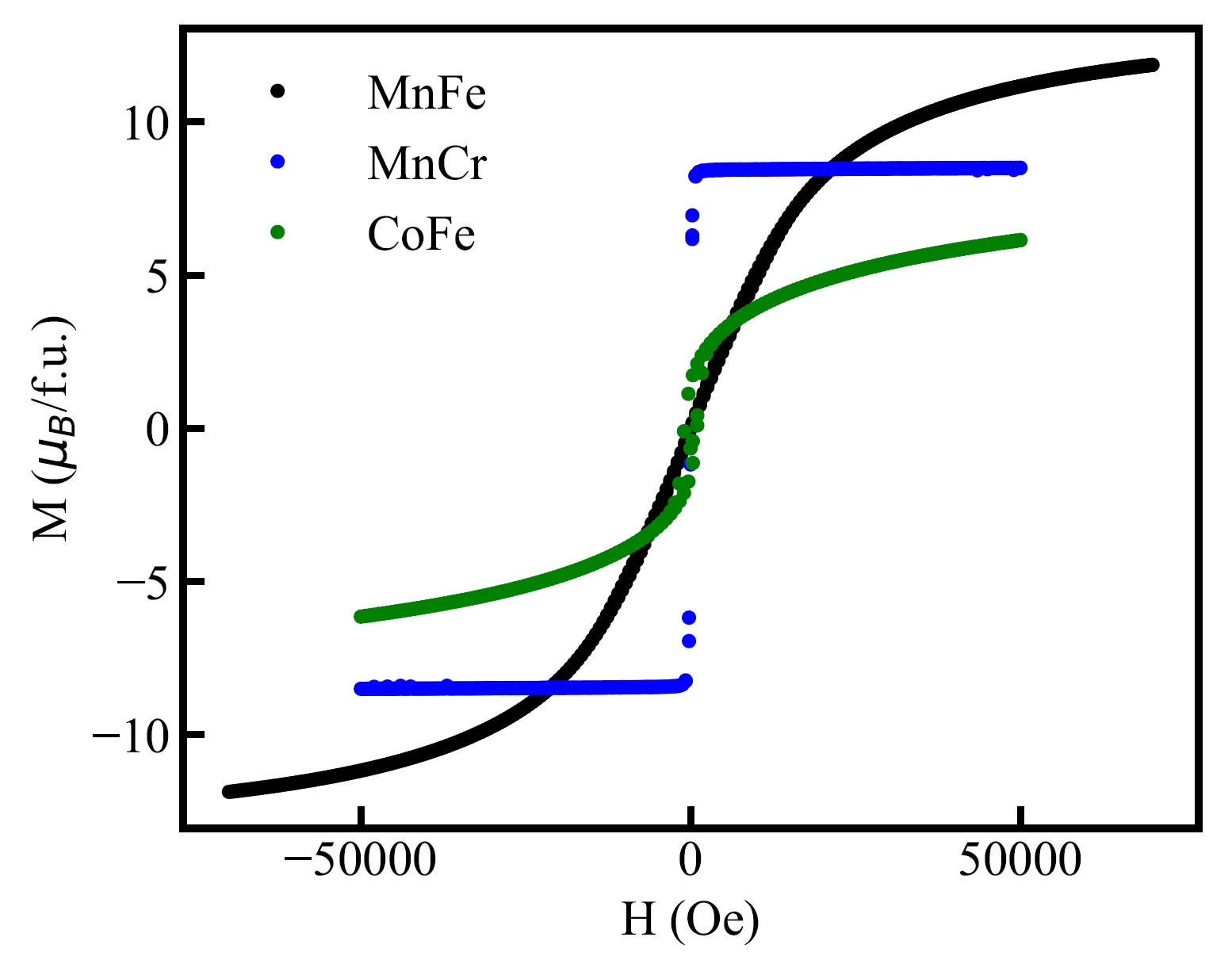
At zero field, the magnetic moments of manganese arrange into a partially frustrated structure, where spins cannot come to an agreement with each other. But apply a field of 1.3 tesla, comparable to that of a medical MRI scanner, and the moments realign into a collinear ferrimagnetic state. The same transition occurs if you simply dry the crystal: water leaves, and the spins change their configuration.
The Heisenberg model shows that the cause is a near-exact compensation between the antiferromagnetic Mn–Fe interaction and the geometrically frustrated Mn–Mn interaction on the face-centered cubic sublattice of manganese. This places MnFe near a magnetic compensation point, where the slightest perturbation switches the state.
Previously, in XMCD experiments, MnFe behaved mysteriously: magnetization did not saturate even in a field of 7 T. Now it is clear that measurements were taken at 1.3 T, meaning already in the field-induced state, not at zero field. This work is the first to fully determine the magnetic structures using neutron diffraction and link them to water content.
This knowledge will be useful in developing electrodes for sodium-ion batteries based on Prussian blue analogues, where water control is critical for stability and performance. The same frame house with empty rooms can now be tuned by adding or removing water to achieve the desired magnetic behavior.
The critical field for the transition in MnFe is only 1.3 tesla, comparable to the field of a typical MRI magnet (1.5–3 T). This means the material's magnetic state could be switched using an ordinary medical scanner. Another interesting fact: dehydrating MnFe leads to the same magnetic transition as applying a field, so water acts as a 'chemical field' that controls the spin structure.
The idea of switching a material's magnetic state with a small external stimulus (a field or removal of water) echoes the concept of 'smart materials' from science fiction, such as the programmable matter in Neal Stephenson's novel 'The Diamond Age', where a substance's properties change on command. Here, the switching occurs at the level of magnetic structure, which could inspire the creation of controllable magnetic switches.