Magnetic order refers to the regular, coordinated alignment of magnetic moments (the tiny magnetic fields associated with electron spins) in a material. In a magnetically ordered state, the moments align in a repeating pattern—all pointing the same way (ferromagnetism), alternating (antiferromagnetism), or in more complex arrangements—producing a net magnetization or a distinctive response to external fields. This order is fundamental to the existence of permanent magnets and to many modern technologies, from data storage to magnetic sensors. The concept also extends beyond solids: the early universe's magnetic fields, as mentioned in the corpus, may have arisen from ordered processes in the primordial plasma.
History
The modern understanding of magnetic order began with Pierre Curie's work on the temperature dependence of magnetism in the 1890s, followed by Pierre Weiss's molecular field theory in 1907. The microscopic explanation came with Werner Heisenberg's exchange interaction model in 1928 and Louis Néel's description of antiferromagnetism in the 1930s.
How it works
Magnetic order emerges from interactions between neighboring magnetic moments, typically the exchange interaction, which favors either parallel or antiparallel alignment depending on the material's electronic structure. At high temperatures, thermal fluctuations destroy the order, and the material becomes paramagnetic; as it cools below a critical temperature (the Curie or Néel temperature), the order sets in. The specific pattern of order is determined by the crystal lattice and the strength and sign of the exchange couplings, which can now be measured with techniques like neutron scattering or inferred from machine-learning analyses of experimental data, as highlighted in the corpus.
In practice
Magnetic order underpins hard disk drives, magnetic random-access memory, and the permanent magnets in electric motors and wind turbines; it is also central to spintronics, where electron spin is used to carry information.
Fun fact
In some materials, magnetic order can be so fragile that it is destroyed by the heat from a single photon, a phenomenon exploited in ultra-sensitive magnetic sensors.
In some crystals, electrons are not spread uniformly but arrange themselves into a strict checkerboard: one cell has more electrons, the neighboring cell has fewer. Such a pattern is called charge order, and for a long time it was considered something frozen, like a pattern on frosty glass.
In the world of magnetism, a simple dichotomy long reigned: ferromagnets, where spins point in one direction, and antiferromagnets, where they line up in a checkerboard pattern, canceling each other out. But a recent 'third player' — altermagnets — forced a rewrite of the rules.
Inside a crystal, an invisible ballet unfolds: the magnetic moments of atoms, like dancers, sometimes align in unison, sometimes scatter in antiphase. The choreography is dictated by quantum exchange — music sensitive to the geometry of bonds.
Right after the Big Bang, space was a hot plasma — a mix of charged particles and light. In such a medium, electric currents couldn't flow on their own: a 'potential difference' was needed to push electrons relative to photons.
Two swift streams of charged particles collide, and magnetic field lines begin to tear and reconnect. This process powers solar flares and auroras. It was usually assumed that all particles behave alike, like bullets from the same gun. But each particle has a tiny top: its intrinsic rotation, or spin.
A crystal without inversion symmetry is like a room where one wall is mirrored and the other is frosted: the reflection doesn't match the original. Such materials often behave unusually because electrons feel the lattice distortion.
Ruthenium oxide has long been regarded as a textbook altermagnet — a material where magnetic moments of neighboring atoms point in opposite directions but do not fully cancel due to the crystal's special symmetry. New measurements show that inside the crystal, there is no magnetism at all. All the magnetic action is confined to the surface.
A crystal does not grow as a single whole but like a city of neighborhoods — grains. In each neighborhood, atoms are arranged in their own way, and the boundaries between them are like streets.
A tiny magnet made of layers of sulfur, chromium, and bromine sits on a microscope stage. Inside it, like unexpected guests, sit erbium atoms — a rare-earth metal. These atoms can glow when hit with a laser, and their light tells us what's happening around them.
An ordinary magnet can be imagined as a row of soldiers all facing the same direction. An antiferromagnet is arranged differently: neighboring 'soldiers' face opposite directions, but the row as a whole remains ordered. Flipping such a row is difficult: it doesn't respond to weak external fields.
The crystal of RbMn6Bi5 resembles a five-story building of manganese atoms, where the residents on each floor form a pentagon. At room temperature, the magnetic moments of the atoms fluctuate chaotically, like compass needles during a magnetic storm.
A compass needle always points north because inside the material, all the atomic magnets are aligned in one direction. But there are materials where neighboring atoms face opposite ways, like rows of soldiers turned to face each other. Such materials are called antiferromagnets.
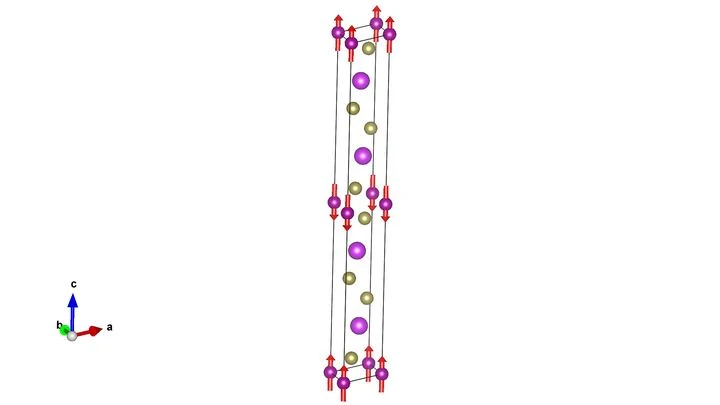
Imagine a stack of pancakes where each pancake is magnetized, but the magnetization directions in adjacent pancakes are opposite. That's exactly how this new magnetic material is arranged: in each atomic layer, all magnetic moments — the atom's 'arrows'—point in one direction, while the next layer is magnetized in the opposite direction.
In a typical magnet, all spins of electrons (internal ‘arrows’-magnets, discovered by Pauli) point one way. Altermagnets, like MnTe, are trickier: these arrows alternate direction, like ripples spreading from a pebble tossed into water. But here’s the twist — the ripple arises from the electrons’ own motion.