Water and vacancies control magnetic switching in Prussian blue analogues ✛
Context
Prussian blue analogues (PBAs) are porous coordination polymers with a cubic lattice in which metal ions are linked by cyanide bridges. Their open structure allows the incorporation of alkali metal ions and water molecules, giving tunable composition and rich magnetic, electronic, and ion-exchange properties. However, the role of water and vacancies in shaping magnetic order has remained poorly understood, especially for manganese-containing compounds. This work fits into the line of research on PBAs as model systems for spectroscopy and magnetism, but stands out because it is the first to fully determine magnetic structures using neutron diffraction and link them to water content.
Methods
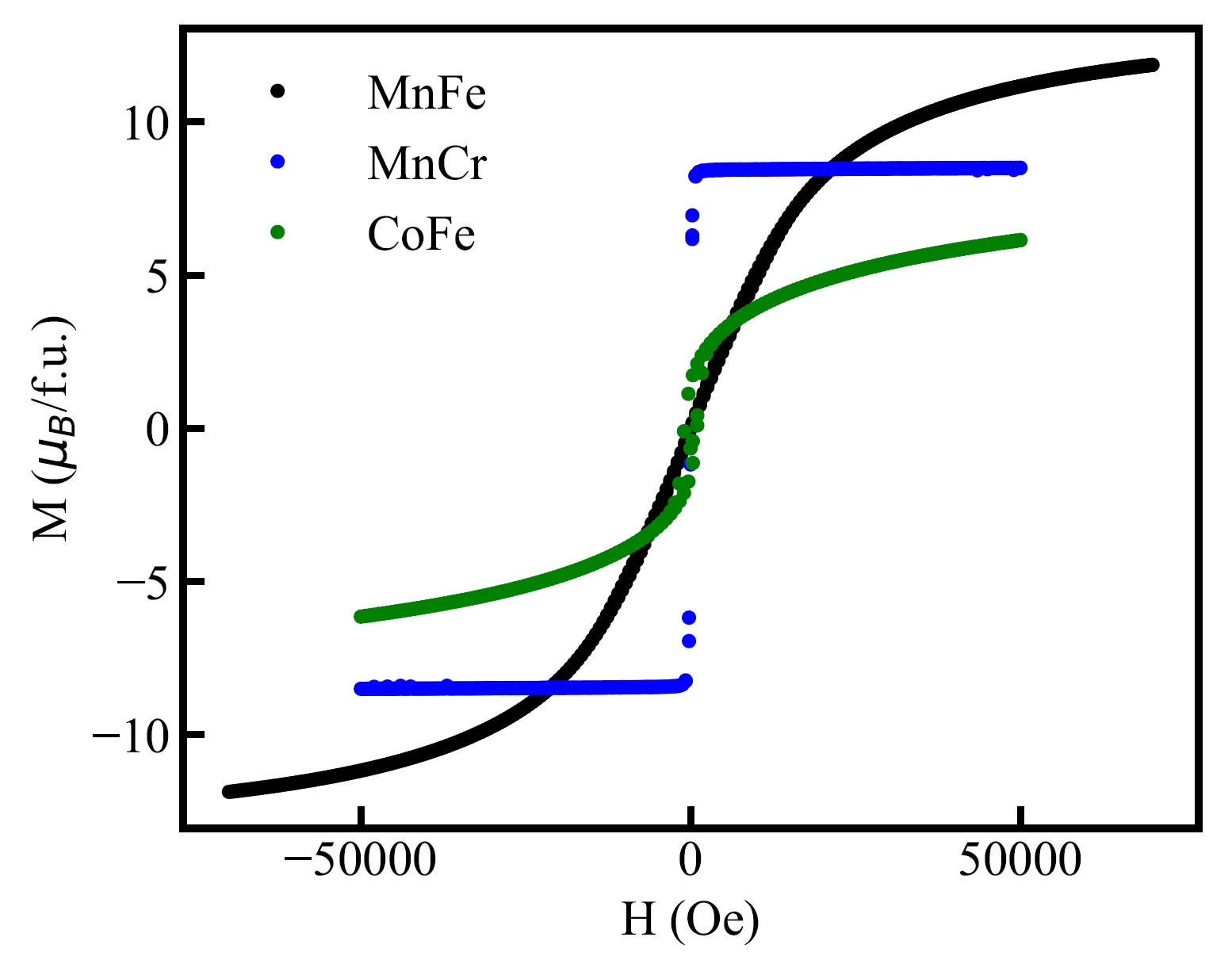
The compounds were synthesized by coprecipitation from aqueous solutions of metal salts and hexacyanometallates. Magnetic properties were measured on an MPMS3 SQUID magnetometer in fields up to 7 T. Neutron diffraction was performed on the D1B diffractometer at the Institut Laue–Langevin with a wavelength of 2.52 Å over a temperature range of 2–450 K and in magnetic fields up to 5 T. Difference diffractograms (below and above the Curie temperature) and Rietveld refinement using the FullProf program were used to determine magnetic structures. Symmetry analysis of magnetic space groups was performed with MAXMAGN. To explain the field-induced transition in MnFe, a minimal Heisenberg model was constructed with exchange interactions Mn–Fe (nearest neighbors) and Mn–Mn, Fe–Fe (next-nearest neighbors).
Results
All bimetallic PBA compounds in the Fm-3m family exhibit broad diffuse scattering at low angles, which is absent in the cation-stabilized Rb2NiFe. Comparison shows that this scattering is an intrinsic signature of correlated vacancies and associated interstitial water. Upon heating, CoFe and MnFe undergo a continuous transition from positive to negative thermal expansion, whereas NiFe remains structurally stable up to 450 K. Magnetically, all compounds except MnFe order into a collinear ferrimagnetic state with wave vector k=(0,0,0). MnFe at zero field has a partially frustrated structure with k=(1,0,0) and magnetic space group PI4/mnc. Applying a field of 1.3 T drives MnFe into a collinear ferrimagnetic state with k=(0,0,0) and group I4/mm'm', and dehydration does the same. Refinement gives ordered moments of Mn = 3.52(5) μB and Fe = 0.59(7) μB at zero field; at 5 T the moments increase to 5.59(6) μB and 1.20(8) μB, respectively. The minimal Heisenberg model shows that the transition is driven by an almost exact compensation between the antiferromagnetic Mn–Fe interaction and the geometrically frustrated antiferromagnetic Mn–Mn interaction on the fcc Mn sublattice. Estimation of exchange constants yields the hierarchy |$J_{Mn-F}$e| > |$J_{Mn-M}$n| >> |$J_{Fe-F}$e| and an energy scale of |J| ~ 0.1 meV. The field-induced transition also explains the XMCD anomaly at the Fe K-edge: XMCD measurements were performed at 1.3 T, meaning they already probed the field-induced state rather than the zero-field state.
Implications
This work is the first to fully determine the magnetic structures of several PBAs using neutron diffraction and establishes that water content is a key parameter controlling both structural and magnetic stability. Unlike previous studies that focused on XMCD spectroscopy and macroscopic magnetization, here absolute, site-resolved magnetic moments are obtained and a genuine field-induced magnetic transition is discovered at a moderate field of 1.3 T. This resolves the long-standing ambiguity in interpreting the XMCD response of MnFe compounds and provides a microscopic explanation for the lack of magnetization saturation up to 7 T. The hierarchy of exchange interactions estimated from the model is the first quantitative estimate for this system and places MnFe near a magnetic compensation point, characteristic of metamagnetic behavior.
Future development
The topic could develop toward investigating MnFe single crystals to unambiguously confirm the magnetic space groups and refine the exchange parameters. Also promising is the study of controlled hydration/dehydration effects on magnetic transitions in situ using neutron diffraction and spectroscopy. First-principles theoretical calculations could refine the magnitudes of exchange interactions and the role of vacancies in the local topology of exchange pathways. Furthermore, it would be interesting to explore other PBA compositions with manganese and other 3d metals to construct a general phase diagram of magnetic states as a function of water content and cationic composition.
Impact
The results are directly relevant for the application of PBAs as electrodes in sodium-ion and potassium-ion batteries, where controlling water content is critical for stability and electrochemical performance. Understanding the link between water, vacancies, and magnetic order is also important for developing materials with tunable thermal expansion (negative or zero) and for photo- and magneto-switchable molecular magnets.
Next steps
Next steps could include the synthesis and investigation of MnFe single crystals to precisely determine the magnetic structure and exchange constants, as well as conducting in situ neutron diffraction under controlled humidity to observe the transition in real time. Theoretical modeling that accounts for vacancies and disorder would help refine the exchange interaction model.
Key open problems
This work connects the long-standing problem of interpreting XMCD spectra at the K-edges of transition metals in PBAs with the actual magnetic structure determined by neutron diffraction. It also addresses the fundamental question of the role of geometric frustration on the fcc sublattice in forming complex magnetic states in coordination polymers. Furthermore, the results highlight the need to account for water content when comparing magnetic properties of PBAs from different syntheses, which is a common issue in the chemistry of these materials.
The knowledge machine's view
This section is addressed to the author of the paper and their colleagues. Neighbouring works were found by meaning-based search across our archive, not by word overlap. We do not review: we show the field around the work.
What the work does
This study examines the structural and magnetic properties of Prussian blue analogues A4[Fe(CN)6]2.7 (A = Co, Mn, Ni), Rb2Ni4[Fe(CN)6]3.3, and Mn4[Cr(CN)6]2.7 using neutron diffraction over a temperature range of 2–450 K and in fields up to 5 T. Broad diffuse scattering at small angles was observed, attributed to correlated vacancies and interstitial water. In MnFe, a spin reorientation occurs at a critical field of 1.3 T, which can also be induced by dehydration; the Heisenberg model explains the transition as being close to the magnetic compensation point.
Where its strength is
This work provides the first complete determination of magnetic structures via neutron diffraction and links them to water content, resolving a long-standing ambiguity in the XMCD response. This offers a solid foundation for controlling the magnetic state through hydration.
Where it could go next
- It might be interesting to see how other magnetic systems with frustration and competing interactions control the magnetic state through structural changes. In our archive, there is a nearby work on cryogenic cation rearrangement in spinels, where the magnetic order is also sensitive to the local environment.based on: Cryogenic Cation Rearrangement in Spinel arXiv:2609.02368v1
- It may be useful to compare the behavior of MnFe with materials where the magnetic transition is induced by external parameters, for example, in alloys with multiple magnetic sublattices. The archive contains an analysis of Co₂FeGe, which discusses the relationship between structure and magnetic properties.based on: Magnetic Co₂FeGe Alloy: A Metal with Two Faces arXiv:2505.24836
- It would be interesting to consider how vacancies and interstitial ions affect long-range magnetic order in other coordination compounds. Nearby is a work on the magnetic cocoon around a heavy seed, where local distortions play a key role in shaping the magnetic structure.based on: Heavy seed in a magnetic cocoon arXiv:2607.25055v1
Worth trying
- Investigate whether diffuse scattering persists when vacancies are controllably filled with other cations, analogous to Rb2NiFe but with different alkali metals.
- Study the magnetic structure of MnFe at intermediate hydration levels to construct a water–field–temperature phase diagram.
- Apply symmetry analysis to other manganese-based PBA to identify possible incommensurate magnetic structures.
Why this may matter
Understanding the role of water and vacancies in magnetic switching paves the way for materials with tunable magnetic properties, with potential applications in spintronics and sodium-ion batteries, where reversible compositional changes could serve as a switch.
Nearby works in our archive
- Cryogenic Cation Rearrangement in Spinelsimilarity 0.51
- An Alloy with Three Facessimilarity 0.50
- Cold from Iron: How a Cheap Alloy Replaces Rare-Earth Magnetssimilarity 0.49
- How a Nickel Impurity Turns a Superconductor into a Magnetic Tanglesimilarity 0.49
- An Atom-Thick Magnet: Power in a Single Layersimilarity 0.49
- Hidden Charge Wave Found in Bronzesimilarity 0.48
- Magnetic Co₂FeGe Alloy: A Metal with Two Facessimilarity 0.48
- Heavy seed in a magnetic cocoonsimilarity 0.47
The archive is sparse around this work: the closest review is only 0.51, against a usual 0.64. It looks like few have drilled nearby.
The critical field for the transition in MnFe is only 1.3 tesla, comparable to the field of a typical MRI magnet (1.5–3 T). This means the material's magnetic state could be switched using an ordinary medical scanner. Another interesting fact: dehydrating MnFe leads to the same magnetic transition as applying a field, so water acts as a 'chemical field' that controls the spin structure.
The idea of switching a material's magnetic state with a small external stimulus (a field or removal of water) echoes the concept of 'smart materials' from science fiction, such as the programmable matter in Neal Stephenson's novel 'The Diamond Age', where a substance's properties change on command. Here, the switching occurs at the level of magnetic structure, which could inspire the creation of controllable magnetic switches.
Key numbers
- critical transition field: 1.3 T
- magnetic ordering temperature of MnFe: 12 K
- ordered Mn moment at 0 T: 3.52 μB
- ordered Fe moment at 0 T: 0.59 μB
- estimated exchange constant: ~0.1 meV