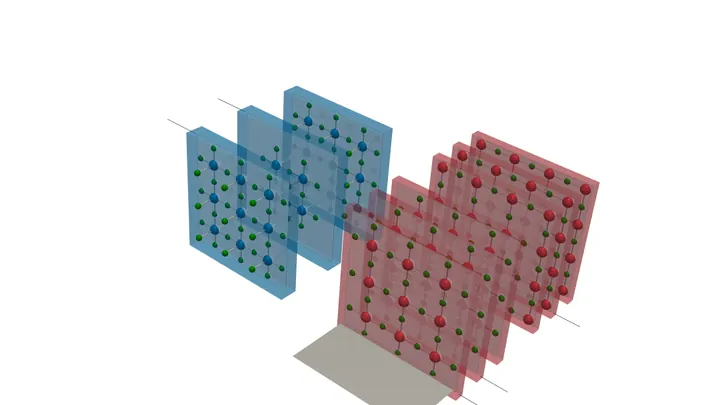
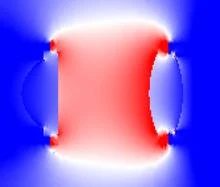
Neutron diffraction is a technique used to probe the atomic and magnetic structure of materials by firing a beam of neutrons at a sample and analyzing the pattern of scattered neutrons. Because neutrons have no electric charge but possess a magnetic moment, they interact strongly with magnetic fields and can reveal the arrangement of magnetic moments in a material — something X-rays, which interact with electrons, cannot do directly. This makes neutron diffraction indispensable for studying magnetic materials, from simple ferromagnets to complex quantum magnets.
History
Neutron diffraction was first demonstrated in 1945 by Ernest Wollan and Clifford Shull at Oak Ridge National Laboratory. Shull later shared the 1994 Nobel Prize in Physics for his contributions to neutron scattering techniques.
How it works
A beam of neutrons with a well-defined wavelength is directed at a crystalline sample. The neutrons scatter off the atomic nuclei (nuclear scattering) and off the magnetic moments of unpaired electrons (magnetic scattering). The scattered neutrons interfere constructively at specific angles, producing a diffraction pattern of peaks. By analyzing the positions and intensities of these peaks, scientists can determine the positions of atoms and the orientation and magnitude of magnetic moments in the crystal lattice.
In practice
Neutron diffraction is used in materials science to study magnetic structures, in engineering to measure residual stresses in components, and in biology to locate hydrogen atoms in proteins, which are invisible to X-rays.
Fun fact
Neutrons are so penetrating that they can pass through thick metal containers, allowing scientists to study materials under extreme conditions like high pressure or temperature inside specialized furnaces and cryostats.
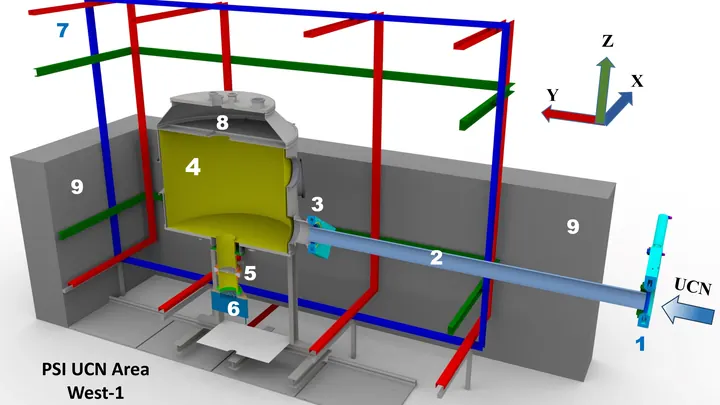
An aluminum sphere the size of a large globe sits in a neutron beam and answers each hit with a precise note. Inside the sphere there is nothing but nitrogen and eleven tiny steel balls, each the size of a pinhead. When a neutron enters the sphere, it knocks a particle out of a nitrogen atom, and that jolt turns into an electrical signal.
The neutron is a particle that usually sits in the atomic nucleus and doesn't disappear. But some theories suggest that occasionally it might transform into its invisible twin — a particle that ordinary detectors can't catch.
The antiproton is the mirror twin of the proton: same mass, but negative charge. When it hits matter, it usually annihilates instantly — disappearing in a burst of energy upon colliding with an atomic nucleus.
At nine in the morning, the DarkSide-50 detector, 1400 meters beneath Gran Sasso, records a weak ionization pulse. By eleven at night, the frequency of such events drops noticeably. This is not an electronics glitch or a seasonal background variation.
In boron neutron capture therapy (BNCT), the patient receives an injection of the isotope boron-10, which selectively accumulates in tumor cells. The tumor area is then irradiated with a beam of thermal neutrons.
In the first seconds after the Big Bang, the Universe left us not only light but also something far more elusive — the relic neutrino background. This echo of creation permeates every cubic centimeter, yet we barely notice it.
An ordinary microscope is powerless when you need to examine a single virus in detail. It's too small. But there's a tool that fires flashes billions of times brighter than sunlight — an X-ray free-electron laser. It's designed to 'photograph' a particle before the beam vaporizes it.
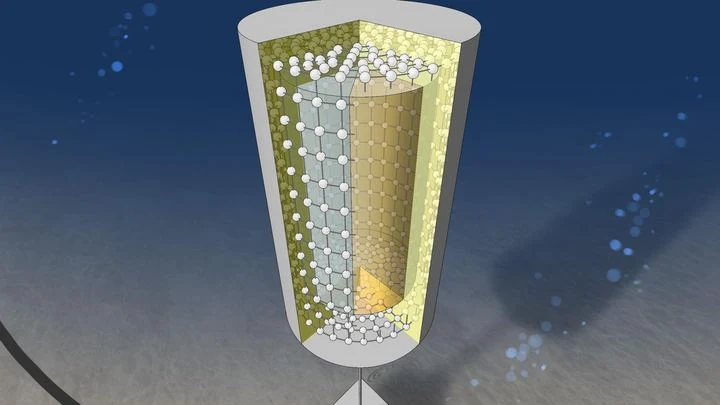
In the depths of the ocean, where light never reaches, a plan is taking shape to capture particles that barely interact with anything. Geoneutrinos, tiny messengers from the scorching mantle, are emitted during the decay of uranium and thorium. Their flux carries information about how much heat lies hidden beneath our feet.
Neutron stars are the ultra-dense remnants of stars, where matter is compressed to the limit described by Subrahmanyan Chandrasekhar. Magnetars are a type of neutron star with a magnetic field a quadrillion times stronger than Earth's.
A detector filled with superfluid helium-4 is like a perfectly still lake. The liquid doesn't slosh or bubble: it's frozen in a single quantum state. An invisible guest, a dark matter particle, flies through it. It doesn't shine or leave a track. But sometimes it nudges a helium nucleus.
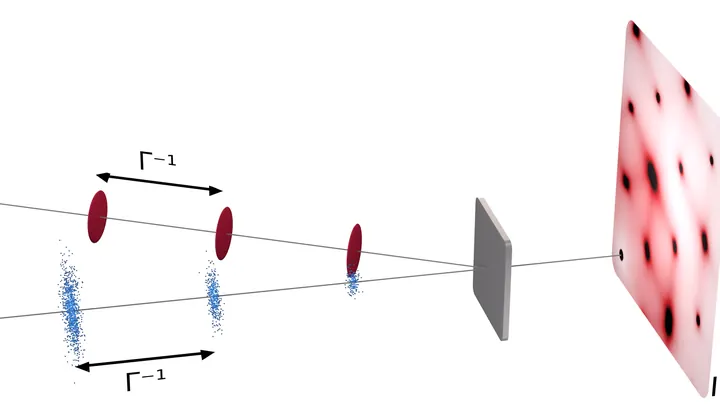
A light carousel spins not people but electrons. Instead of wooden horses, there are invisible blades of light. This is exactly the kind of 'carousel' physicists built to give electrons a spin.
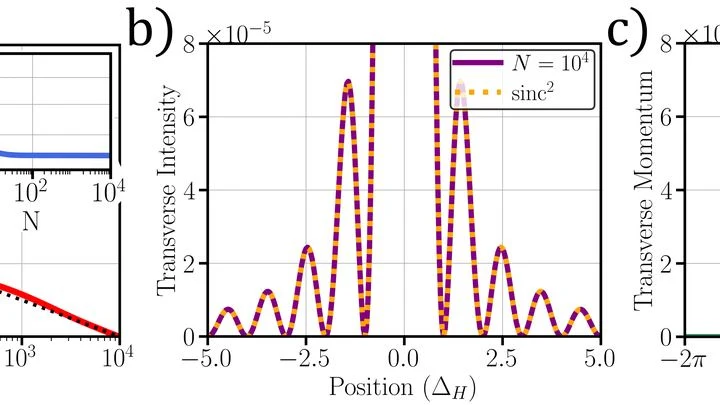
Usually, to twist an electron beam into a vortex, you need a tiny mask — a stencil with slits carved on the atomic scale. Fabricating it is extremely challenging.
A substance's spectrum is its fingerprint. Usually, to record one, you place the sample in a strong magnetic field, like in an MRI scanner. But there is a way to do without a magnet altogether: detect the signal from atomic nuclei at zero field. Until now, this method suffered from poor sensitivity, and its complex spectra were hard to predict.
In the crystal Rb1-xV2Te2O, the spins of vanadium atoms arrange in a checkerboard pattern: each spin is surrounded by opposite spins. This pattern is called G-type antiferromagnetism. Neutrons passing through the sample scatter off this pattern and reveal its geometry, like light from a flashlight shining through blinds casting stripes on a wall.
A crystal without inversion symmetry is like a room where one wall is mirrored and the other is frosted: the reflection doesn't match the original. Such materials often behave unusually because electrons feel the lattice distortion.
The neutron is a particle with no electric charge, making it tricky to catch: it slips through instruments like a bullet through fog. In typical experiments, it gets just one pass through a crystal, and all measurements must fit into that instant.
A new idea is to make the neutron loop inside a trap, like a ball bouncing between two walls.
On the surface of a thin film of bismuth iron oxide, you can see neat stripes, like furrows in a plowed field. What lies beneath them has remained a mystery until now.
The atomic nucleus is not just a ball of protons and neutrons. Inside it, like a tiny magnet, there is its own distribution of magnetization. Until now, it has been difficult to see: nuclei live for tiny fractions of a second, and their magnetic field is weak. Now physicists at CERN have found a way to look inside.
In a solid, atoms vibrate, transmitting sound. Sometimes this wave doesn't run straight but curls into a spiral, like a corkscrew entering a cork. In ordinary crystals, such 'sound vortices' are known, but in magnetic materials they had long eluded detection.
The neutron, a particle inside the atomic nucleus, can live in two worlds: ours and a mirror one. The mirror world has its own neutron twin, invisible to our instruments. If an ordinary neutron sometimes hops to the mirror world and back, some neutrons in a trap would seem to dissolve into thin air.
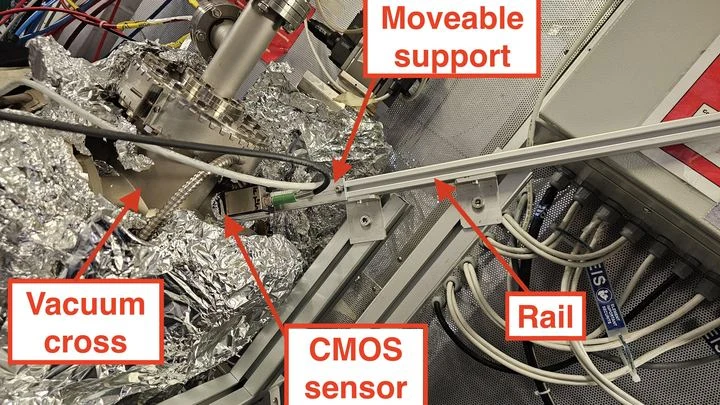
A camera that captures not light but a stream of electrons reflected off a crystal is a hybrid pixel detector. It can count every electron that hits it, generating almost no noise of its own. In normal mode, when the electron beam flows continuously, the detector works perfectly.
Drop a stone into a pond, and ripples spread across the water. Magnets have waves too — only instead of water molecules, it's the directions of atomic magnetic arrows that oscillate. These waves are called magnons, and their behavior reveals a lot about the invisible forces between atoms.
A thin crystal of hexagonal boron nitride is a relative of graphite, but transparent and insulating. Occasionally, single defects appear in its lattice: a boron or nitrogen atom is missing, leaving a trap for electrons. Such a trap can absorb light and re-emit it, like a tiny flashlight.
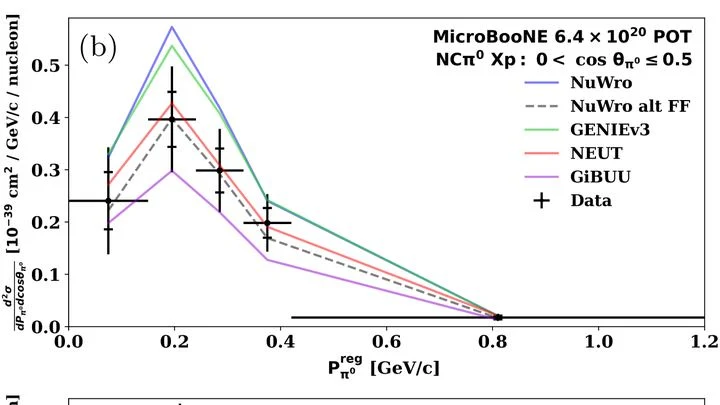
In an underground hall at Fermilab, a huge tank holds liquid argon — a transparent fluid at minus 186 degrees. When an invisible neutrino flies into the tank, it occasionally strikes an argon nucleus, and a short track of charged particles flashes.
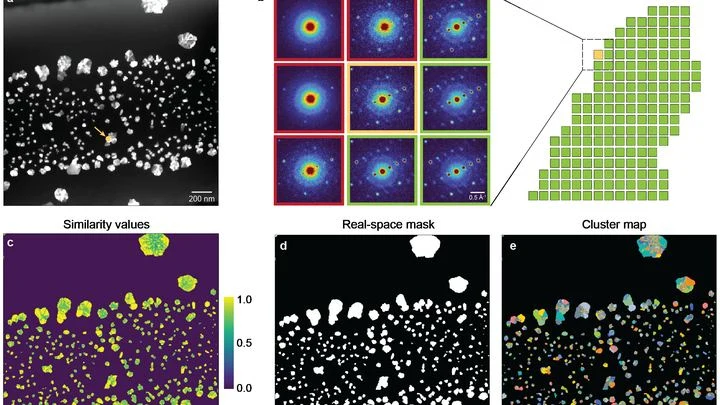
An electron microscope scans a sample and records how electrons scatter off atoms at each point. The result is a giant stack of images — one for every point. These images encode information about how atoms are arranged: in neat rows or with a tilt, the orientation of the crystal lattice, and whether there are internal strains.
A dense piece of plastic the size of a coin flashes when an invisible particle hits it. That's how scintillators work — materials that turn radiation into faint light. They're usually made from fragile crystals or expensive polymers. But now there's a simpler option: plain polyurethane, the stuff used to mold furniture foam and shoe soles.
When cooled to -272°C, the Fe₄Nb₂O₉ crystal turns into a magnetic pattern where atomic arrows don't line up in a single row but fan out. It's like a crowd frozen in place, but each person looks in their own direction rather than at the back of the neighbor's head.
Electrons in a metal are like a crowd in a subway: each on their own, but at the slightest push, everyone moves at once. Physicists call this collective oscillation of the electron gas a plasmon. In superconductors, these oscillations are especially important because they reveal how electrons interact with each other.
A magnetic field is invisible, but you can make it 'glow'. To do that, take a tiny diamond with defects — places where a carbon atom is replaced by nitrogen and a neighboring lattice site is vacant. These defects, like sensitive compass needles, respond to the slightest changes in the magnetic field and emit light of varying brightness.
Neutrinos are the most elusive of all known particles. Every second, trillions of neutrinos from the Sun fly through your body, but you never notice: they barely interact with matter. To catch even one, physicists build giant detectors — pools of water or liquid argon deep underground.
Visible matter is a drop in the sea of cosmic soup. The foundation of the Universe is made of invisible dark matter, whose gravity keeps galaxies from flying apart. The best candidate for this role is sterile neutrinos, ghost particles connected to us only by the thinnest of bridges.
Inside a giant spectrometer in Karlsruhe, shaped like a huge metal barrel, scientists are catching particles that are nearly impossible to catch. Neutrinos are the ghosts of the microcosm: every second, trillions of these particles fly through your body, and you don't even notice. But they do have mass, and scientists want to measure it.
A silicon sphere 166 nanometers in diameter floats in a beam of infrared laser light. The pressure is below 10⁻⁸ mbar, and the motional temperature is about 10 millikelvin. That is colder than the cosmic microwave background.