Quantum calculation refers to computations that exploit quantum mechanical phenomena, such as superposition and entanglement, to process information in ways that classical computers cannot. Unlike classical bits, which are either 0 or 1, quantum bits (qubits) can exist in a combination of states, allowing a quantum computer to explore many possibilities simultaneously. This makes quantum calculations potentially transformative for problems like factoring large numbers, simulating molecules, and optimizing complex systems.
History
The concept of quantum computing was introduced in the early 1980s by Richard Feynman and Paul Benioff, who suggested that quantum systems could simulate physics more efficiently than classical computers. In 1994, Peter Shor's algorithm for factoring integers demonstrated a practical advantage, sparking intense research and development.
How it works
A quantum calculation involves preparing qubits in a known initial state, applying a sequence of quantum gates (operations that manipulate the qubits' states), and then measuring the final state. The challenge is that qubits are extremely sensitive to their environment—thermal noise, electromagnetic interference, and even ion jitter (as mentioned in the seed) can cause decoherence, destroying the fragile quantum state. Error correction and isolation techniques are therefore essential to maintain the calculation's integrity.
In practice
Quantum calculations are being developed for drug discovery, materials science, cryptography, and artificial intelligence, with companies like IBM, Google, and startups racing to build scalable quantum computers.
Fun fact
A quantum computer with just 300 qubits could theoretically hold more information than the number of atoms in the observable universe, due to the exponential growth of its state space.
Clocks in the Universe are tricky things. Usually, in calculations of the birth of the world, a special scalar field plays the role of a clock — something like an invisible fluid filling all of space. It ticks, and physicists watch how the world changes relative to that ticking. But these clocks are man-made, introduced for convenience.
The authors of the new work took a different path.
Strike a tuning fork with a mallet — it vibrates, and the sound gradually fades. A black hole behaves much the same way when disturbed: it emits gravitational waves — ripples in spacetime itself — and then settles down.
In the scorching heart of a dying star, an invisible stream is born — a neutrino gas. The particles race through matter almost without stopping, but when their density is enormous, they start to feel each other. Old calculations described this as a jostle in a crowd: each shove changes direction, but no connection arises between passersby.
The biggest puzzle in physics is how to reconcile spacetime curvature with quantum mechanics. At the Planck length, billions of billions times smaller than an atom, the rules break down. This frontier was discovered by Max Planck.
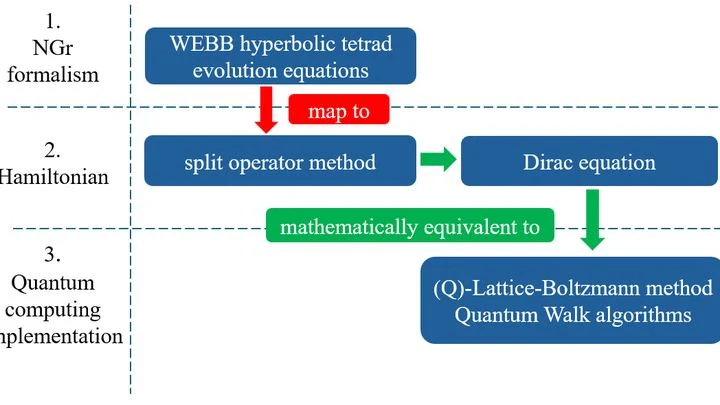
Two seemingly incompatible mathematical languages describe a single quantum reality. The first is the language of quantum walks: here, a particle (such as an electron or even a quasiparticle in a condensed medium) takes a stroll on a graph, simultaneously exploring all possible paths — much like a pedestrian in an unfamiliar city instantly finding…
In 2019, a group of theorists asked a simple question: what would happen if you embedded a single irreversible element into an ordinary quantum computer, a gate that slightly "eats" probability? The answer was devastating. Any such gate, no matter how weak, instantly turns the machine into a device capable of solving problems in the class PostBQP = PP.
At the hilltop of classical physics, a particle is frozen in unstable equilibrium. The slightest nudge — and it rolls down with increasing speed. In the quantum universe, no nudge is needed: the uncertainty principle itself acts as an all-pervading wind, blowing the particle off the peak.