Charge separation is the process by which positive and negative electric charges become spatially separated, creating an electric dipole or a net charge imbalance. This phenomenon is fundamental to many physical and chemical processes, from the generation of electricity in batteries and solar cells to the behavior of biological membranes and atmospheric lightning. It underlies the operation of capacitors, the polarization of molecules, and the formation of electric fields in nature.
History
The concept of charge separation has been understood since the 18th century with the study of static electricity, but its modern understanding in terms of electrons and ions developed in the late 19th and early 20th centuries with the work of J.J. Thomson and others. The photovoltaic effect, a key application, was discovered by Edmond Becquerel in 1839.
How it works
Charge separation occurs when an external force, such as chemical reactions, light absorption, or friction, moves charges against the electrostatic attraction that would otherwise keep them together. For example, in a solar cell, photonsexcite electrons, leaving behind positively charged 'holes', and the built-in electric field of the junction separates them, creating a voltage. In biological systems, ion pumps in cell membranes actively transport ions across the membrane, establishing a concentration gradient that stores energy.
In practice
Charge separation is exploited in photovoltaic cells, capacitors, batteries, and in biological systems like photosynthesis, where it drives the conversion of light into chemical energy. It is also essential in electrostatic precipitators for pollution control and in the operation of field-effect transistors.
Fun fact
Lightning is a dramatic example of charge separation: within thunderclouds, collisions between ice particles and graupel separate charges, building up potentials of hundreds of millions of volts before a discharge.
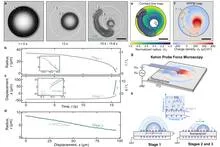
A water droplet on a fluoropolymer film initially behaves as expected: it sits and evaporates. But once it shrinks to a quarter of its initial size, it suddenly takes off and, within fractions of a second, covers a distance several times its own radius. Then it crawls slowly but persistently, leaving behind an invisible trail of electric charges. That trail is what drives the motion.
A tightly stretched membrane, squeezed into a narrow case, decides on its own where to burst. So does a cell: when it is cramped, the point of division shifts from the middle, and the two halves come out unequal. Previously, it was thought that such asymmetry is predetermined by chemical labels, but the new work shows that mechanics alone is enough.
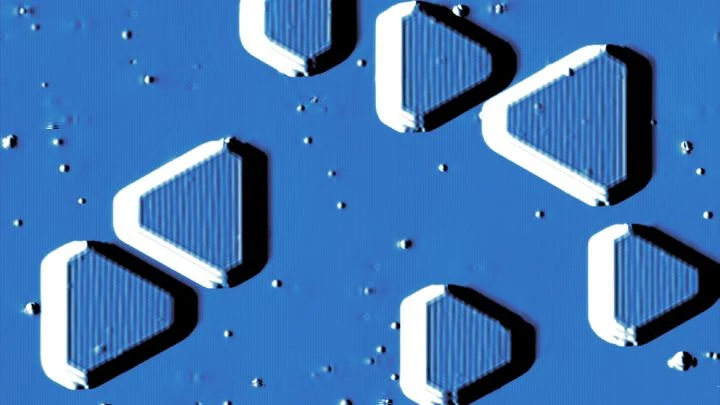
In some crystals, electrons are not spread uniformly but arrange themselves into a strict checkerboard: one cell has more electrons, the neighboring cell has fewer. Such a pattern is called charge order, and for a long time it was considered something frozen, like a pattern on frosty glass.
Imagine a carousel with two types of seats: some spin clockwise, others counterclockwise. If you push all of them at once, the carousel jerks but stays in place. That's how a Weyl semimetal crystal works: electrons are born in pairs—'left' and 'right'—and their contributions to current cancel each other, like two identical motors running in opposite directions.
Battery aging is like metal fatigue: a crack grows inside long before the part breaks. Usually, you only learn about the problem when capacity drops below 80%—but by then, the damage is irreversible.
Two grains of salt fall into a glass of water. They dissolve, and sodium and chloride ions spread throughout the volume. The schoolbook truth is simple: like charges repel, opposite charges attract. But recent experiments with tiny spheres in liquids have revealed a picture that breaks this rule.
A thin layer of oil on the surface of water breaks into separate droplets at the slightest disturbance. Something similar happens in the pulsar wind — a stream of particles ejected by a rapidly rotating neutron star. This stream also contains plasma layers, which can break apart into clumps — magnetic islands.
A lithium-ion battery is like a multi-story building where lithium ions live on every floor. When you charge the battery, the ions move from floor to floor, and the whole building warms up a bit. Usually, this heat dissipates evenly, like from underfloor heating. But sometimes one spot gets too hot, and then the whole building can go up in flames.
A tiny glass sphere floats in a laser beam like a speck of dust in sunlight. Inside it is radioactive lead, which decays from time to time. Each decay ejects charged particles, and the sphere loses or gains a tiny electric charge.
Two tiny emitters, each about the size of an atom, can together do what neither can do alone. We're talking about light scattering — when light hits particles and bounces off in all directions. Usually, a pair of particles scatters light only slightly more than a single one.
When two different materials are pressed together and then pulled apart, a spark jumps between them. Anyone who has pulled off a wool sweater in the dark or gotten a shock from a doorknob knows the feeling. For a long time, it was thought that charges simply hop from one surface to another due to differences in material properties.
A drop of metal on a semiconductor is like an island in the sea. For an electron to reach that island, it must pay a "toll": overcome a barrier that arises because the island is tiny, and each extra charge significantly changes its energy. This phenomenon is called Coulomb blockade. It underpins single-electron transistors, where current flows one electron at a time.
Batteries usually have two terminals — an anode and a cathode. Engineers are trying to remove the anode from solid-state batteries (with solid electrolytes) to make them lighter and more capacious. During charging, metal should deposit itself as a layer on the contact, and then vanish completely during discharge. But after a few cycles, capacity drops.
Manganese is like bricks in a wall, and zinc is a guest that comes and squeezes in between them. If the guest sits awkwardly, it pushes a brick out of the masonry. That's roughly what happens in a zinc-ion battery: during discharge, zinc ions insert into the crystal lattice of manganese oxide, and manganese starts to wash out into the solution.