A saddle point is a point on a surface or in a function where the gradient (slope) is zero, but it is not a local maximum or minimum. In two dimensions, it looks like a mountain pass: the surface rises in one direction and falls in another, resembling a horse's saddle. In higher dimensions, saddle points are more common than extrema and play a crucial role in optimization, physics, and game theory.
History
The concept was formalized in the 19th century by mathematicians like Joseph-Louis Lagrange and Carl Friedrich Gauss, who studied surfaces and critical points. The term 'saddle point' became standard in the early 20th century.
How it works
Mathematically, at a saddle point, all partial derivatives are zero, but the second derivative test is inconclusive: the Hessian matrix has both positive and negative eigenvalues. This means that moving along one direction increases the function, while moving along another decreases it. In optimization algorithms, saddle points are problematic because gradient descent can get stuck there, mistaking them for minima. In physics, saddle points appear in potential energy landscapes, where they correspond to unstable equilibriumstates, such as the top of a barrier between two stable configurations.
In practice
Saddle points are central to machine learning, where training neural networks involves navigating high-dimensional loss landscapes filled with saddle points. In physics, they are used in transitionstatetheory to calculate reaction rates.
Fun fact
In a game of chess, the minimax theorem guarantees that every finite two-player zero-sum game has a saddle point in mixed strategies, meaning there is a value that both players can achieve with optimal play.
A crowd at the entrance to a narrow corridor behaves differently than in a spacious hall: some people get pressed against the walls, others are pushed forward. Roughly the same happens when an elongated particle finds itself in a fluid teeming with self-propelled dumbbells. Until now, it was unclear why such a particle moves faster along its long axis than across it, and how the crowd density affects its speed.
A lone fish sees a shadow overhead. Should it flee? If it's just a leaf, it wastes energy and gives away its position to a predator. If it's a heron, hesitation is fatal. That's the eternal trade-off of the solitary individual: quick reactions mean many false alarms, while caution means risking being eaten.
In a school, it's different.
The Josephson junction is a bridge made of superconductor, separated by an ultra-thin insulating layer. Current flows through it even without voltage. But when the current becomes too large, the bridge starts to oscillate, and even steps, Shapiro steps, appear on the voltage graph. Between these steps hide invisible gaps where the system behaves strangely.
Water droplets shoot out of a nozzle one after another, like cyclists on a narrow track. The faster ones catch up with the slower ones and merge into larger drops. This simple mechanism is called ballistic aggregation, and until now it had only been observed on cosmic scales: this is how dust particles stick together to form planets.
Every quantum system (whether an atom, a crystal, or the entire Universe) has its own set of allowed energies, like the steps of a ladder. The hotter the system, the more readily particles climb to higher rungs.
If you toss a book into a black hole, the pages don't vanish without a trace: their content remains encoded in the radiation the hole emits. But how exactly does that happen? In some models, 'islands' appear — regions inside the hole that seem to push information back out.
In the mid-20th century, Roger Penrose described a black hole using the concept of a “trapped surface” – a region where even a light ray directed outward inevitably falls inward. A situation familiar to everyone: water in a sink’s vortex is irretrievably sucked down the drain.
A flashlight beam in a dark room can hold a dust mote almost still: that's how optical tweezers work. But light doesn't just push the particle; it also jostles it with random kicks. Each absorbed photon strikes it like an invisible hammer. The authors of the new study have devised a light trap of a special shape.
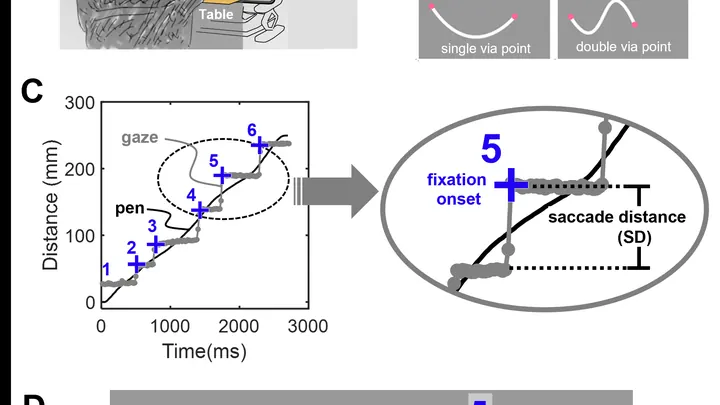
When the hand draws a line, the gaze almost always runs ahead, like a scout peeking around the corner before the column turns. But how far ahead? It turns out that each person has their own distance, and it does not change from attempt to attempt.
In the experiment, professional calligraphers and ordinary people traced a contour on a screen while instruments recorded eye and pen movements.
A stag beetle the size of a fingernail stands on the ground with its legs spread wider than its own height. An elephant as tall as a room, on the other hand, towers above the ground like a tower. Why is that? Both animals walk on the same ground, but they see it differently. For a beetle, each pebble is a boulder, while for an elephant, it's a grain of sand.
A glass of solidified glass may seem motionless, but inside, the atoms are frozen in random positions, never having found perfect order. A similar situation occurs in spin glasses: the magnetic moments of atoms freeze, pointing in different directions, and the material loses the ability to be simply magnetized.
A seismograph records underground tremors: the smooth line suddenly jerks and changes its character. Similarly, functional data, such as ocean temperature maps or brain signals, may shift their shape at some point. The new algorithm FSBS catches such breakpoints, even when each curve is measured at only one point and noise drowns the signal.