Precision in Every Detail: How a Telescope Reconstructs Distorted Light ✛
Context
Modern ground-based telescopes use adaptive optics to compensate for atmospheric turbulence, but images are still distorted. For precise scientific measurements, we need to know the shape of each distortion (the PSF). Usually it is measured from bright reference stars near the target, but such stars are not always available. The PSF-R method reconstructs the distortion shape from the adaptive optics system's own data, without additional observations. This is especially important for the future ELT telescope with its 39-meter mirror, where accuracy requirements are very high.
Methods
The scientists used data from the ERIS instrument on the VLT telescope, obtained in 2023 and 2024. They observed three stars: one reference star for adaptive optics and two at distances of 7 and 16 arcseconds. To reconstruct the distortion shape, they used only adaptive optics telemetry (data on mirror correction), atmospheric turbulence profiles from the MASS-DIMM instrument, and wind forecasts from the FATE project. All information was compressed into three atmospheric layers. The same method was applied to simulations created by the SPECULA program to compare results.
Results
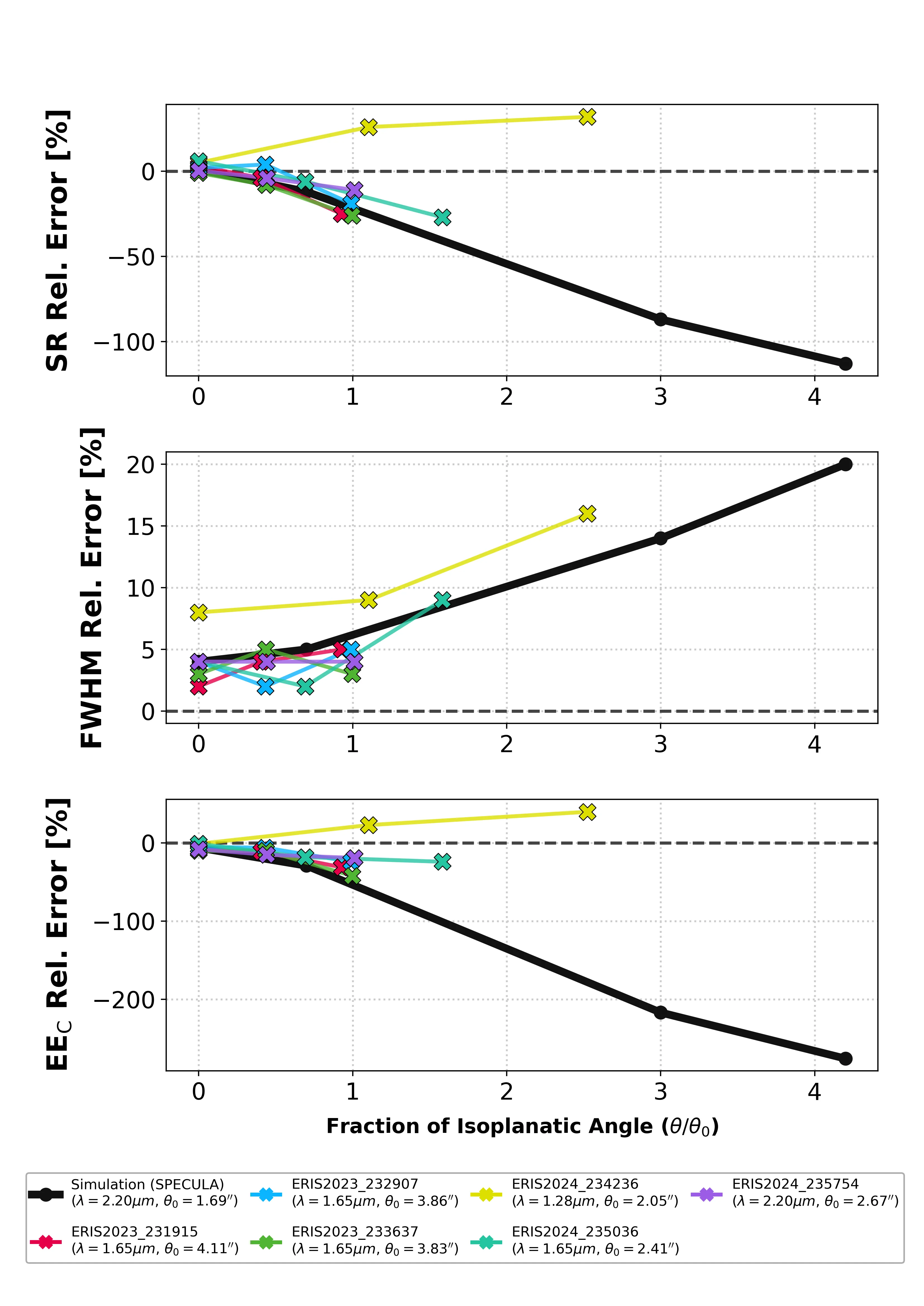
The reconstructed distortion shapes matched the real ones with about 10% accuracy in key parameters: Strehl ratio, full width at half maximum, and core energy. The accuracy held up to distances of half the isoplanatic angle (about 2 arcseconds). At a distance of one isoplanatic angle, the error grew to 20%. One 2024 dataset showed inflated turbulence, likely due to the short wavelength. Simulations confirmed these results and showed that on the larger ELT telescope, accuracy will be higher because of the larger mirror size.
Implications
This work is the first to confirm on real data that the PSF-R method works for off-axis observations with accuracy sufficient for scientific tasks. This differs from previous work, which mostly used simulations. Success on the 8-meter VLT telescope is encouraging for the 39-meter ELT: a larger mirror provides more information for reconstruction, which should improve accuracy.
Future development
The method will be refined to account for uncertainty in wind forecasts. There are also plans to test it on other instruments and conditions. For MICADO on the ELT, a PSF-R service will be created that will automatically provide reconstructed distortion shapes to all users.
Impact
The method will improve the accuracy of photometry and morphology for bright extended objects such as galaxies and star clusters. It will also allow observations of targets that lack bright reference stars nearby.
Next steps
Conduct additional observations on ERIS to test the method at different wavelengths and conditions. Develop and test the PSF-R service for MICADO on the ELT.
Key open problems
The work solves the problem of accurately determining the distortion shape for adaptive optics, which is critical for faint objects and precise photometry. It is part of the broader task of improving the efficiency of ground-based telescopes.
The knowledge machine's view
This section is addressed to the author of the paper and their colleagues. Neighbouring works were found by meaning-based search across our archive, not by word overlap. We do not review: we show the field around the work.
What the work does
The study tests a method for reconstructing the PSF from adaptive optics telemetry on real VLT/ERIS data for off-axis targets. Using AO data, MASS-DIMM profiles and FATE wind forecasts, the authors reconstruct the PSF to an accuracy of ~10% within half the isoplanatic angle and confirm the results with SPECULA simulations.
Where its strength is
This is the first demonstration that PSF-R works on real data for off-axis observations, which is a key step toward applying it on the ELT.
Where it could go next
- It might be interesting to see how the PSF-R method combines with approaches that use telemetry to monitor mirror shape: our archive contains a nearby paper in which telescope telemetry is used to assess the state of the optics.based on: The Telescope Listens to Itself arXiv:2608.07357v1
- A potentially useful step would be a comparison with methods that do not require a bright reference star: the archive has an analysis of an approach in which the focus is captured without such a star, which resonates with the task of reconstructing the PSF when reference sources are scarce.based on: How a Telescope Locks Focus Without a Bright Star arXiv:2602.15746
- To improve accuracy at large angular separations, one could consider ideas from the paper on freezing atmospheric ripples: it uses a full analysis, and some of its techniques might help extend the range of applicability of PSF-R.based on: Freezing the Ripple to See the Bottom arXiv:2608.10151v1
Worth trying
- Test whether including FATE wind data at different altitudes with higher temporal resolution improves the accuracy of PSF reconstruction.
- Compare PSF-R with a method that uses only mirror telemetry without external turbulence profiles, in order to assess the contribution of each data source.
- Try applying PSF-R to data at a longer wavelength to test the hypothesis of overestimated turbulence in the 2024 dataset.
Why this may matter
A successful demonstration of PSF-R on real data paves the way for using this method on the ELT, where it could become a standard tool for precise photometry and astrometry without additional observations of reference stars.
Nearby works in our archive
- The Telescope That Will See the Surfaces of Distant Starssimilarity 0.55
- Photo Compression: How Brightness Helps Predict Colorsimilarity 0.53
- Earth's Gravitational Lens: Hunting Axions in the Focus of Spacetimesimilarity 0.52
- Freezing the Ripple to See the Bottomsimilarity 0.52
- How a Telescope Locks Focus Without a Bright Starsimilarity 0.52
- Camera Jitter Blurs Our View of Alien Worldssimilarity 0.50
- The Telescope Listens to Itselfsimilarity 0.49
The archive is sparse around this work: the closest review is only 0.55, against a usual 0.64. It looks like few have drilled nearby.
The method reconstructs the distortion shape without looking at the star itself, using only data on mirror correction. It's like determining the shape of a wave from the movement of a float.
Key numbers
- reconstruction accuracy: 10%
- distance for 10% accuracy: half the isoplanatic angle
- ELT mirror diameter: 39 meters
- VLT mirror diameter: 8 meters