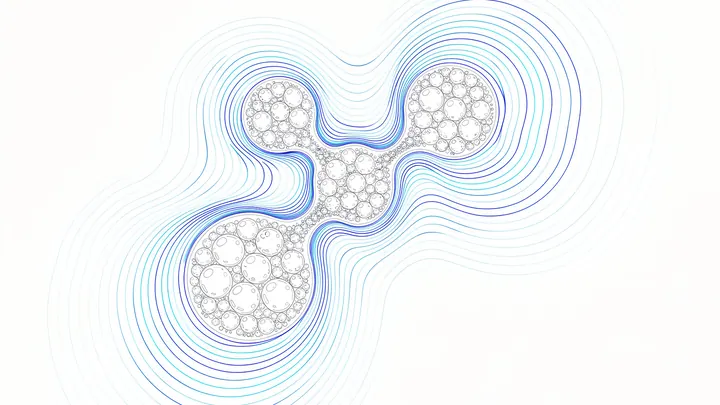
Reconstruction is a data-processing technique used in cosmology to partially undo the late-time gravitational distortions that obscure the primordial patterns in galaxy clustering. In the early universe, tiny density fluctuations left an imprint on the distribution of matter, a pattern known as baryon acoustic oscillations (BAO). As the universe evolved, the gravitational pull of large-scale structures — dark matter halos, galaxy clusters, and filaments — shifted galaxies from their original positions, smearing out this signal. Reconstruction aims to reverse these shifts statistically, sharpening the BAO feature and improving measurements of cosmic distances.
History
The technique was introduced in the early 2000s by Daniel Eisenstein and colleagues, who proposed it as a way to enhance the BAO signal in galaxy surveys. It has since become a standard tool in cosmological analyses.
How it works
The method works by estimating the displacement field of galaxies using the observed galaxy distribution itself. From the density field, one computes the gravitational potential and then moves galaxies back along the inferred trajectories, effectively 'undoing' the bulk flows caused by large-scale structure. This is done iteratively or with a single step, depending on the algorithm. The result is a reconstructed density field that more closely resembles the initial conditions, with the BAO peak in the correlation function becoming sharper and more detectable.
In practice
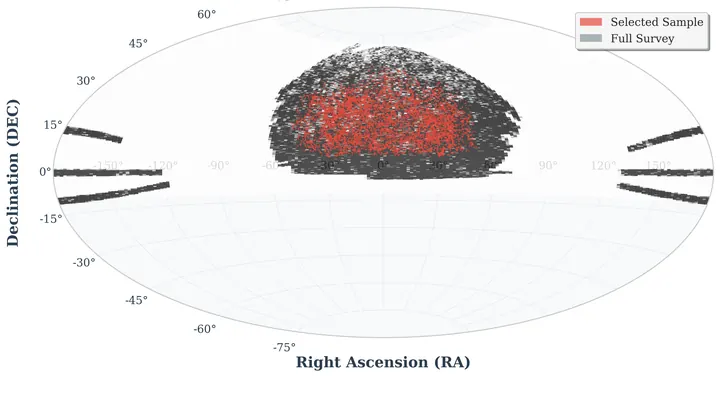
Reconstruction is routinely applied in large galaxy redshift surveys, such as the Dark Energy Spectroscopic Instrument (DESI) and the Euclid mission, to sharpen BAO measurements and constrain dark energy parameters.
Fun fact
Reconstruction can improve the precision of BAO distance measurements by roughly a factor of two, effectively doubling the survey's statistical power without observing more galaxies.
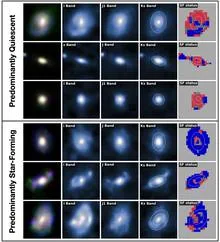
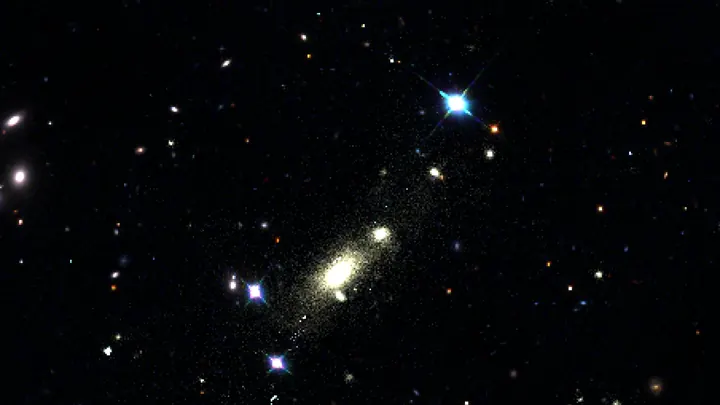
A ground-based image of a distant galaxy looks like a view through frosted glass: the atmosphere smears details, hiding the internal structure. Astronomers have long wanted to know where exactly star formation shuts off in galaxies, but ground-based telescopes could not resolve the subtle color gradients.
An interpreter gets distracted by every rustle in the hall, and a one-hour meeting stretches into two. A neutron star compresses a solar mass into a sphere the size of a city, and the matter in its core is denser than an atomic nucleus. Physicists cannot probe its structure in the lab: the required pressures are unattainable.
The temperature at the center of a galaxy cluster reaches a hundred million degrees. These largest gravitationally bound systems are natural laboratories where nature hides 85% of its mass in invisible dark matter.
Dark matter remains one of the greatest mysteries of modern physics. Back when Vera Rubin observed galaxy rotation, she proved that visible matter is insufficient to keep stars from flying apart.
In quantum field theory, there is a strict law: a signal cannot outrun light. This is causality — the foundation on which the order of events rests. But near black holes, this foundation begins to crack, especially if the hole is not quite ordinary.
The universe is like a vast warehouse where a strict inventory was taken long ago. The cosmic microwave background is an ancient record of everything in stock 380,000 years after the big bang. According to it, the fraction of matter in the cosmic 'budget' (the parameter Omega_m) is known with high precision.
Two rulers show slightly different lengths for the same table. That's roughly the situation in cosmology with the Hubble constant — the number that tells how fast the universe is expanding.
Through the ripples on the water, pebbles at the bottom of a pool look shifted and warped. In a similar way, the gravity of invisible dark matter bends the light of distant galaxies — a phenomenon known as weak lensing.
Two dots on the surface of a balloon: that's all the reference points you have when trying to figure out how it inflates. That's roughly how cosmologists reconstruct the history of the universe's expansion.
Toss a handful of glitter into a river, and some flakes will drift straight while others spin in tiny eddies. Galaxies in the universe do something similar: they don't just recede due to cosmic expansion: they also swirl in giant currents, like wood chips caught in invisible whirlpools.
When the first stars ignited, their ultraviolet light began stripping electrons from hydrogen atoms. The universe transformed from a neutral fog into transparent plasma. This process, cosmic reionization, proceeded unevenly: slowly at first, like a fire catching in damp wood, then faster as the flames spread through dry tinder.
The night sky looks as smooth as the surface of a calm lake. But if you look at gamma-ray bursts (brief, blinding explosions visible across the entire universe) you'll find ripples in that smoothness.
Scientists took a catalog of such bursts and divided the sky into two hemispheres. In the southern one, they found a tiny group: 4–5 bursts huddled together.
Images of distant galaxies are riddled with curved arcs and smears — light warped on its way to us. This effect, predicted by Albert Einstein, acts like a giant funhouse mirror: a massive galaxy cluster distorts the images of background sources.
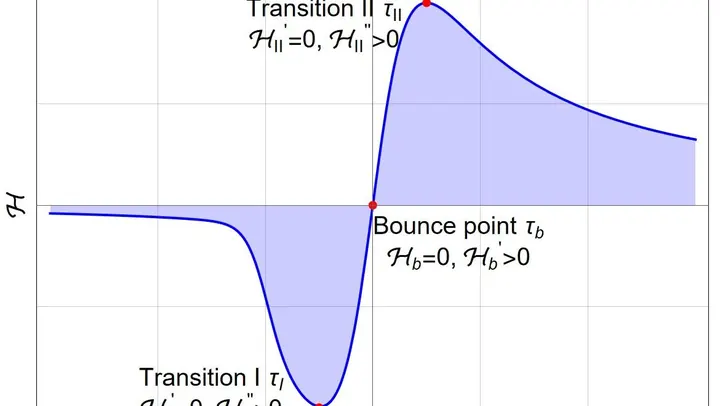
The standard cosmological model describes the birth of the universe as an explosion from a singularity — a point of infinite density and spacetime curvature.
At the heart of the Milky Way spins a stellar bar — an elongated cluster, like a rotating paddle. Its gravity creates a rhythmic field around it, like waves from a speedboat.
Cosmic rays are charged particles that constantly bombard Earth from deep space. When one of these particles enters the atmosphere, it collides with air nuclei and spawns a whole cascade of secondary particles: electrons, muons, photons.
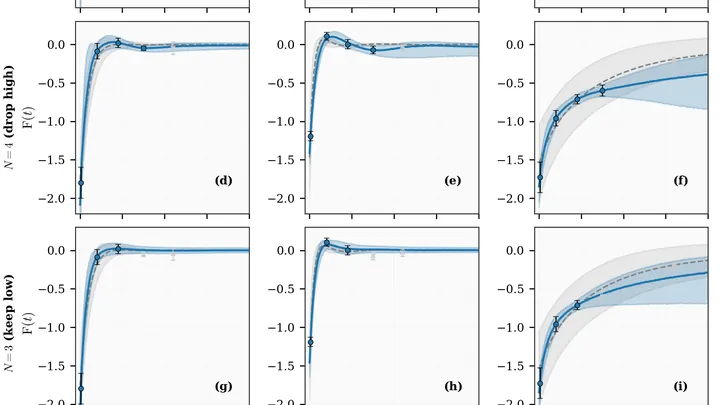
The proton is not a smooth ball but a tangle of quarks and gluons in constant motion, exchanging energy. Finding out exactly how energy, pressure, and spin are distributed inside it is impossible to do directly: measurements yield only sparse, noisy points. It's like trying to guess a face from a few blurry photos taken from different angles.
Proteins in a cell communicate like people in a bustling city: some pass signals, others put on the brakes, and still others just hang around. A graph neural network sees the map of these connections, who's linked to whom, but to it, they're just lines.