A Float That Feels the Wave: How a Telescope Reconstructs Distorted Light ✛
At night, a telescope looks at a star but sees it as a quivering blob. Earth's atmosphere is constantly rippling, and light passing through it bends like a flashlight beam through water. Astronomers long ago learned to correct this quivering with adaptive optics: the telescope's mirror changes shape hundreds of times per second to straighten the light wave. But even after such correction, small distortions remain, and without knowing their exact shape, you cannot measure the brightness or shape of a distant galaxy.
Usually this fingerprint is captured using a bright reference star near the target. But such stars aren't always available. The new PSF-R method reconstructs the shape of the distortion without looking at the star itself, using only data on how the adaptive optics performed. It's like a float that senses a wave without seeing it: from the float's motion, you can reconstruct the wave's shape. The telescope records how the mirror corrected the light, and from these records it computes what the distortion was.
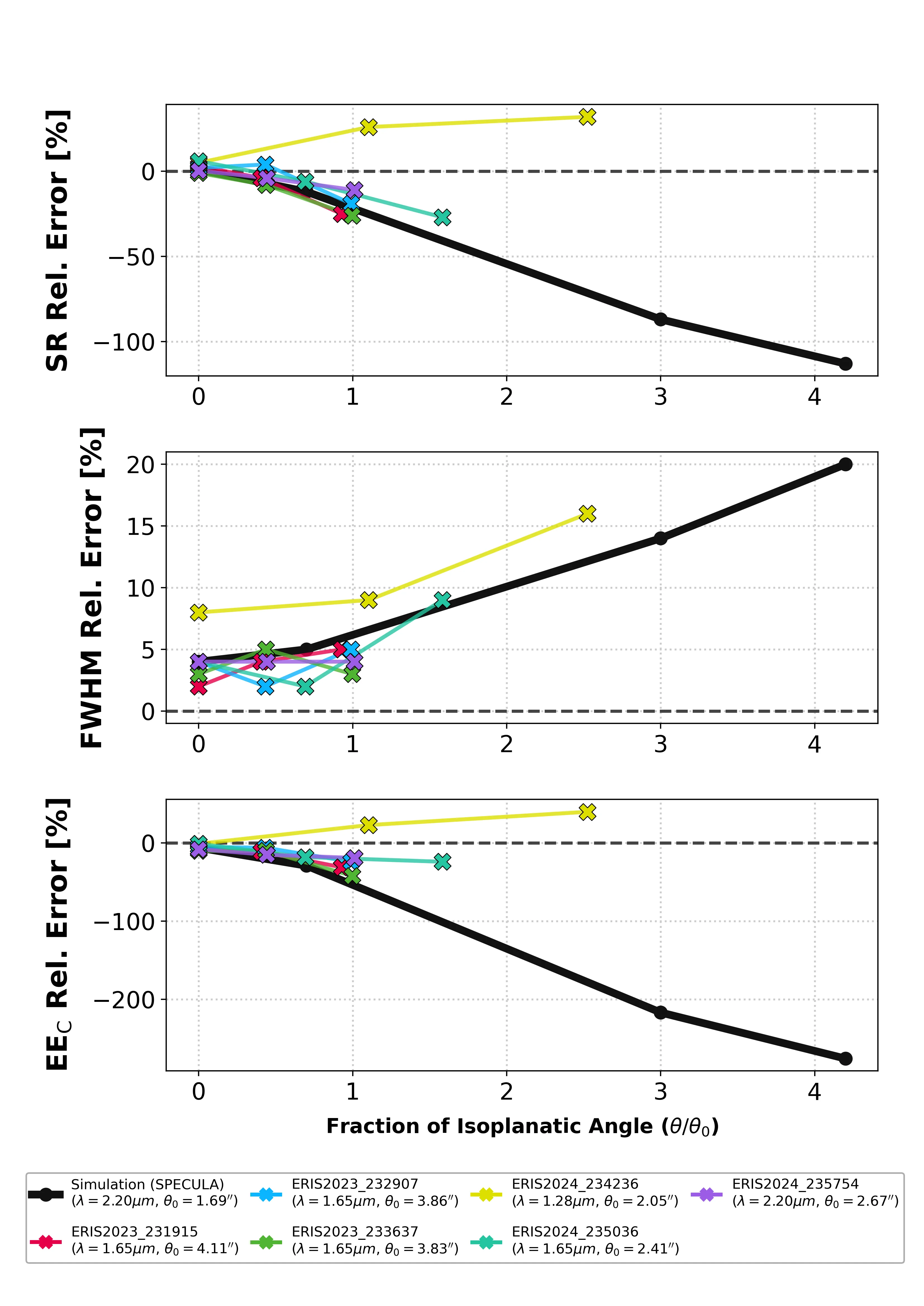
The scientists tested the method on the real VLT telescope with the ERIS instrument. They observed three stars: one reference star for adaptive optics and two at distances of 7 and 16 arcseconds. For the reconstruction, they used only adaptive optics telemetry, atmospheric turbulence profiles, and wind forecasts. All the information was compressed into three atmospheric layers and the result was compared with the actual distortions.
This accuracy held up to distances of half the isoplanatic angle (about 2 arcseconds). Beyond that, the error grew to 20%. One dataset showed inflated turbulence, probably because of the short wavelength. Simulations confirmed the results and showed that on the future ELT telescope with its 39-meter mirror, accuracy will be higher, because a larger mirror provides more information for reconstruction.
The method is ready for use on the ELT. For the MICADO camera, a PSF-R service will be created that will automatically deliver reconstructed distortion shapes to all users. This will improve measurement accuracy for bright extended objects such as galaxies and star clusters, and will make it possible to observe targets without bright reference stars. The float that senses the wave will open up new depths of space.
The method reconstructs the distortion shape without looking at the star itself, using only data on mirror correction. It's like determining the shape of a wave from the movement of a float.