An Invisible Turnstile Inside the Battery: Lithium Shuttles Back and Forth Without Losses
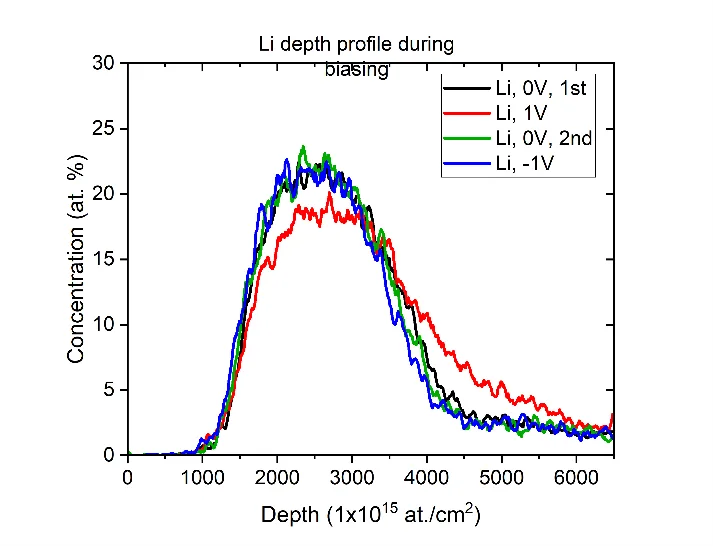
Inside a thin-film battery there is a junction that cannot be seen directly. The cathode and the solid electrolyte meet so tightly that the boundary between them is hidden from view. Until now, no one knew what happens at this junction while the battery operates. Now scientists have peered in there for the first time, using neutrons and a beam of iodine ions.
The experiment showed that the boundary works like a turnstile. At a voltage of +1 V, some lithium ions move from the cathode into the electrolyte, and at −1 V they return. The total amount of lithium does not change: only about 9.3% of all atoms were redistributed. This means the boundary neither breaks down nor accumulates junk; it simply lets ions pass back and forth. Such behavior matters for batteries: it affects their capacity and resistance. The technique can be used to monitor thin-film batteries right now.
A 45 MeV iodine ion beam knocks lithium out of the sample like a billiard ball hitting light balls, and from the time of flight one can reconstruct the depth from which each atom came.