A solid-state battery is an energy storage device that uses solid electrodes and a solid electrolyte, unlike conventional batteries that use liquid or gel electrolytes. This design promises higher energy density, improved safety, and longer lifespan, making it a key technology for electric vehicles and portable electronics. The shift from liquid to solid electrolytes eliminates the risk of leakage and flammability, while also enabling the use of high-voltage electrode materials that are incompatible with liquid electrolytes.
History
The concept of solid-state batteries dates back to the 19th century, but practical development accelerated in the 2010s with advances in materials science, particularly the discovery of sulfide and oxide electrolytes with high ionic conductivity.
How it works
In a solid-state battery, ions move through a solid crystalline or glassy electrolyte between the anode and cathode during charge and discharge. The solid electrolyte must have high ionic conductivity while being an electronicinsulator. The challenge lies in maintaining good contact between the solid electrolyte and electrodes, as volume changes during cycling can create voids. Researchers are also addressing the growth of dendrites—metallic filaments that can pierce the electrolyte and cause short circuits—by engineering the electrolyte's mechanical properties and interface chemistry.
In practice
Solid-state batteries are being developed for electric vehicles, aiming to double the driving range while reducing charging times, and for medical implants where safety and longevity are critical.
Fun fact
Some solid-state batteries use glass electrolytes that are so flexible they can be bent without breaking, yet they conduct ions as well as liquid electrolytes.
A light switch clicks, and the light comes on. But imagine a switch that, with the same press, can either turn on the lamp or leave the room dark. It also remembers what it did last time, and sometimes it seems to flip a coin to decide whether to light up.
This kind of behavior was found in a crystal of black phosphorus — a semiconductor just a few atomic layers thick.
Every battery or supercapacitor has an unassuming player — the polymer glue. It binds the active material particles together and helps them stick to the current collector. Previously, it was considered just inert mass: it's there, as long as it doesn't get in the way. But in this work, the glue takes center stage.
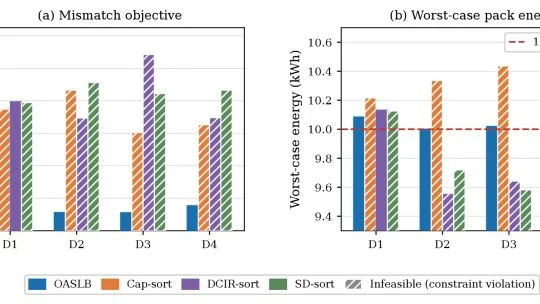
Used EV batteries behave like moody musicians: one plays too loud, another too soft, a third goes out of tune for no reason. Slapping them together randomly creates a cacophony: some cells get overloaded, others sit idle, and the system fails quickly.
Engineers turned this problem into a conductor's challenge.
A solid electrolyte is not just a crystal lattice: it’s a bustling metropolis for ions. Each act of conduction resembles a trip through the city: there are wide highways with low energy barriers, gridlocks in bottlenecks, and tricky detours where an ion can get stuck.
A chef pours hot sugar syrup onto a cold table, and it sets into crystals. That's roughly how engineers pictured metal solidification: the liquid instantly becomes a scatter of crystalline grains. But close-up imaging revealed an extra stage wedged between liquid and solid.
River water often swirls into funnels. But in semiconductors, the foundation of microchips, electrons at low temperatures and high purity also turn into a fluid. If you create a circular cavity, vortices appear, just like in a river backwater.
An ordinary phone battery breathes — not with air, but with contact. Inside a solid body, where there are no liquids, lithium presses against the electrolyte (the ion-conducting substance) during charging and pulls away during discharging, like a lung on inhale and exhale. This 'breathing' is not poetry but physics: each cycle creates and destroys the contact points through which current flows.
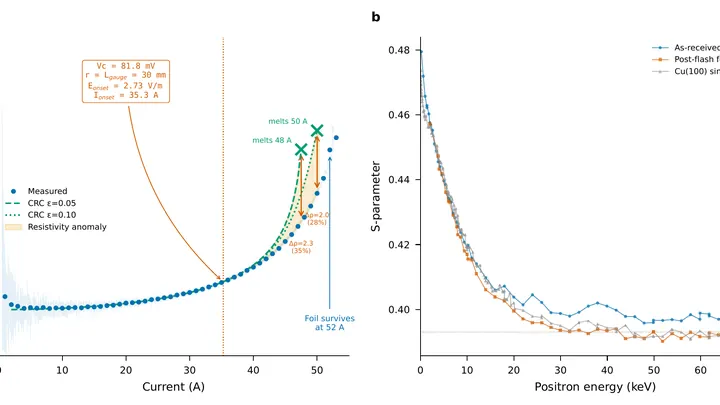
A copper wire under current is a familiar sight, but inside it something unexpected is happening. A strong electric current doesn't just heat the metal: it knocks atoms out of their rightful places, leaving behind tiny voids, as if a few balls were suddenly removed from a tightly packed arrangement.
A lithium battery is like a sandwich: two slices of bread are the electrodes, and the filling between them is the electrolyte, through which lithium ions shuffle back and forth. In conventional batteries, the filling is liquid, like a sauce, and it can leak or catch fire.
Splitting water into hydrogen and oxygen with electricity is an age-old dream of clean fuel. But tiny gas bubbles stand in the way: they cling to the electrodes like foam on the side of a soda glass, interfering with the current's work. Each bubble is a tiny plug, blocking part of the surface where the reaction should occur.
A metal filament as thin as a hair grows through the ceramic like a root through asphalt. In solid-state batteries, such filaments are called dendrites, and they appear when the charging current exceeds a critical threshold. The ceramic electrolyte is solid but brittle, like glass.
Hydrogen is a champion in energy per kilogram, but storing it is a hassle. As a gas, it takes up a huge volume, and if you compress it or cool it to a liquid, you need heavy tanks and lots of energy. There's a third way: some solid materials absorb hydrogen like a sponge soaks up water and hold it within. Heat it up, hydrogen comes out; cool it down, it gets absorbed back.
A solid electrolyte is like a sponge for lithium ions. In a regular lithium battery, ions float in a liquid, like fish in an aquarium. In a solid-state battery, they have to squeeze through the crystal lattice, like through narrow corridors.
A lithium battery is like a house with a storage room: during charging, lithium goes inside; during discharging, it comes out. But if the storage room gets cluttered, some lithium stays inside forever. How much lithium returns depends on the metal the walls are made of.
The authors of the study took four metals: aluminum, magnesium, silver, and copper.
In a regular battery, the electrolyte is liquid, and charged particles (ions) move freely. In the solid-state version, they squeeze through atomic 'corridors', like pedestrians in narrow passages. For a battery to work quickly, you need a material with high ionic conductivity.
A semiconductor film just one atom thick is like a communal apartment: it houses negatively charged electrons and positively charged 'holes.' When light hits such a film, an electron and a hole can pair up into an exciton — a bound state of an electron and a hole, akin to a hydrogen atom.
A glowing dot in a vacuum chamber refuses to go out, even though the light source has long been switched off. A single ytterbium ion, held by electric fields, is stuck in an excited state, as if the electron inside it has forgotten how to return to its usual place.
A quantum computer is like an orchestra where every musician must come in exactly on the beat. The faintest rustle in the hall throws off the violinist, and the melody falls apart. In silicon chips, that rustle is electrical noise: random fluctuations of charge inside the material. They make quantum bits err.
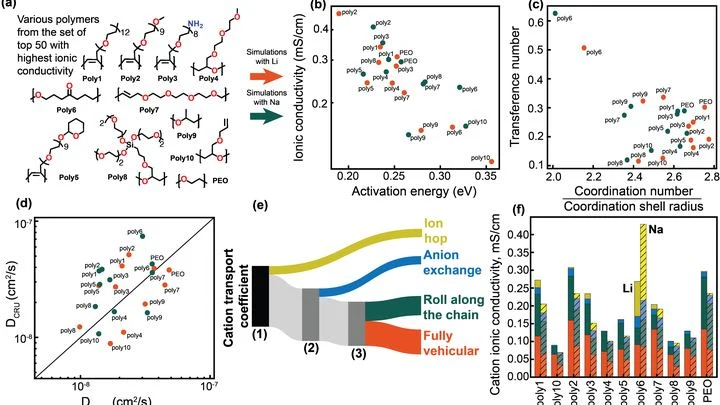
Modern batteries with liquid electrolytes can leak or catch fire. Polymer electrolytes (solid, plastic-like materials) solve that problem, but ions move through them more slowly, so the battery loses power.
Researchers set up a virtual assembly line: a computer program generated new polymer structures the way a chef experiments with new dough recipes.
Superconductors are materials that conduct electricity without loss, but their properties are usually fixed. In the new work, scientists made a device resembling a crossroads of two superconducting tracks. By applying a weak magnetic field perpendicular to this crossroads, they were able to change the current the device can carry by a factor of four.
In a lithium-sulfur battery, sulfur tends to dissolve and drift toward the other electrode — the battery loses charge within dozens of cycles. To hold the runaway in check, a separator film is placed between the electrodes. A standard polyethylene film lets lithium ions through, but sulfur molecules slip along with them.
Imagine a superhighway where cars zoom along with barely a slowdown: that's what a layer of ultraclean semiconductor looks like, where electrons travel vast distances without a single collision. Scientists have built a transistor in which electrons run twice as fast as in any similar device before.
Two pendulums hanging from the same crossbar gradually begin to swing in sync. But if you give one of them a slight nudge, the shared rhythm changes, and from that change, you can detect even the lightest touch. This is roughly how sensors based on coupled oscillating systems work.
In the new study, the researchers considered two coupled circuits, like two pendulums connected by a spring.
A piece of chromium exposed to air gets covered in invisible armor, an oxide film, within a minute. That film protects the metal from rust, but for a battery it's a disaster: the film blocks chromium ions, so no current flows.
Scientists mixed five metals — chromium, bismuth, copper, tin, and nickel.
Ordinary computer memory constantly consumes energy to avoid forgetting what's stored. A superconductor could store data without loss, but it's hard to make it switch.
In the new work, a superconductor is sandwiched between two magnetic insulators.
Conventional atomic clocks are essentially optical counters: they rely on spectroscopy — a method for measuring the frequency of radiation with high precision as electrons jump between energy levels.
A laser on a lithium niobate crystal comes to life with a current of 40 milliamps. Its light splits into two streams, each passing through a six-millimeter waveguide, where twin photon pairs are born. One stream rotates the polarization of its twins, after which both flows merge into a common channel.