Direct Observation of Reversible Ion Polarization at the Buried Interface of a Solid-State Battery
Context
Solid-state batteries promise more energy and safety, but their cathode-electrolyte interfaces remain a mystery. Theory predicts space-charge formation and ion redistribution under an electric field, yet seeing this directly was hindered by lithium's lightness and its deep burial. The work stands apart: the closest neighbors in the archive study lithium batteries, solar cells, and graphene layers, but no one has looked inside the buried interface with nanometer resolution and absolute quantitative accuracy. Here, two complementary methods were combined for the first time to answer the question: is the interface passive, irreversibly degrading, or capable of a reversible ionic response?
Methods
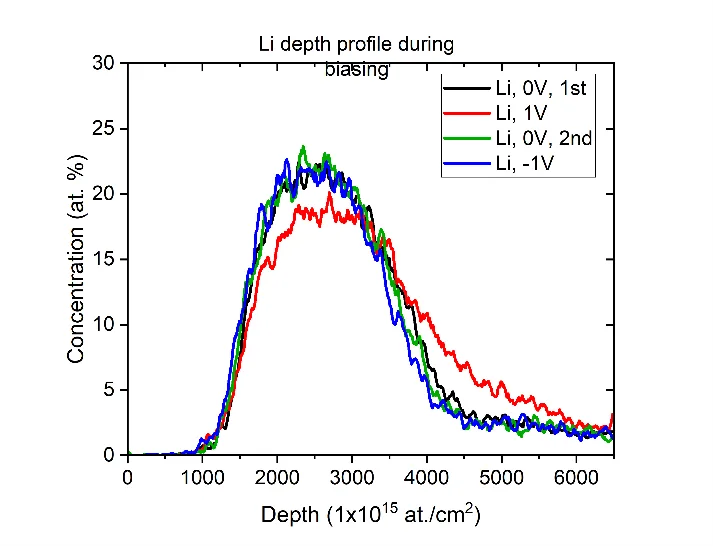
A thin-film structure of Al2O3/Cu/Fe2O3/LAGP/LCO/Cu was fabricated by ion-beam sputtering at room temperature to obtain amorphous layers and avoid grain effects. The total thickness is about 450 nm. First, neutron depth profiling (NDP) at the LVR-15 reactor measured the total lithium content: 2.21±0.08×10¹⁶ atoms/cm². Then, time-of-flight elastic recoil detection analysis (ToF-ERDA) with a 45 MeV iodine beam provided lithium depth profiles with nanometer resolution. Voltages of +1 V and −1 V were applied to the anode, and profiles were taken after each step and compared with the initial state.
Results
At +1 V, the lithium concentration in the cathode dropped, while at the LCO/LAGP interface on the electrolyte side it increased. Integrating the signal over the layers showed that the total amount of lithium remains unchanged within error. About 9.3% of all lithium redistributed, corresponding to 2.06×10¹⁵ atoms/cm², or roughly 1×10¹⁴ atoms over a 5 mm² area, that is, a charge of 1.7×10⁻⁵ C. When the voltage was removed, the profile returned to its initial state, and at −1 V lithium again accumulated in the cathode. Full reversibility rules out irreversible lithium loss, formation of a permanent interlayer, or beam-induced migration. The response is localized: the field shifts only a small fraction of mobile ions, while most of the lithium stays put.
Implications
The work differs from its neighbors in the archive by directly, quantitatively, and with nanometer resolution showing reversible ion polarization at a buried interface for the first time. Neighboring studies address batteries but do not probe the interface with such precision or link local redistribution to the preservation of the total lithium inventory. This changes the view of the cathode/electrolyte interface: it is not a passive junction or a zone of irreversible degradation, but an electrically reconfigurable ionic region. Such behavior can affect impedance, apparent capacity, and the response at low voltages before irreversible processes begin.
Future development
The topic could advance toward operando measurements during cycling and at higher voltages to see the transition from reversible polarization to the formation of a chemically distinct interlayer. The amorphous nature of the layers opens a path to studying the heterogeneous energy landscape of lithium: which sites become mobile under a weak field. This will link nanoscale ion redistribution to the macroscopic characteristics of solid-state devices.
Impact
The result will influence the development of thin-film solid-state batteries, microelectronics, and iontronics, where low-voltage responses and interface stability are important.
Next steps
Conduct operando structural and spectroscopic measurements during prolonged cycling and at higher voltages to determine the threshold for irreversible interlayer formation.
Key open problems
Connection to unresolved problems in battery materials science: how disorder, space charge, and interfacial electrochemical potential determine which ions become mobile under weak fields, and where the boundary lies between reversible polarization and irreversible degradation.
A 45 MeV iodine ion beam knocks lithium out of the sample like a billiard ball hitting light balls, and from the time of flight one can reconstruct the depth from which each atom came.
Key numbers
- redistributed lithium: 9.3% of the total content
- total lithium content: 2.21×10¹⁶ atoms/cm²
- redistributed charge: 1.7×10⁻⁵ C
- thickness of the multilayer structure: 450 nm
- applied voltage: ±1 V