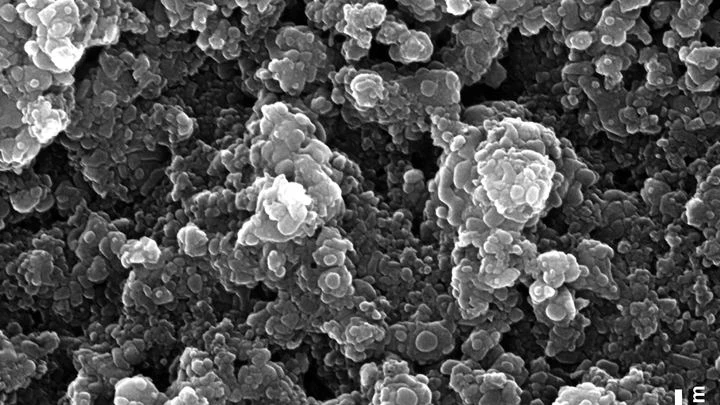
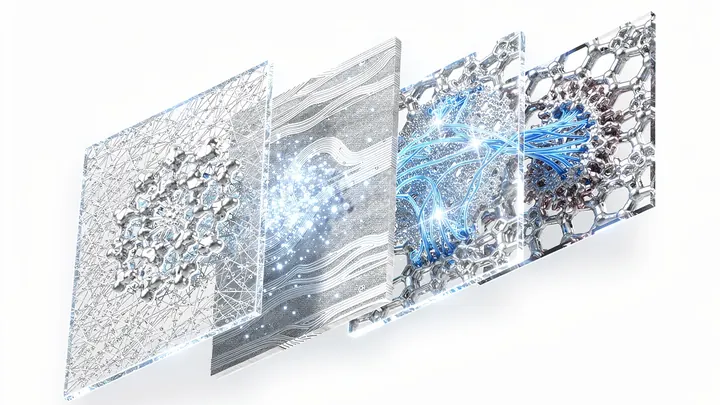
A lithium-ion battery is a rechargeable energy storage device that relies on the movement of lithium ions between an anode and a cathode through an electrolyte. The seed definition highlights that its internal material composition can be analyzed non-destructively, which is crucial for quality control, safety assessment, and understanding degradation. These batteries power everything from smartphones to electric vehicles because of their high energy density and long cycle life.
History
The concept was developed in the 1970s by M. Stanley Whittingham, with significant contributions from John B. Goodenough and Akira Yoshino, leading to the first commercial lithium-ion battery by Sony in 1991.
How it works
During discharge, lithium ions move from the anode (typically graphite) through the electrolyte to the cathode (often a metal oxide), while electrons flow through an external circuit, providing power. During charging, an external voltage drives the ions back to the anode. Non-destructive analysis techniques, such as X-ray imaging or neutron scattering, allow researchers to observe internal structures—like electrode cracking, lithium plating, or electrolyte distribution—without taking the battery apart, revealing why a battery might fail or lose capacity.
In practice
Used in portable electronics, electric vehicles, grid energy storage, and aerospace, with ongoing research into solid-state and sodium-ion variants for improved safety and sustainability.
Fun fact
The title 'Литий и стеклянная соль: спокойный союз' hints at research into glasselectrolytes that could make batteries safer by eliminating flammable liquid components.
Imagine a book with latches on its pages: you can only flip a page if you know how to click its edge. That is roughly how the mechanical metamaterial we are about to discuss works. Each cell is a small mass inside a larger one, connected by an elastic beam. The beam can sit in two stable positions, like a switch.
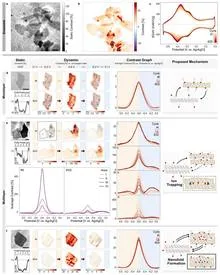
A stack of pages that has been flipped through many times remembers it: some sheets lie flat, others stick up, and creases remain here and there. Layered materials behave much the same way when ions enter them.
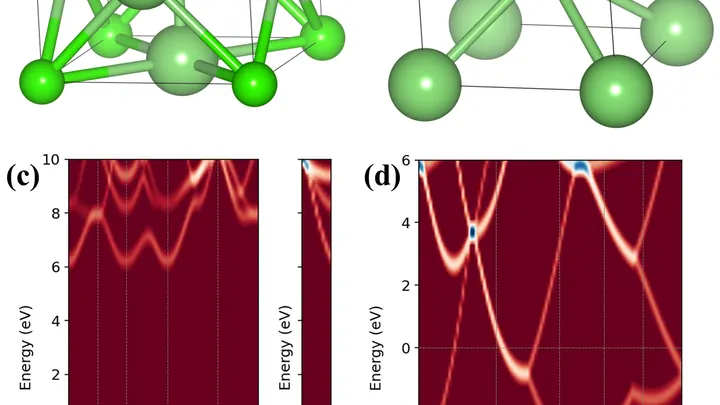
You can make light turn on command, like water in a hose — if you know where to squeeze. That's what electro-optic circuits do: they change the direction of a beam inside a chip using an electric field. The classic material for such tricks is lithium niobate, a crystal that responds to voltage like a string to a pluck.
Atomic batteries powered by plutonium decay have been running pacemakers and space probes for over sixty years. But the raw material is scarce: worldwide, only a few kilograms of plutonium-238 are produced each year, barely enough for the most critical missions.
Every battery or supercapacitor has an unassuming player — the polymer glue. It binds the active material particles together and helps them stick to the current collector. Previously, it was considered just inert mass: it's there, as long as it doesn't get in the way. But in this work, the glue takes center stage.
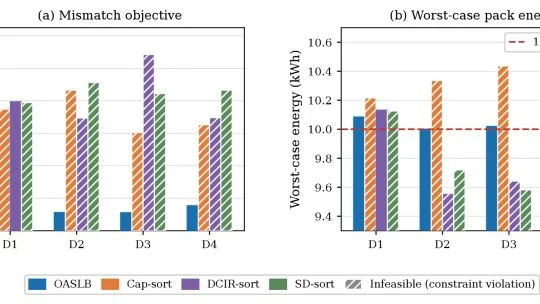
Used EV batteries behave like moody musicians: one plays too loud, another too soft, a third goes out of tune for no reason. Slapping them together randomly creates a cacophony: some cells get overloaded, others sit idle, and the system fails quickly.
Engineers turned this problem into a conductor's challenge.
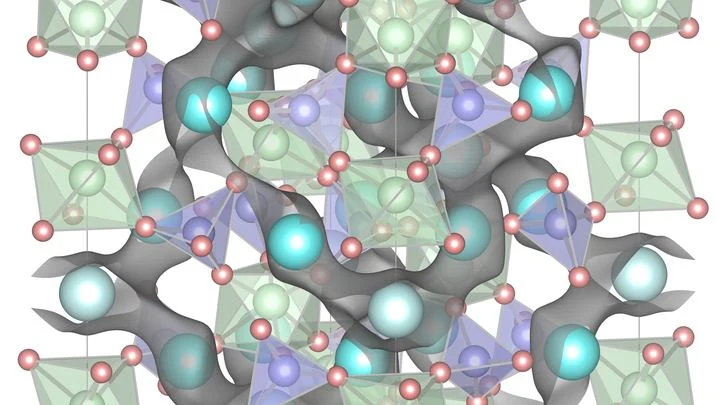
A solid electrolyte is not just a crystal lattice: it’s a bustling metropolis for ions. Each act of conduction resembles a trip through the city: there are wide highways with low energy barriers, gridlocks in bottlenecks, and tricky detours where an ion can get stuck.
A lithium battery is like a tiny city: lithium ions are the residents who move between electrode neighborhoods, generating current. But to understand how much energy the city can deliver, you need to know not only the street layout (the material's structure) but also how residents interact with neighbors, transportation, and even the weather.
Battery aging is like metal fatigue: a crack grows inside long before the part breaks. Usually, you only learn about the problem when capacity drops below 80%—but by then, the damage is irreversible.
An ordinary phone battery breathes — not with air, but with contact. Inside a solid body, where there are no liquids, lithium presses against the electrolyte (the ion-conducting substance) during charging and pulls away during discharging, like a lung on inhale and exhale. This 'breathing' is not poetry but physics: each cycle creates and destroys the contact points through which current flows.
A lithium battery is like a sandwich: two slices of bread are the electrodes, and the filling between them is the electrolyte, through which lithium ions shuffle back and forth. In conventional batteries, the filling is liquid, like a sauce, and it can leak or catch fire.
An ordinary flash drive stores bits in electron traps, but you can only read them through a separate wire and amplifier. In the new development, the same piece of the semimetal tellurium plays both the role of storage and the light bulb.
A conventional graphite anode in a sodium battery is like a cramped garage that barely fits a large truck. Sodium is larger than lithium and doesn't fit well between graphite layers, so batteries quickly lose capacity.
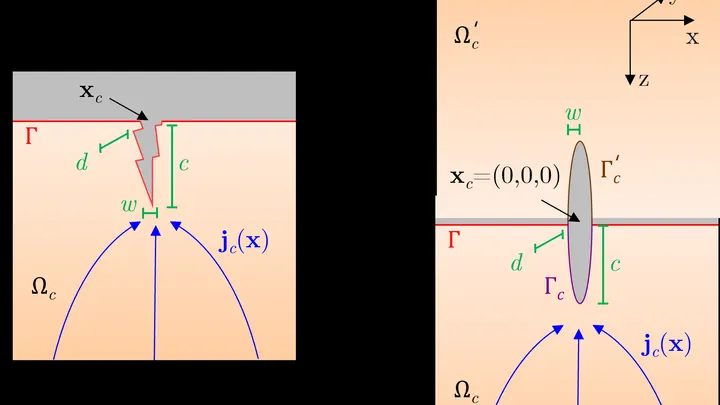
A metal filament as thin as a hair grows through the ceramic like a root through asphalt. In solid-state batteries, such filaments are called dendrites, and they appear when the charging current exceeds a critical threshold. The ceramic electrolyte is solid but brittle, like glass.
Inside every battery sloshes a liquid electrolyte, and how ions jostle within it determines how much energy the battery delivers and how long it lasts. Previously, peeking into that crowd meant either running long experiments or launching ultra-precise calculations that devour weeks of computer time.
A solar cell is like a heart: if you force it to beat out of rhythm, it tires quickly. Usually, cells are tested by applying reverse voltage, but in real life, a shadow from a leaf or a bird forces neighboring cells to pass foreign current through themselves.
A steady laser beam is like a taut string: if it vibrates even a little, the music turns into cacophony. In a quantum computer, the laser holds atoms in a trap, and any frequency jitter ruins the computation. That's why laser setups used to occupy entire tables, and tuning took weeks.
A lithium battery is like a house with a storage room: during charging, lithium goes inside; during discharging, it comes out. But if the storage room gets cluttered, some lithium stays inside forever. How much lithium returns depends on the metal the walls are made of.
The authors of the study took four metals: aluminum, magnesium, silver, and copper.
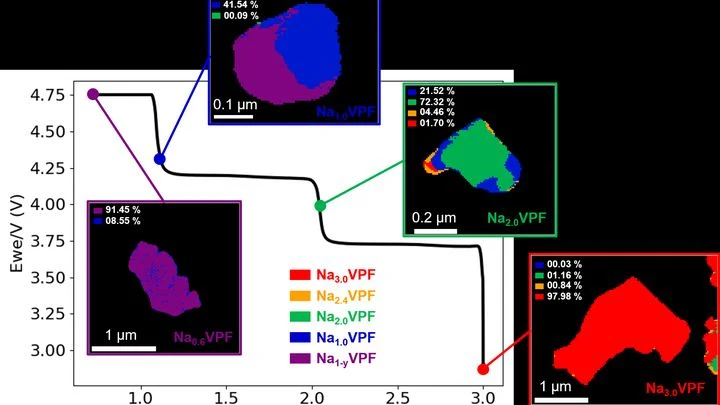
Inside each tiny particle that makes up the cathode of a sodium-ion battery, sodium is unevenly distributed — like sugar clumping in tea. This reduces the battery's capacity and lifespan. To see this hidden landscape, scientists used X-ray microscopy and trained artificial intelligence to interpret the data.
Batteries usually have two terminals — an anode and a cathode. Engineers are trying to remove the anode from solid-state batteries (with solid electrolytes) to make them lighter and more capacious. During charging, metal should deposit itself as a layer on the contact, and then vanish completely during discharge. But after a few cycles, capacity drops.
The battery in your phone or electric car is a tiny chemical factory. Inside, lithium ions shuttle between two electrodes, and at the boundary with the liquid electrolyte, a thin film forms: it determines how long the battery will last. This film is called the solid-electrolyte interphase.
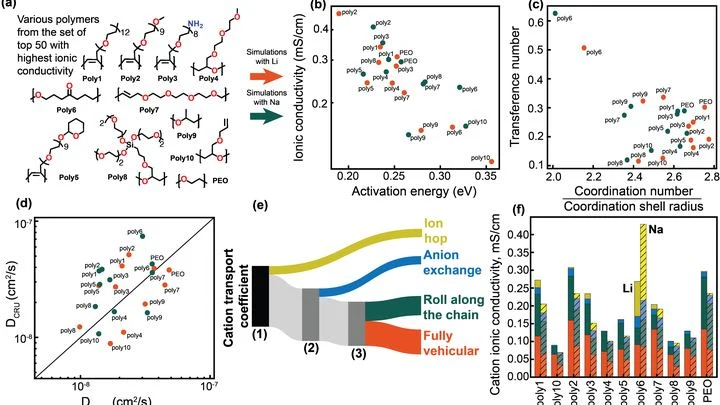
Modern batteries with liquid electrolytes can leak or catch fire. Polymer electrolytes (solid, plastic-like materials) solve that problem, but ions move through them more slowly, so the battery loses power.
Researchers set up a virtual assembly line: a computer program generated new polymer structures the way a chef experiments with new dough recipes.
An ordinary solar cell does one thing: when the sun shines, current flows. Here, when the sun shines, the current flows differently depending on which side you bring the magnet.
Manganese is like bricks in a wall, and zinc is a guest that comes and squeezes in between them. If the guest sits awkwardly, it pushes a brick out of the masonry. That's roughly what happens in a zinc-ion battery: during discharge, zinc ions insert into the crystal lattice of manganese oxide, and manganese starts to wash out into the solution.
An old T-shirt was dissolved in alkali to produce a gel, and it became the heart of an energy storage device. The second component was made from chitosan, a substance derived from shrimp shells. No metals: just recycled cotton and seafood.
The gel was soaked in ammonium salt, and its conductivity nearly doubled: from 17.1 to 37.8 millisiemens per centimeter.
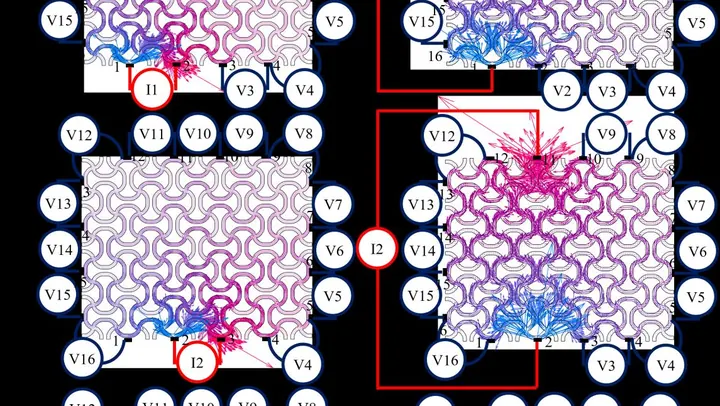
Ordinary materials break in silence. First, invisible struts inside them snap, and only then does a crack appear that you can see with your eyes. Engineers at Carnegie Mellon University have taught a material to 'talk' about such hidden damage.
They 3D-printed a lattice resembling honeycomb but with a more intricate pattern.
Sodium is lithium's neighbor on the periodic table, but it's hundreds of times more abundant in the Earth's crust and much cheaper. So sodium batteries could replace lithium ones in electric vehicles and energy storage.
An atomic nucleus usually lives in a single energy state, like a ball resting on the floor. But thorium-229 has a rare exception: the nucleus can get stuck on a tiny step above the floor — the so-called isomeric state. This step is so low that it can be nudged by ordinary light, not just hard radiation.
Inside a battery, like a layered cake, different solid layers sit side by side. The meeting point, the interface, behaves capriciously: stresses concentrate there, and over time the battery ages. To understand these processes, we need computer models that see every atom. But accurate calculations are too expensive, and fast ones are too crude.
In a lithium-sulfur battery, sulfur tends to dissolve and drift toward the other electrode — the battery loses charge within dozens of cycles. To hold the runaway in check, a separator film is placed between the electrodes. A standard polyethylene film lets lithium ions through, but sulfur molecules slip along with them.
A catalyst is a substance that speeds up a chemical reaction without being consumed itself. The best catalyst is one where every metal atom counts: the finer the particles, the more atoms are on the surface and the more active the material.
A piggy bank where coins slip in easily but can only be retrieved by smashing it. Something similar happens with a new material for sodium batteries. It readily accepts sodium ions during charging, but during discharge, it gives back almost nothing.
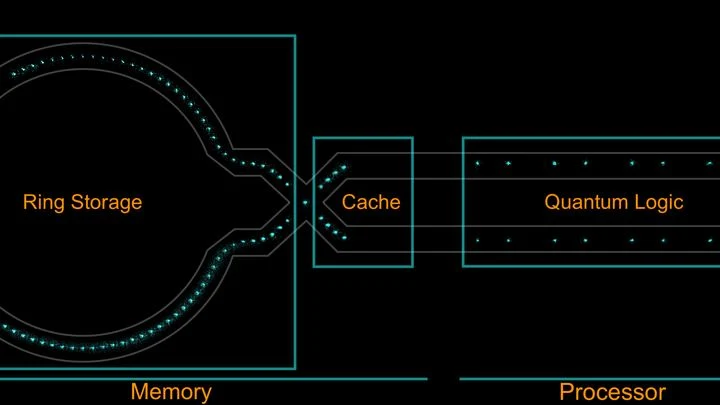
In the new Helios processor, 98 barium ions circle along a closed loop, like horses on a carousel. This architecture allows any ion to exchange data with any other, making the system flexible and powerful. Laser pulses, like a conductor's baton, issue commands at the speed of light.