Charge transferstates are electronic configurations in molecules or materials where an electron has moved from one part of the system to another, creating a spatial separation of positive and negative charge. These states are crucial intermediates in many photophysical and photochemical processes, including photosynthesis, organic solar cells, and certain battery chemistries. They often have characteristic optical signatures, such as absorption or emission bands that differ from the ground state, and can be either 'bright' (optically active) or 'dark' (inaccessible by direct light absorption).
History
The concept of charge transferstates emerged in the mid-20th century with studies of organic donor-acceptor complexes. Robert Mulliken's work in the 1950s on charge-transfer complexes laid the theoretical foundation, and the concept was later extended to polymers and biological systems.
How it works
When a molecule absorbs light, an electron can be promoted to a higher energy level. If the molecule has donor and acceptor moieties, the excited electron may transfer from the donor to the acceptor, forming a charge-separatedstate. This state has a dipole moment and can be stabilized by the surrounding environment. In materials, charge transfer states can be delocalized or localized, and their dynamics—formation, migration, and recombination—determine the efficiency of processes like charge separation in solar cells or energy storage in batteries.
In practice
Central to the operation of organic photovoltaics and light-emitting diodes, where charge transferstates mediate the conversion between light and electrical energy. Also relevant in designing new battery materials with high energy density.
Fun fact
In some molecules, charge transferstates can be 'dark'—they do not absorb light directly—but they can still be populated via intersystem crossing from bright states, making them important but tricky to study.
A thin film of neodymium nickelate, fifteen nanometers thick, sits on a neodymium gallate substrate. Below one hundred eighty kelvin it behaves as an insulator: electrons are locked inside their atomic cells and cannot move freely.
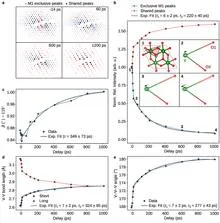
The camera captures not a race but a dance of atoms. In vanadium dioxide, the transition from an insulating to a metallic state occurs within trillionths of a second, yet until now no one had seen exactly how the vanadium and oxygen atoms move. Now, ultrafast electron diffraction has captured this route frame by frame.
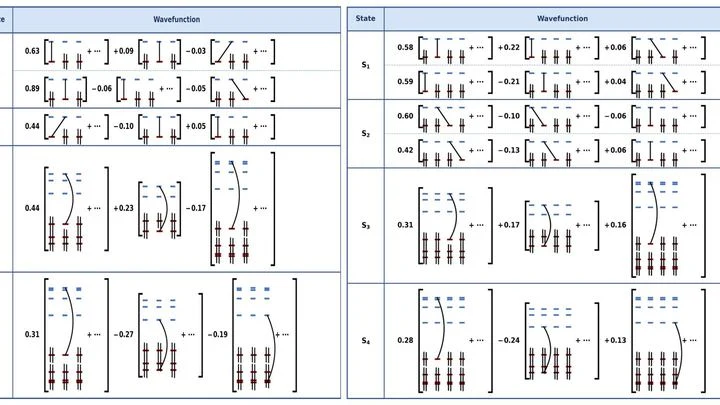
The lifetime of the entangled triplet pair in the protein is about 60 picoseconds, which is eight times longer than in solution.
Sunlight is like a continuous stream of balls flying at a wall.
In a tight row of atoms, spaced closer than the wavelength of light, a remarkable state hides. The excitation is distributed among all particles so that their radiation cancels itself out. This quantum 'silence' is an ideal vault for a photon: it can be stored there hundreds of times longer than usual.
Light hits an organic molecule, and inside, a pair of twin excitations is born. They're called triplet pairs. In single pentacene molecules, such pairs have long been known to share their energy with neighbors: this is the basis of singlet fission, which boosts the efficiency of solar cells.
Two pendulums on a shared string trade motion: push one, and the second starts swinging, and a moment later the first gets a push back. In a thorium-229 atom, energy flows nearly loss-free between the electron shell and the nucleus.
An electron and its antiparticle — the positron, predicted by Дираком, — upon meeting, momentarily form позитроний: a tiny pair circling each other, like in an atom but without a nucleus. Almost instantly it decays, emitting two photons that turn out to be mysteriously linked.
A superconductor is like an ideal highway with no traffic lights: electrons race along without hindrance. But apply a voltage, and the picture changes. In a new experiment, physicists found that an electric field penetrates the superconductor and creates a mixed regime inside.
Two guitar strings are stretched on the same neck. They are almost identical, but one is slightly shorter — and they sound different. That's roughly how the two isomers of ethanimine work: molecules with the same set of atoms but rotated differently in space. Astronomers spotted this molecule in the dense clouds near the center of our Galaxy.
In diamond quantum devices, there's a tiny defect — the nitrogen-vacancy center (a nitrogen atom plus a vacancy where a carbon atom should be). It acts as a switch that spontaneously flips back and forth: it can carry an extra electron or not, and this determines whether it emits light or not.
In the quantum world, light and matter constantly exchange energy. Previously, they were described statically, like frozen poses. The new approach follows the dance itself: the transitions between states, like a continuous sequence of movements.
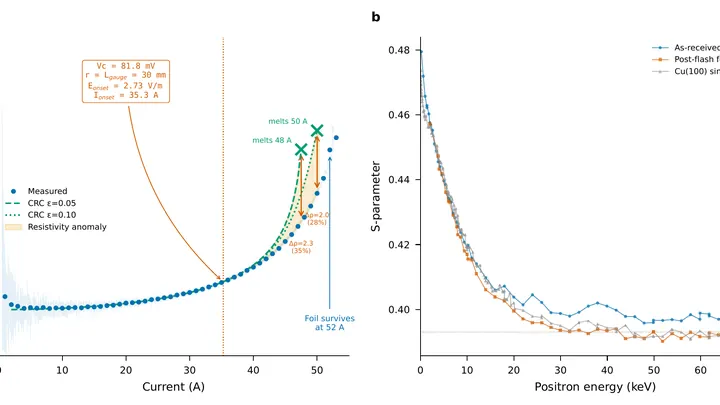
A copper wire under current is a familiar sight, but inside it something unexpected is happening. A strong electric current doesn't just heat the metal: it knocks atoms out of their rightful places, leaving behind tiny voids, as if a few balls were suddenly removed from a tightly packed arrangement.
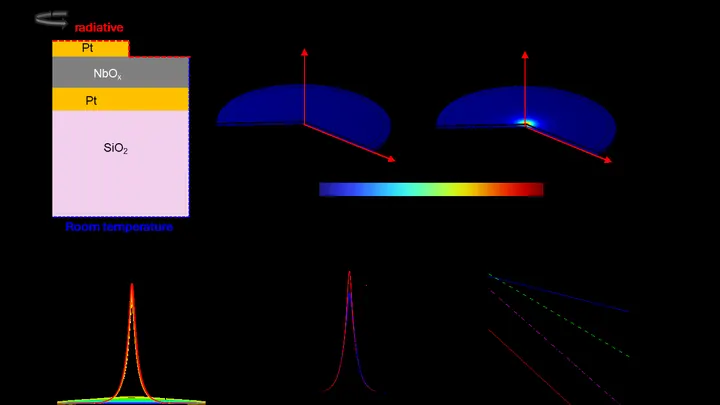
A memristor is a resistor with a memory: after the current is turned off, it retains its resistance. Inside, a thin film of metal oxide is sandwiched between two metal electrodes. When a strong current is first passed through the device, conductive filaments of oxygen vacancies form in the oxide, and the resistance drops sharply.
A lithium battery is like a sandwich: two slices of bread are the electrodes, and the filling between them is the electrolyte, through which lithium ions shuffle back and forth. In conventional batteries, the filling is liquid, like a sauce, and it can leak or catch fire.
A laser beam inside a special crystal spontaneously turns into a “Schrödinger’s cat”—a mixture of two states. Erwin Schrödinger dreamed up this paradox for an atom, but now physicists see it happen with an entire stream of photons.
Light is like a company of soldiers on a parade ground.
When you stir sugar into a glass, the water seems to move every which way. But inside a chemical reactor with an impeller, the liquid isn't just churning: it forms hidden "islands" that barely exchange their contents. Scientists found a way to see these islands by following the paths of tiny particles.
When two different materials are pressed together and then pulled apart, a spark jumps between them. Anyone who has pulled off a wool sweater in the dark or gotten a shock from a doorknob knows the feeling. For a long time, it was thought that charges simply hop from one surface to another due to differences in material properties.
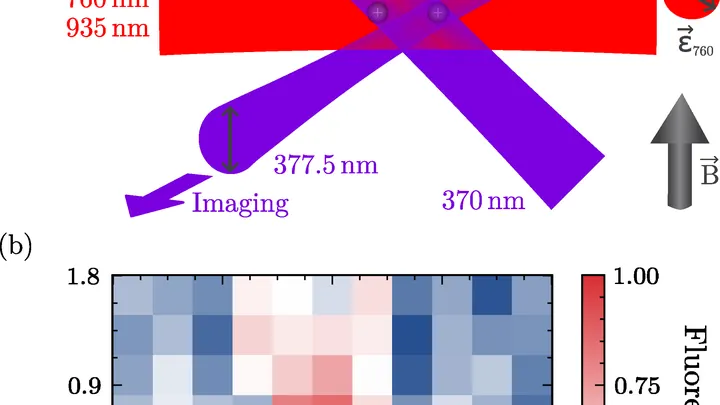
A glowing dot in a vacuum chamber refuses to go out, even though the light source has long been switched off. A single ytterbium ion, held by electric fields, is stuck in an excited state, as if the electron inside it has forgotten how to return to its usual place.
A chain of red phosphorus atoms is like a train where the cars are atoms and the couplers are chemical bonds. Sometimes the couplers are stronger, sometimes weaker, and that affects how electrons run through the train.
A laser flash hits a one-atom-thick layer of silver sitting on bilayer graphene, and within quadrillionths of a second, a gap opens in graphene's electronic structure where none existed before. It's as if an ordinary wire momentarily became a semiconductor: electrons stop flowing freely, and a band gap appears.
Lithium in a battery sometimes behaves like ivy on a building facade: instead of a uniform layer, it sprouts thin, sharp tendrils. These needles can pierce the separator inside the battery and cause a short circuit. So engineers are looking for ways to make lithium grow calmly.
One trick they've found is to put a thin silver film under the lithium.
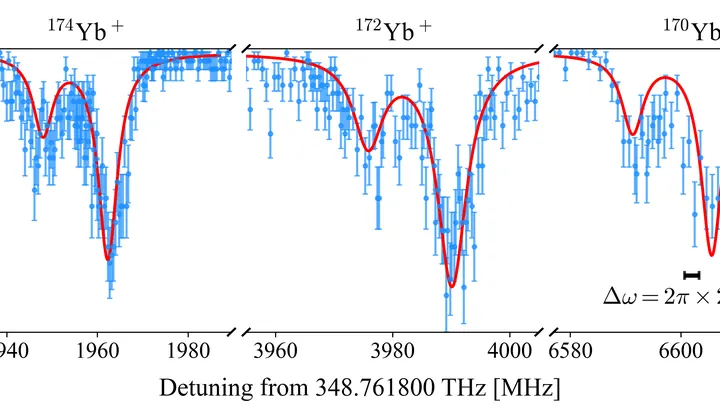
The light an atom emits or absorbs is like a fingerprint: each element has its own pattern of lines. In an ytterbium ion (an atom that has lost one electron), researchers have found three new lines that were previously unused. These lines are very narrow, like thin slits in a fence that let you see far and clearly.
Accelerators sometimes produce particles that don't fit the usual two- or three-quark scheme. Two such particles, Zb(10610) and Zb(10650), have been puzzling physicists for over a decade. They look like heavy cousins of pions, but with a clear sign of a four-quark composition. The question is how those four quarks are packed.
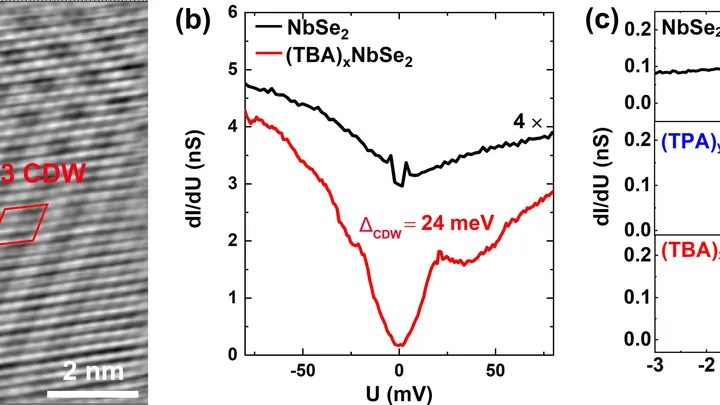
The NbSe2 crystal is like a stack of paper: layers lie tightly packed, and their properties blend together. Chemists found a way to pry this stack apart by nearly double — inserting long organic molecules between the layers like spacers. Now each layer behaves as if it were all alone, just one atom thick.
Vanadium oxide is a material that can act as an insulator, not conducting electricity, or as a conductor, like a metal. The switch takes trillionths of a second, and that's what makes it a candidate for ultrafast electronic devices.
But exactly how it happens has long been a mystery.
Two voices in a molecular duet can sound in unison or cancel each other into silence. In physics, such silence is called a dark state: a quantum excitation that does not interact with light and therefore lives unusually long.
A thin film of thorium dioxide, just 10 nanometers thick, is deposited on a steel disk. A laser pulse strikes it, but instead of the expected glow, the detector catches a stream of electrons.