A Turnstile Inside the Battery: How Lithium Crosses an Invisible Boundary
A battery film half a micron thick hides a junction that cannot be seen directly. A lithium cobalt oxide cathode and a solid lithium germanium phosphate electrolyte meet so tightly that the boundary between them is invisible. For a long time it remained unclear what happens at this junction when the battery operates: does it stay a dead seam, or does it become a turnstile letting ions pass back and forth?
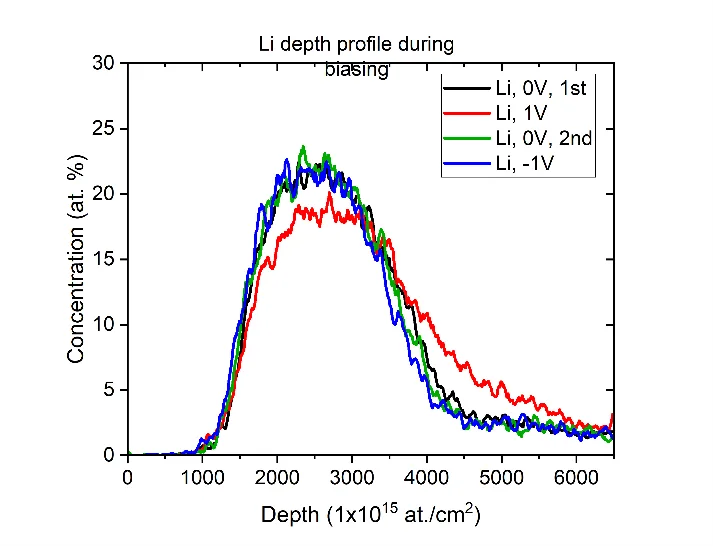
The experiment was performed on a thin-film structure Al2O3/Cu/Fe2O3/LAGP/LCO/Cu, grown by ion-beam sputtering at room temperature. The amorphous layers, free of crystalline grains, helped avoid interference from inhomogeneities. The total sample thickness was about 450 nanometers, and the working area was 5 square millimeters. First, the total lithium content was measured: 2.21±0.08×10¹⁶ atoms per square centimeter. Then a voltage of +1 V was applied to the anode, and a depth profile of the lithium distribution was taken.
The picture turned out to resemble a subway turnstile: some passengers cross to the other side, but the total number of people in the hall stays the same. At positive voltage, the lithium concentration in the cathode dropped, while at the electrolyte side of the interface it rose. Integrating the signal over the layers confirmed that the total amount of lithium is conserved within the error margin. About 9.3% of all lithium redistributed, that is, 2.06×10¹⁵ atoms per square centimeter, or roughly 1×10¹⁴ atoms over the 5 mm² area. This corresponds to a charge of 1.7×10⁻⁵ C. When the voltage was removed, the profile returned to its original state, and at −1 V lithium accumulated in the cathode again.
This result changes how we view the cathode/electrolyte boundary. It is not a passive junction or a zone of irreversible degradation, but an electrically reconfigurable ionic region. Such behavior can affect impedance, apparent capacity, and the response at low voltages before irreversible processes begin. The turnstile that lets some ions pass both ways without losses turned out to be real, and now it can be measured directly. The technique is suitable for quality control of thin-film solid-state batteries and for studying low-voltage interface responses in ionic devices right now.
A 45 MeV iodine ion beam knocks lithium out of the sample like a billiard ball hitting light balls, and from the time of flight one can reconstruct the depth from which each atom came.