The Landau distribution describes the probability of energy loss when a charged particle passes through a thin layer of matter. Unlike symmetric distributions, it has a long tail extending to high energy losses, reflecting rare but large energy transfers. It is strongly asymmetric, with a peak at low energy loss and a slow decay on the high-energy side.
History
Derived by Lev Landau in 1944 in his paper on the energy loss of fast particles in matter.
How it works
The distribution arises from the statistical fluctuations in the number and energy of collisions a particle undergoes. For thin absorbers, the most probable energy loss is small, but occasional large transfers (e.g., from knock-on electrons) create the tail. The distribution is defined by a location parameter (most probable energy loss) and a scale parameter, but has no finite mean or variance.
In practice
Used in particle physics and detector design to model energy deposition in thin sensors, such as silicon trackers, and to correct for energy loss in calorimetry.
Fun fact
Because the Landau distribution has an infinite mean, the average energy loss is not well-defined; only the most probable value is stable.
A sponge slowly watered from a watering can gets soaked all the way through. But if you dump the same bucket of water on it all at once, the middle gets wet while the edges stay almost dry. That's roughly how a material with nonlinear absorption behaves: the more intense the flux, the more it gets stuck at the point of impact.
10¹⁵ Gauss — that's the magnetic field found on some white dwarfs. It is billions of times stronger than what a compass shows on Earth. A white dwarf is not a star in the usual sense, but a cooled core the size of a planet. Inside, gravity opposes the pressure of degenerate electrons.
Glass lenses and mirrors appear perfectly smooth and still. But beneath the surface, a hidden life teems. Atoms in an amorphous material (a substance without a crystalline lattice) are packed haphazardly, and this disorder creates a complex energy landscape, like a mountainous region with countless hills and valleys.
The tau lepton is a short-lived particle, a heavy cousin of the electron. When it decays, quarks inside it exchange gluons, like players in a closed room tossing a ball back and forth. You can't see the throws themselves, only the final score: two pions flying off at certain angles.
An alpha particle is a helium nucleus that flies out when heavy atoms decay. When it hits a gallium nitride crystal, it deposits its energy and creates an electrical pulse. The pulse height tells you how much energy the particle had.
If you drop an ice cube into a glass of water, it will float until it melts. But if you cool the water slowly, at some point it all freezes at once: that's a first-order phase transition: abrupt, with a clear boundary.
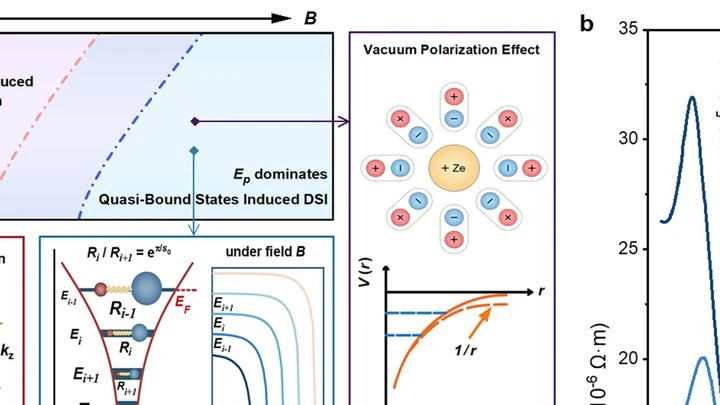
In the crystal HfTe5, electrons behave almost like light: their mass is so small that they obey the laws of relativity. If you place such a crystal in a strong magnetic field, the electrons start to circle in tiny orbits. Their energy then changes not smoothly but in steps, like floors in a building.