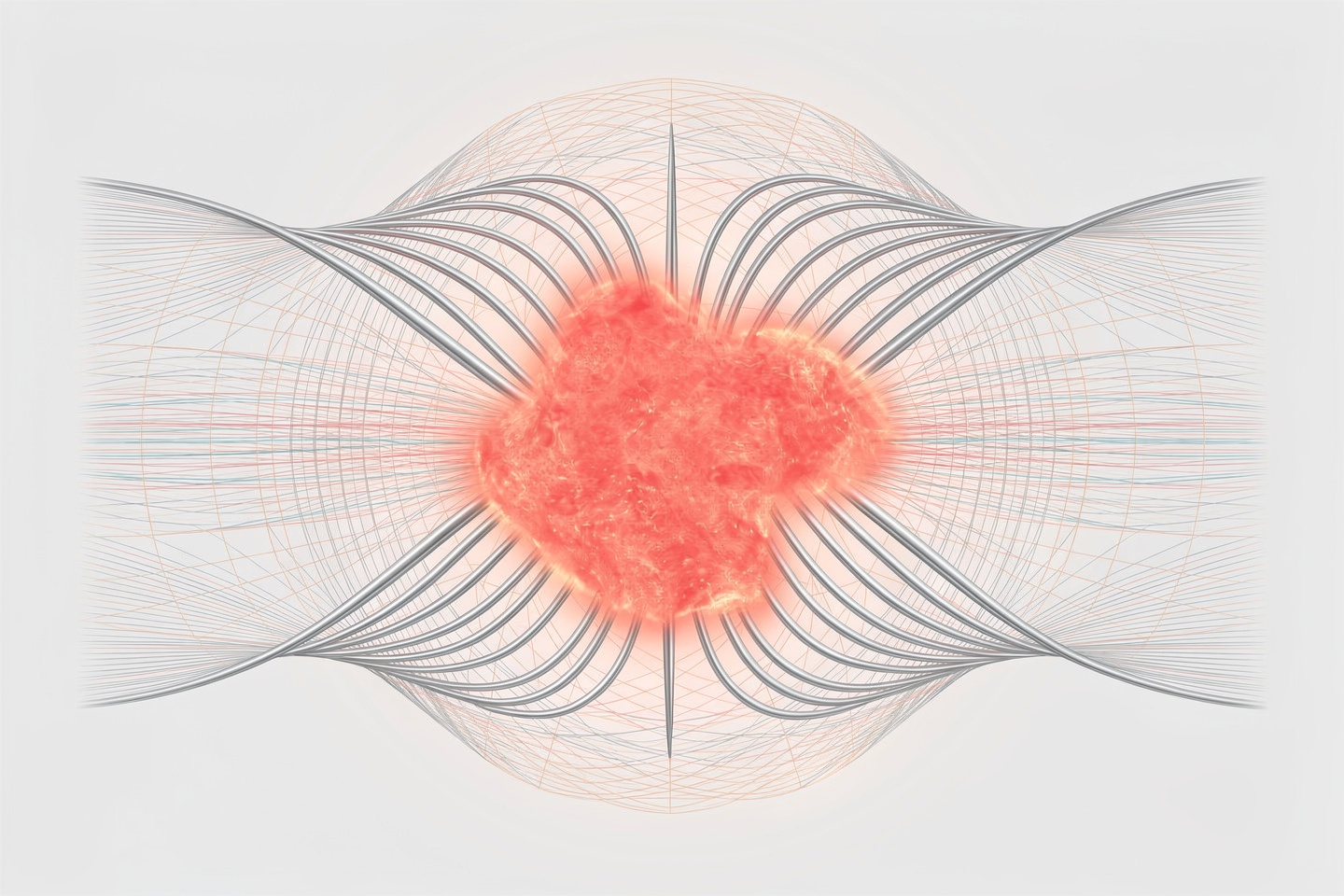
Sunlight carries energy across the void of space. Poynting's theorem reveals the balance: the energy of the electromagnetic field doesn't disappear, but either leaves across an imaginary boundary of a volume or heats the charges inside. Poynting presented the energy flow as a vector, always perpendicular to the electric and magnetic fields — like the direction of wind blowing leaves away.
How it works
Any wireless energy transfer — from cellular communications to Wi-Fi — obeys this theorem. It also describes how light heats water in solar collectors and how electromagnetic waves push charges in laser accelerators.
💡 If you point an antenna at a blank wall, the energy of radio waves reflects back, and the Poynting vector turns around. And in a microwave oven, this vector points straight into your food!
From Maxwell's equations it follows that the change in energy within a volume equals the work of the current minus the flux of the Poynting vector through the surface. John Henry Poynting in 1884 formulated this idea rigorously: ∂u/∂t + ∇·S = -J·E. The Poynting vector S = E × H indicates the instantaneous direction of energy transfer — a powerful tool for engineers determining the radiation patterns of antennas.
How it works
Any wireless energy transfer — from cellular communications to Wi-Fi — obeys this theorem. It also describes how light heats water in solar collectors and how electromagnetic waves push charges in laser accelerators.
💡 Static fields — for example, around a magnet lying on a table — have a non-zero Poynting vector! It kind of 'circulates' around the magnet, but energy isn't radiated because the flux is closed. This still causes philosophical debates about the reality of energy flow in statics.
Poynting's theorem is the energy conservation law for the electromagnetic field: the rate of decrease of energy in a volume equals the sum of the work of the field on currents and the flux of the Poynting vector through a closed surface. In differential form: ∂u/∂t + ∇·S = -J·E, where u is the energy density of the field, S = E×H is the Poynting vector. It is a direct consequence of Maxwell's equations, allowing unambiguous localization of energy flows in space.
Discovery
In 1884, John Henry Poynting, building on James Clerk Maxwell's equations, derived a relation showing that the energy of the electromagnetic field is transferred not along wires, but through the surrounding space. He introduced the concept of the energy flux vector, later named after him. Oliver Heaviside independently reached similar conclusions. The theorem became a cornerstone of radiation theory and the foundation for all modern radio electronics.
How it works
The theorem is applied in the design of antennas, waveguides, fiber-optic lines, and electromagnetic compatibility analysis. It holds rigorously for classical fields, and in quantum electrodynamics is generalized via energy operators. Limits of applicability: situations where radiation from accelerated charges or hysteresis of the medium are neglected.
Caveats
Paradoxes of the static Poynting vector: is there a real circular energy flow around a stationary magnet?; Quantum fluctuations: in vacuum electrodynamics the energy density is formally infinite, requiring renormalization.; Non-locality: the integral form of the theorem does not provide information about the details of absorption distribution inside a volume.
u — volume energy density of the electromagnetic field (in vacuum u = ε₀E²/2 + μ₀H²/2), S — Poynting vector (energy flux), J — electric current density, E — electric field strength, ∇· — divergence operator, ∂/∂t — partial derivative with respect to time.
\mathbf{S} = \mathbf{E} \times \mathbf{H}
S — Poynting vector, electromagnetic energy flux density (W/m²), E — electric field vector, H — magnetic field vector, × — cross product.
A hybrid quantum system has been proposed, combining long-lived spin memory, a fast superconducting processor, and a topologically protected mediator — a magnetic skyrmion. Its oscillations bridge the atomic world of defects with macroscopic circuits, overcoming the scale chasm. Calculations promise
Armed with a quantum magnetometer that reads nuclear spins with incredible precision, scientists hunted for exotic forces that break mirror symmetry. A tandem of rotating lead masses and a cloud of neon atoms improved previous constraints by a thousandfold. The setup works like a miniature gravitati
Quantum tunneling is not just a trick that lets electrons seep through impassable barriers. It’s a window into the deepest mysteries of reality. It turns out that an electron behaves not as a point, but as a distributed entity—something like an octopus squeezing its tentacles through a crack. This v
Contrary to the entrenched view of spontaneous emission as an incoherent process that destroys quantum entanglement, a team of physicists has theoretically demonstrated the possibility of generating near-perfect bipartite entanglement between two bright light fields. The scheme is based on a four-le
Quantum sensors based on Rydberg atoms can detect minuscule electromagnetic fields, but optical readout usually destroys almost all signal photons. Physicists from Warsaw went against the grain and deliberately enhanced nonlinear losses through dipole-dipole collisions of excitations. This paradoxic
The work shows how chirality—the property of a molecule not coinciding with its mirror image—turns a weak magnetic signal into a reliable compass. Chirality does not merely create quantum coherence, but induces spin polarization, forcing the system to endlessly 'freeze' in one state. This amplificat
By combining lithium niobate and gallium arsenide, scientists created a chip. In it, quantum dots interact with microresonator modes, and electro-optic tuning of the feedback phase drives the system to an exceptional point. At this singularity, two modes coalesce, and the spectral density of states
Superconducting qubits and optical photons are separated by a five-order-of-magnitude frequency gap. Direct qubit translation is an engineering dead end, but an architectural trick inspired by packet switching turns weak transducers into entanglement generators. Thus the quantum internet transforms
The study unites two poles of quantum cosmology: tunneling from existing space and the no-boundary Hartle–Hawking state. Numerical solutions of Einstein's equations with an axion (or magnetic) charge and a scalar field revealed a family of Euclidean wormholes—their scale-factor profile shaped like a
The cosmic microwave background not only brings a map of the early universe but also a subtle twist in polarization—just a few thousandths of a radian. For a long time, it was attributed to ultralight axions, but they clash with experiments. A new explanation is more elegant: the rotation arises whe
The weak equivalence principle has been tested with fantastic precision, but always with grounded samples — as if one string of the gravitational violin is deliberately muted. The κ parameter quantifies whether acceleration depends on electric charge: it is the ratio of the difference in acceleratio
The main obstacle for a graviton laser is that gravitational waves cannot be reflected: they pass through any substance. The solution lies in the Gertsenshtein effect. Under a powerful magnetic field, gravity particles temporarily become photons, which are easily reflected by ordinary mirrors. The r