Cosmic Crystal: How Vacuum Defects Twist Light ✛ ✎ ✦
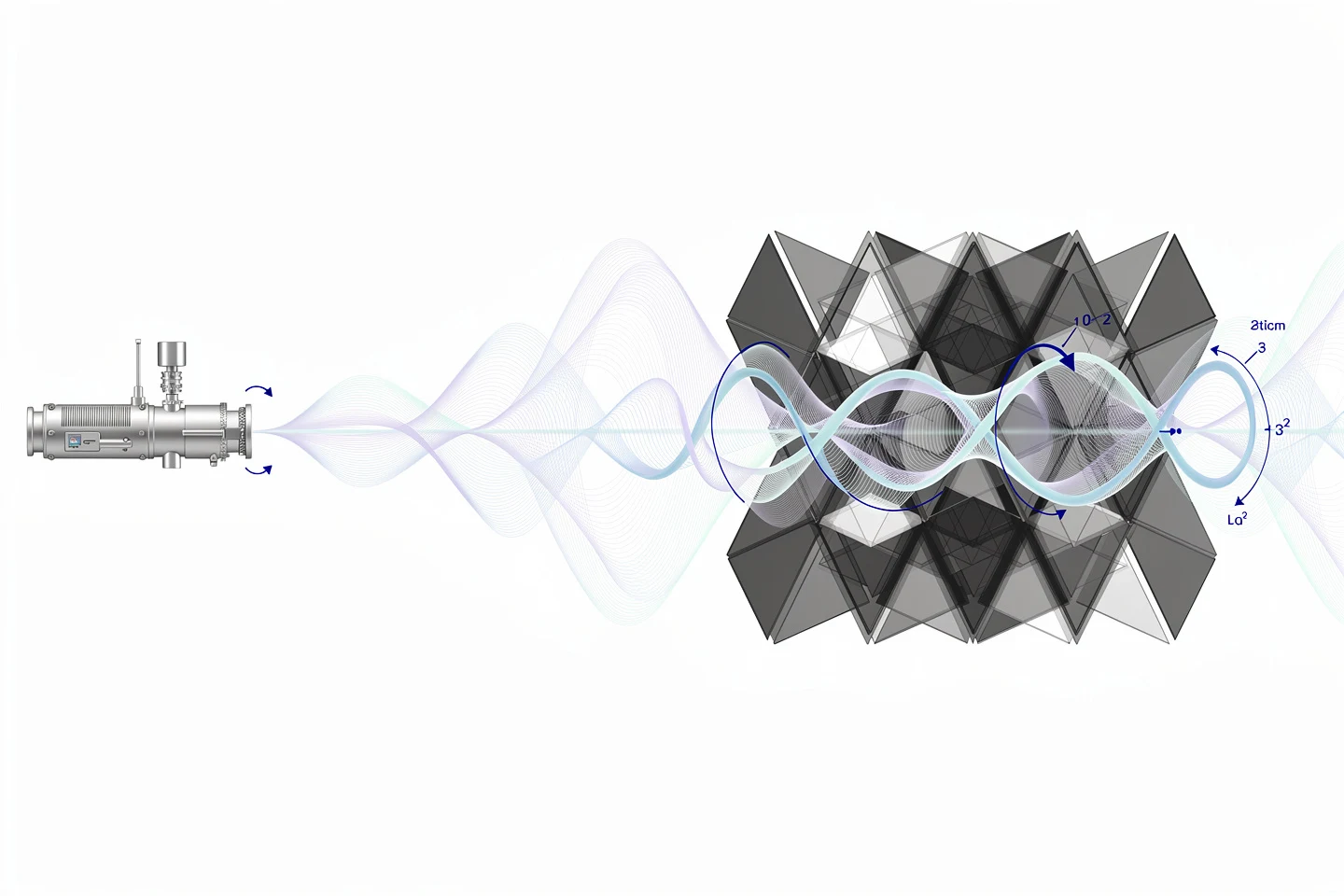
The universe is not emptiness, but a vast crystalline sphere, threaded with invisible boundaries — domain walls frozen after phase transitions. These scars on the body of the vacuum can be thinner than a hair, but when a CMB photon crosses such a wall, its polarization twists, as if the light corkscrews along an invisible threading left by the dark sector.
For a long time, axions were suspected — particles so light (m ≲ 10⁻²⁸ eV) that their field could fill the cosmos and gently rotate polarization, like ocean currents imperceptibly turning a ship. But laboratory constraints and cosmological inconsistencies forced an alternative. Now a new work offers an elegant escape: the rotation is a geometric phase, bestowed by the very structure of space.
Instead of a force, pure geometry: the photon's wave function picks up a topological "notch", whose angle is dictated only by global parameters — the coupling constant and the defect charge. Most strikingly, the rotation is frequency-independent. A radio wave, visible light, or a gamma-ray burst — all acquire the same tilt, as if passing through a single stencil. Just as one and the same stamp leaves its imprint on wax or clay. This fundamentally transforms the hunt for physics beyond the Standard Model.
The formula for this cosmic brand is simple: Δϑ = ζq/6. Here ζ is the secret coupling between dark matter and light, and q is an integer, the topological charge of the wall. Crucially, because q must be integer, the rotation cannot be arbitrary: it's quantized, like the energy of an electron in an atom. This isn't just a numbers game: for q of a few units and ζ from string theories, one gets precisely those mysterious 10⁻³ radians that the polarimetric sky maps whisper to us. An elegant coincidence bridges abstract topologies to real measurements.
This hypothesis is a revival of Wheeler's ideas, who dreamed that geometry and topology would become tangible. Decoding the polarization tapestry of the cosmos, we would get a map of vacuum cracks — a kind of tomogram of the dark realm, which reveals itself only through a micron-scale tilt of the polarization vector. To trust this map, numerical simulations of wall evolution in the expanding universe will be required.
Upcoming missions like CMB-S4 and LiteBIRD are already targeting this signal. The decisive test will be frequency independence of the rotation — from gigahertz to terahertz, without the slightest drift. If passed, axion models will fade, and physics will step into an era of topological cosmology. Then Maxwell, who gave us electromagnetism, and Lorentz, who described polarization, would be amazed: their equations, crafted for laboratory coils, became tools for mapping the very roots of reality.
Amazingly, the key to the cosmological signal was found back in 1956 by Indian physicist Pancharatnam: the geometric phase he discovered for light in ordinary media now emerges at the boundaries of the dark sector. And even if the domain walls themselves vanished long ago, their polarization shadow will forever wander in the CMB.