Quantum Symphony from Noise: How Spontaneous Emission Gives Birth to Entanglement ✛ ✦
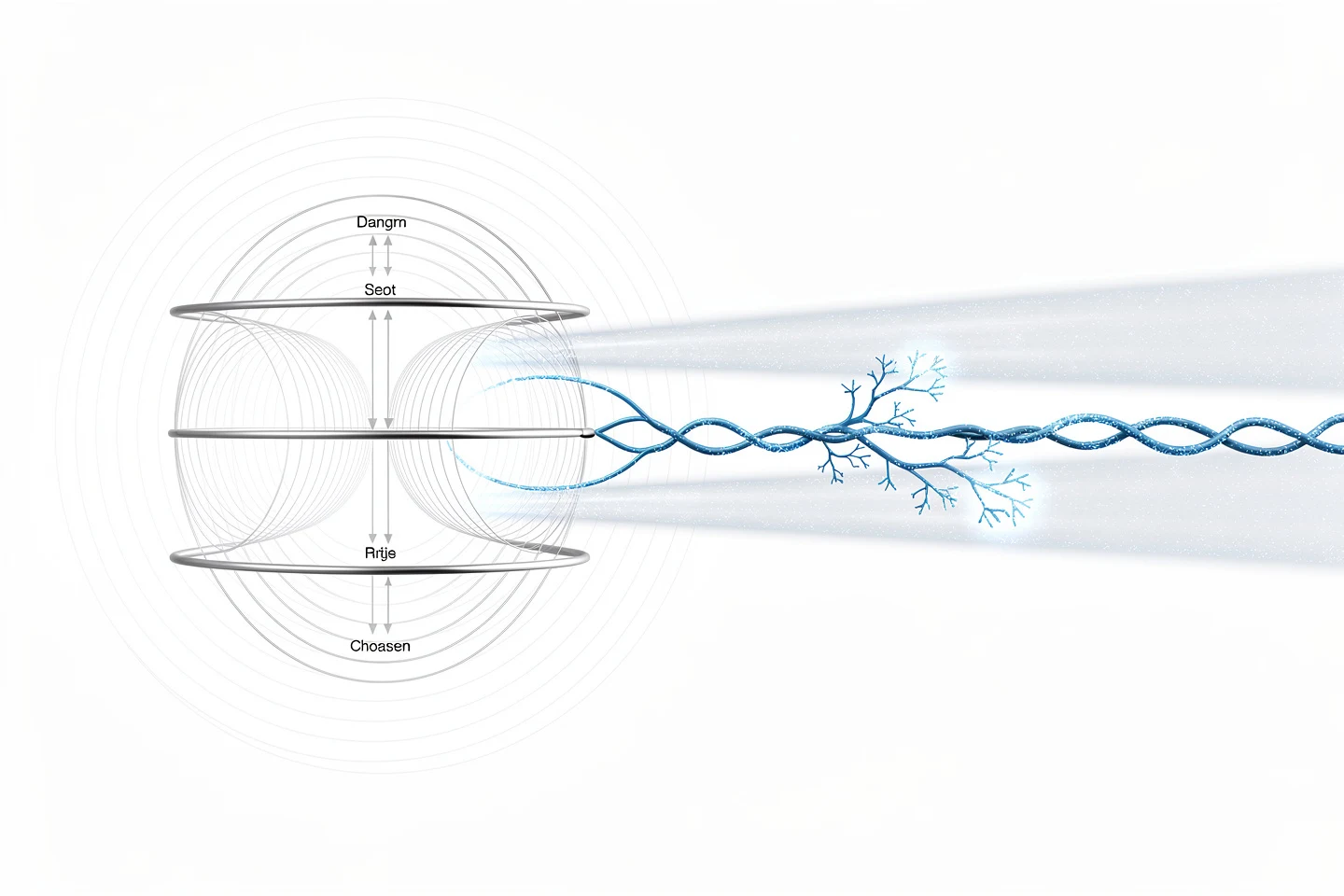
Spontaneous emission, the very process that lights up lamps and stars, has long been considered a pesky noise in quantum physics. This cacophony of random photons ruthlessly destroys fragile quantum entanglement, like radio static drowning out a distant melody. But new theoretical work shows: if you give atoms a strict score, that same noise can transform into perfect harmony — near-perfect entanglement between bright light beams.
The key to this transformation is a four-level atomic system, where two spontaneous decay channels are tuned to exact destructive interference. Imagine two sound waves meeting out of phase, canceling each other to absolute silence. Here, when the laser detunings fall exactly halfway between energy levels, the noise contributions mutually annihilate, and a coherent four-wave process takes center stage. Formally, this is described by the quadrature correlator V₁₂, which, if successful, drops to values around 0.01—almost absolute zero compared to the threshold of 4 (no entanglement). The criterion, a cornerstone of quantum optics, looks like this: V₁₂ = ⟨(δX₁ + δX₂)² + (δP₁ - δP₂)²⟩ < 4. Here δX and δP are the amplitude and phase fluctuations of the two light beams, and the angle brackets denote averaging. If their joint uncertainty is squeezed so much that the sum falls below the magic four, we have genuine nonlocal connection — the very one that first troubled Schrödinger and was later proven in the inequalities of Bell and the experiments of Aspect.
Numerical experiments paint a surprising picture: with parallel dipole moments and precise tuning, entanglement arises not in spite of spontaneous emission but because of it. Moreover, the optimal degree of correlation is achieved not in isolation from the environment but in the presence of a small transition rate between the lower states (γ₁₃ ≈ 0.1γ₁). It turns out that moderate decoherence, usually the enemy of quantum effects, here becomes a catalyst, helping the system reveal its coherent capabilities. And the entanglement is not frozen but dynamic: it pulses to the rhythm of spontaneous transitions, like the heartbeat of the system itself. It’s reminiscent of a jazz improvisation, where a slight dissonance only accentuates the overall harmony.
The discovery upends the familiar view of the role of incoherent processes in quantum optics. Instead of fighting noise, we learn to conduct it. The practical outlook is the creation of bright, narrow-band, and long-lived entangled beams, indispensable for quantum repeaters and a global quantum internet. Rydberg states of sodium atoms, spin ensembles, and in the longer term, solid-state quantum chips could become the stage for this quantum symphony. On a deeper level, the work forces us to ponder the fundamental boundary between quantum measurement and spontaneity, about how reality emerges from the interplay of fluctuations and rules. Perhaps we stand on the threshold of an era where noise becomes not a hindrance but the primary tool for weaving the fabric of light.
Complete destructive interference between two spontaneous emission channels can 'freeze' atoms in excited levels: they stop emitting even though decay is formally allowed. This quantum 'nothingness' resembles a dark state from coherent population trapping, but here it is achieved solely through the interference of vacuum modes.