Seven Lives of a Photon: Exceptional Points Control Spontaneous Emission ✛ ✦
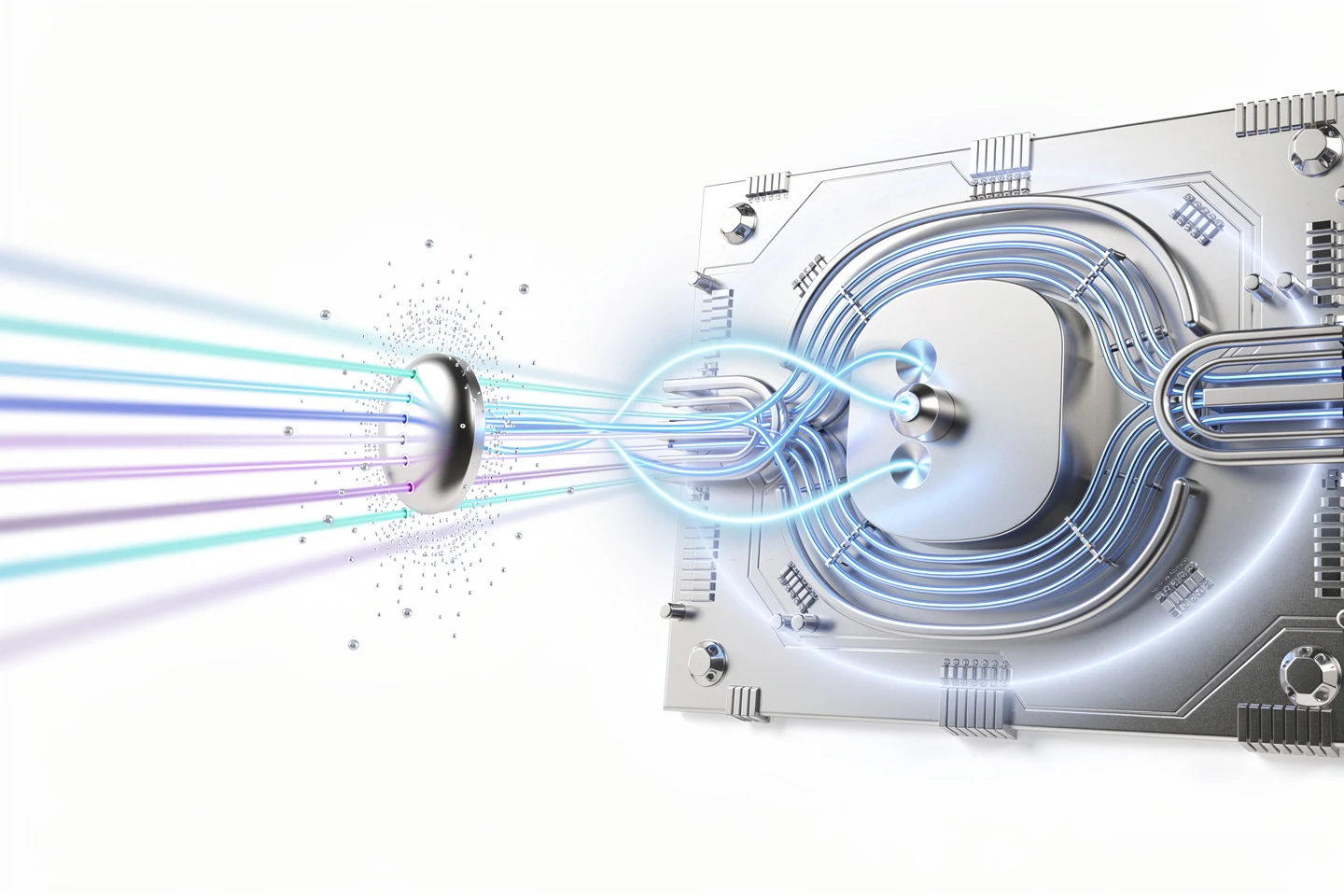
Spontaneous emission was long considered fickle: a quantum dot emits a photon, obeying only probability. The Purcell effect allowed amplifying it by placing the emitter in a resonator, but that only changed the rate, not the spectral shape. The game changed with the advent of non-Hermitian quantum optics. Here, controlled loss and gain create exceptional points — singularities where eigenvalues and eigenvectors coalesce. At such a point, the familiar pattern of standing waves breaks down, and the quantum field acquires plasticity, like a luminous matter ready to take any shape at the experimenter's will. The new work brought this idea to a chip-based realization, showing for the first time how dynamic tuning of an exceptional point controls single photons.
The heart of the experiment was a hybrid chip combining lithium niobate and gallium arsenide — materials seemingly made for the quantum stage. A ring microresonator with a 15-micrometer radius includes a Sagnac mirror and an electro-optic phase shifter. This design allows changing the coupling between counterpropagating modes with unprecedented speed. It is this coupling, tuned by voltage via the Pockels effect, pure electromagnetism in action, that brings the system to the edge of an exceptional point. The foundations were laid by the seminal work of Serge Haroche on cavity quantum electrodynamics and Roy Glauber on quantum coherence, providing the basis for manipulating single quanta.
At a feedback phase of φ = 0, the resonator becomes transparent to the emitter at the resonant frequency. The quantum dot finds itself at a node of the standing wave and goes quiet, its lifetime stretching to 850 picoseconds, while the spectrum shows a transparency effect induced by the exceptional point. When φ = π, a quadratic Lorentzian profile emerges, and the lifetime shrinks to 120 picoseconds — emission accelerates sevenfold. An intermediate phase of φ = π/2 yields a Fano-like resonance with a characteristic dip and peak. All three regimes are switched by an electrical signal on the fly. The correlation function g²(0) = 0.020(5), measured using quantum measurement, confirms strict single-photon emission — no extra quanta. Spectra obtained by high-resolution spectroscopy reproduce the theory with perfect accuracy.
This is not just elegant resonator tuning. Exceptional points allow us to deliberately sculpt the topology of the квантового поля, disrupting the familiar wave-particle duality: now we don't just sit near a node or antinode, but create them at will. Such control promises ultrafast electro-optic modulators and single-photon routers for quantum communication. The contours of all-optical quantum circuits are already emerging, where each photon is switched by voltage, and arrays of such resonators will become non-Hermitian simulators of complex quantum systems. Next step — quality factors in the tens of thousands and multiple emitters for collective effects. Beyond that — gigahertz switches at the frequencies of future quantum processors. Curiously, the method resembles sailing on the ocean: by changing the phase coupling angle, we catch or release the wind of spontaneous emission, steering the speed of photonic "ships".
Predicted in 1946, the Purcell effect long remained the only lever for controlling spontaneous emission. Exceptional points go further: now emission can be not only enhanced but also completely quenched, by manipulating field topology rather than just spectral detuning.