Universes in Wine Glasses: How Wormholes Reconciled the Irreconcilable ✛ ✎ ✦
Cosmology has long sought a loophole behind the Big Bang. Inflation, proposed by Alan Guth, stretches and smooths out primordial inhomogeneities, but what lit the fuse itself? Until recently, physicists vacillated between two extremes: either a newborn universe emerges from the frothing foam of an eternal cosmos through a wormhole, or it arises from pure 'nothing'—via a no-boundary instanton, as taught by Stephen Hawking and James Hartle. The first picture is tunneling between spaces, the second — creation without an external stage. A new class of solutions shows: it's not a choice, but two poles of a single spectrum.
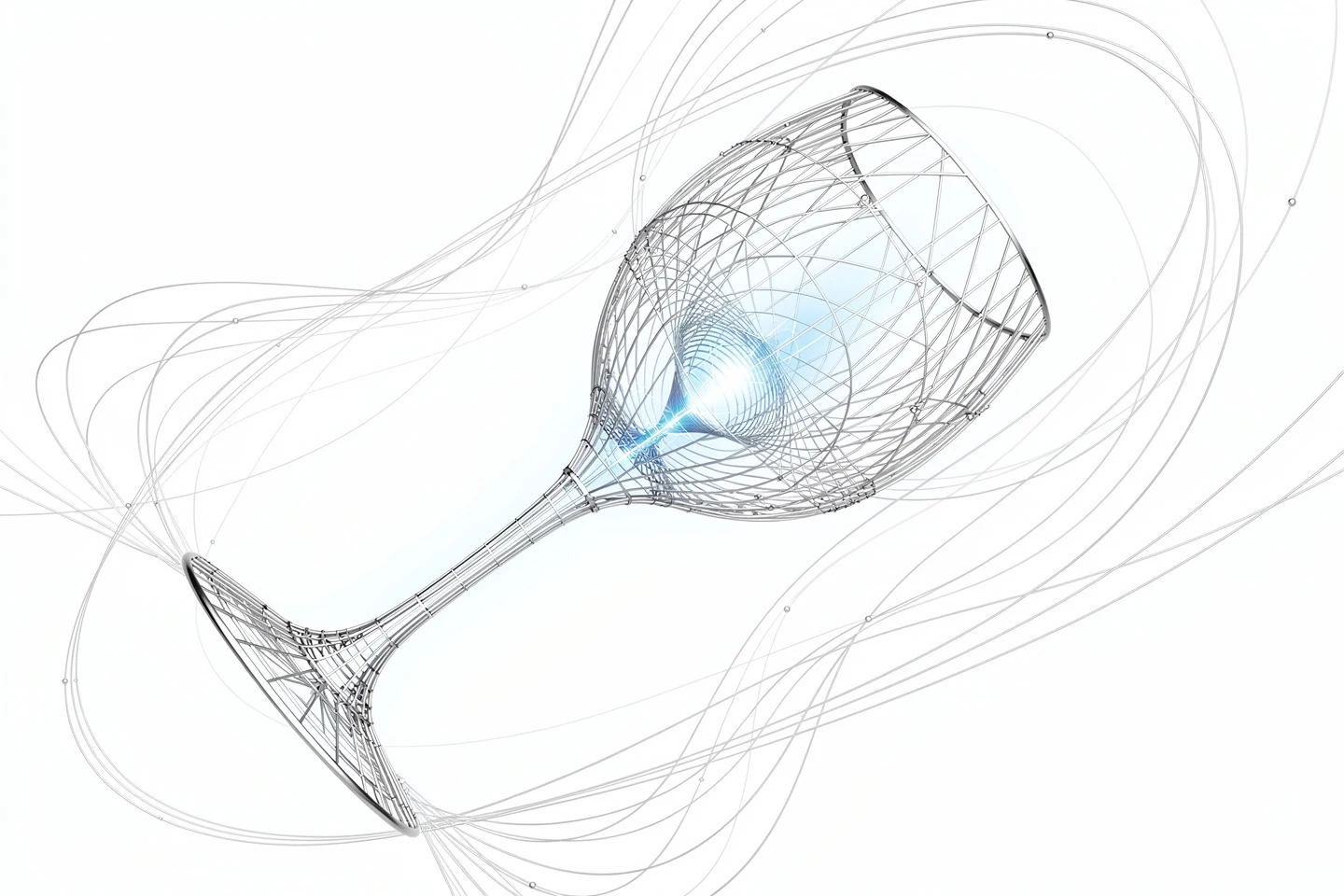
The central image is a wine glass. Mathematically, this is the profile of the scale factor a(τ), depending on Euclidean time τ. The wide bowl corresponds to de Sitter expansion — the future inflationary universe. The thin stem is the wormhole throat, where spacetime curvature soars to extreme values. The flat base symbolizes the distant asymptotics, from which (or to which?) the tunneling geometry departs. To carve such a glass from Einstein's equations, the authors added matter: a self-interacting scalar field with a potential that has a plateau and a minimum, and a charge — axion or magnetic. It's the charge that stabilizes the stem, preventing the throat from pinching off prematurely. Without it, the glass would collapse before giving birth to a universe.
This elegant transition erases the artificial boundary between tunneling and the no-boundary state. From the standpoint of quantum fields and topological fluctuations, numerous histories contribute to the wave function of the Universe, and wine-glass wormholes are a tangible realization of this idea. The next step is to compute the spectrum of primordial perturbations left by such scenarios in the cosmic microwave background and compare it with data from WMAP and Planck satellites. If the signature shows up in subtle statistical anomalies, we'll have a direct window to the very onset of expansion — to the moment when the glass just began to fill with reality.
The prospect is mesmerizing. If wine-glass wormholes are realistic, they naturally solve the initial conditions problem for inflation and embed eternal inflation within a consistent quantum cosmology. Moreover, they force us to rethink the factorization paradox in AdS/CFT and may offer a key to the measure problem — why, among the countless variants of the multiverse, the one we see is realized. From a wine glass to the fate of the cosmos — one sip of mathematics. And in that sip, there's a hint that our universe is perhaps just one of countless sparks flying out of the neck of a quantum wormhole.
The scale factor of these wormholes traces the profile of a wine glass: the wide bowl is the future universe, the thin stem is the throat, and the base is the distant asymptotic region. Hence the poetic name physicists gave their solution.
If in 'Interstellar' a wormhole is a portal to another galaxy, here it's a quantum cradle of universes, frozen in Euclidean time.