Cosmic Tango: How Spins Dance with Dark Matter ✛ ✦
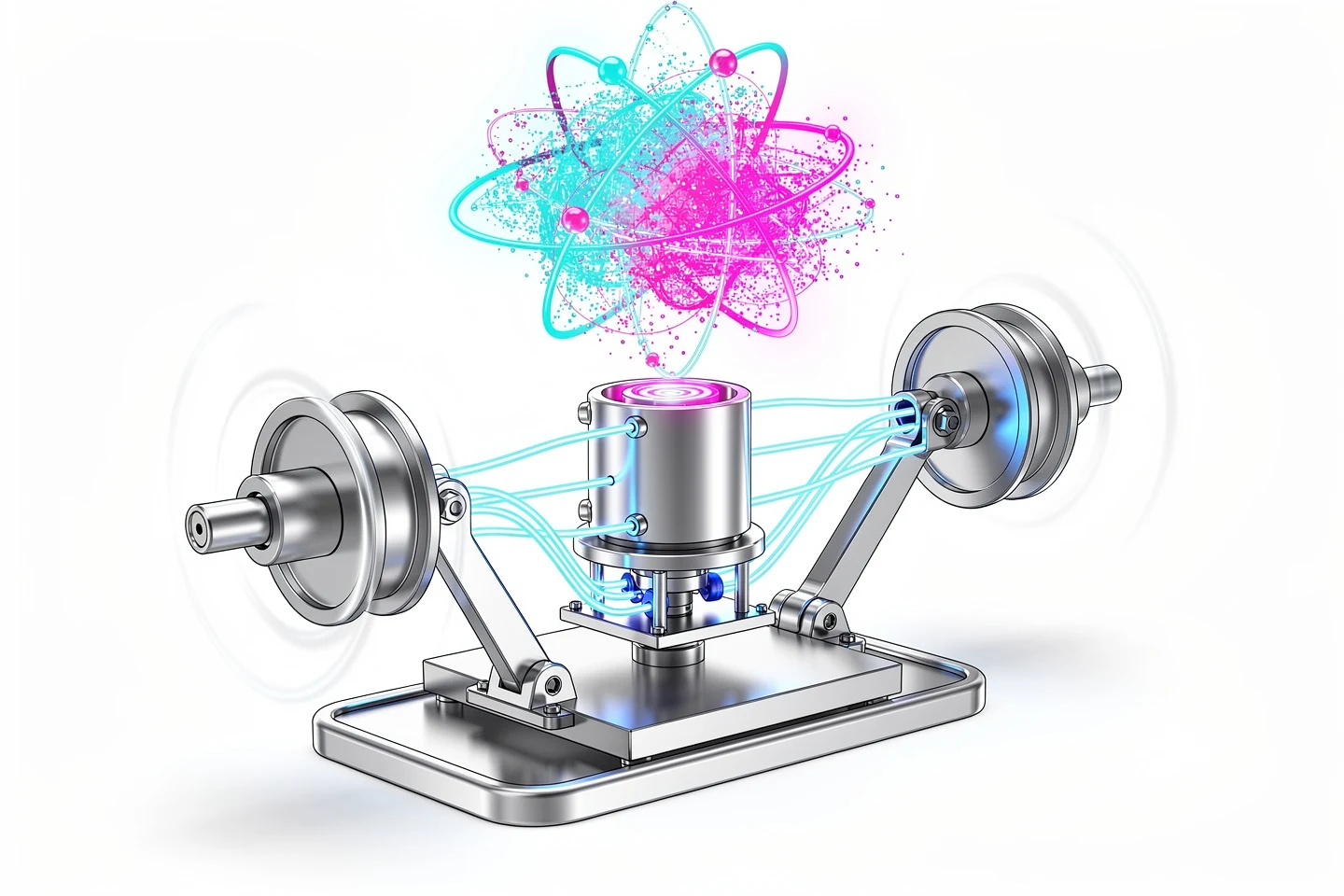
Among the fundamental symmetries of nature, mirror parity holds a special place. The Standard Model already knows one violation of it, in the weak interaction, but hypothetical long-range forces that don't conserve left and right could reveal a lot about dark matter. Their carriers could be light particles like axions, and the laboratory hunt for them has been going on for decades, so far, noise drowns out the weak signal.
An experiment at Peking University turned this cosmic whisper into a discernible rhythm. Picture a ballroom: the nuclear spins of a cloud of neon and rubidium are dancers whose movements are described by the same Pauli matrices as the electron. A pair of massive lead blocks rotates like a metronome, setting the beat. If new parity-violating forces exist, the motion of the masses generates a pseudomagnetic field, and the spins begin a silent tango at a frequency of 6 Hz — a dance that could reveal the presence of an invisible partner. The detector (a hybrid spin-resonance magnetometer, a marvel of quantum measurement) watches this dance via a spectroscopic laser beam. To stay in rhythm, the setup had to be shielded from Earth's magnetic noise and ground vibrations.
After 108 hours of data collection, the spins showed a deviation of only (1.8±4.2stat±2.0syst) attotesla. Essentially zero. But the uncertainty itself is so small that it sharply constrains any exotic force. For the neutron-nucleon coupling at a distance of 5 meters, the constant $g_A^n$ $g_V^N$ now does not exceed 2.9×$10^{-38}$—a thousandfold improvement over previous laboratory experiments. The electron-nucleon constraint also became tighter by two orders of magnitude. These numbers narrow the hiding places for models with light Z′ bosons and bring the laboratory table closer to galactic scales.
This result is more valuable than yet another null: it confirms the power of precision tabletop experiments. The broadband sensor, inheriting the ideas of Dirac and Feynman, those who taught us to test symmetries to the breaking point, opens the way to new navigation systems, the search for gravitational waves, and possibly to probing quantum gravity. The next tango will enlist squeezed spin states and machine learning to suppress quantum noise. Then we could detect forces a billion times weaker. In such silence, where you can hear the vacuum itself breathing, dark matter might finally knock on the door.
The lead blocks have a density of 11.3 g/cm³ — almost one and a half times denser than steel, making them a powerful source of virtual particles. And suppressing vibrations 700-fold is like trying to hear a whisper during a rock concert while hiding in a soundproof room.