Graviton Laser: Translating Gravity into the Language of Light ✛ ✦
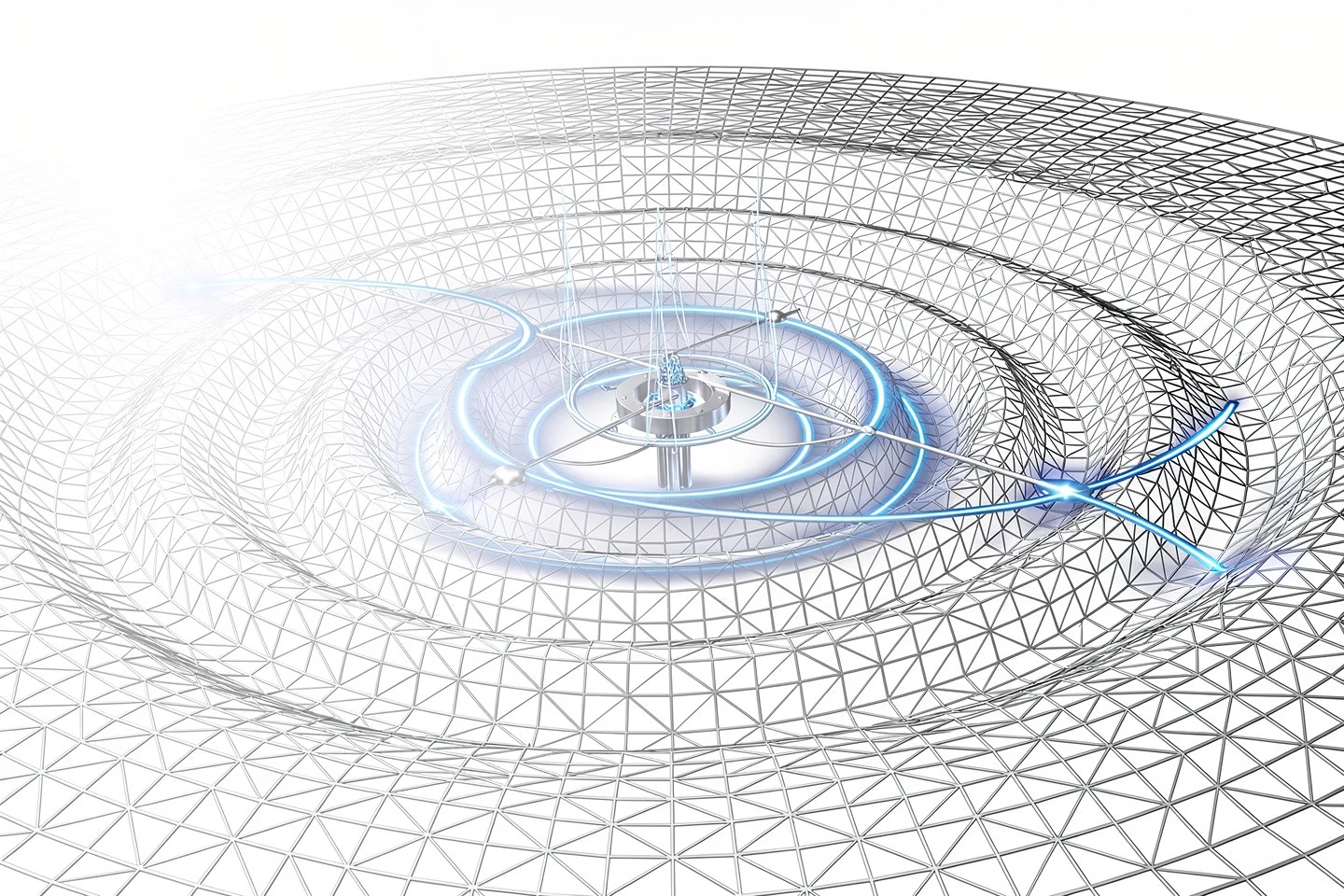
The Universe speaks two fundamental languages — gravity and light. Under normal conditions, they do not mix: gravitational waves glide through matter without a trace, while photons dance in mirror labyrinths. But in 1962, physicist Mikhail Gertsenshtein discovered that a magnetic field can act as a translator — for a fleeting moment, a graviton turns into a photon. This quantum bilingualism, where particles change their essence like actors backstage, lies at the heart of the first graviton laser.
In the quantum picture, a graviton’s wavefunction, entering a constant magnetic field, becomes a superposition — a mix of photon and graviton components. The key condition: both particles must race at the same speed of light. The conversion amplitude grows with path length and field strength, but under terrestrial conditions (100 Tesla, one meter) it is vanishingly small — about 10⁻⁴⁵. However, if the beam contains not a lone particle but a whole swarm — a typical black hole merger emits roughly 10⁷⁸ gravitons — the suppression factor vanishes like morning mist. In fields of magnetars, reaching 10¹¹ Tesla, the effect is enhanced so much that gravitons and photons mix almost freely, like two voices merging in unison.
Thus a graviton resonator is born: a photon born from a graviton reflects off an ordinary mirror, passes through a reverse converter, and becomes a graviton again. Much like in a laser, but here it's not photons being amplified, but waves of spacetime. The amplifying medium could be ultracold neutrons in a gravity field, quantum oscillators like LIGO’s mirrors, or clouds of ultralight dark matter orbiting black holes. Stimulated emission of a graviton is governed by a universal cross-section proportional to the Planck area — that very microscopic window into quantum field theory.
If such a device can be built, we will bridge the gap between gravity and electromagnetism experimentally — uniting the lines of Einstein and Maxwell. Eventually, graviton lasers could not only detect but also amplify gravitational signals, ushering in an era of quantum gravitational astronomy. Challenges of decoherence and losses in real magnets remain, but physicists are already searching for natural “seeds”— powerful bursts of gravitons from astrophysical sources. Perhaps one day we will learn to manipulate the curvature of spacetime as freely as we now modulate light — and even send the first gravitational message to the stars.
Every black hole merger produces 10⁷⁸ gravitons — more than the number of atoms in the Solar System. These particles, capable of piercing right through the Earth, barely interact with matter. The Planck area (about 10⁻⁷⁰ m²) is that microscopic target they need to hit. But when there are so many particles, even the smallest target can't resist.
In Star Trek, graviton beams tow starships, and in Greg Bear’s novel The Anvil of Stars, aliens use gravitational weapons. A laboratory graviton laser turns these fantasies into an engineering challenge — a first step toward technologies that will change our relationship with spacetime.