Lunas cálidas de planetas errantes exprés
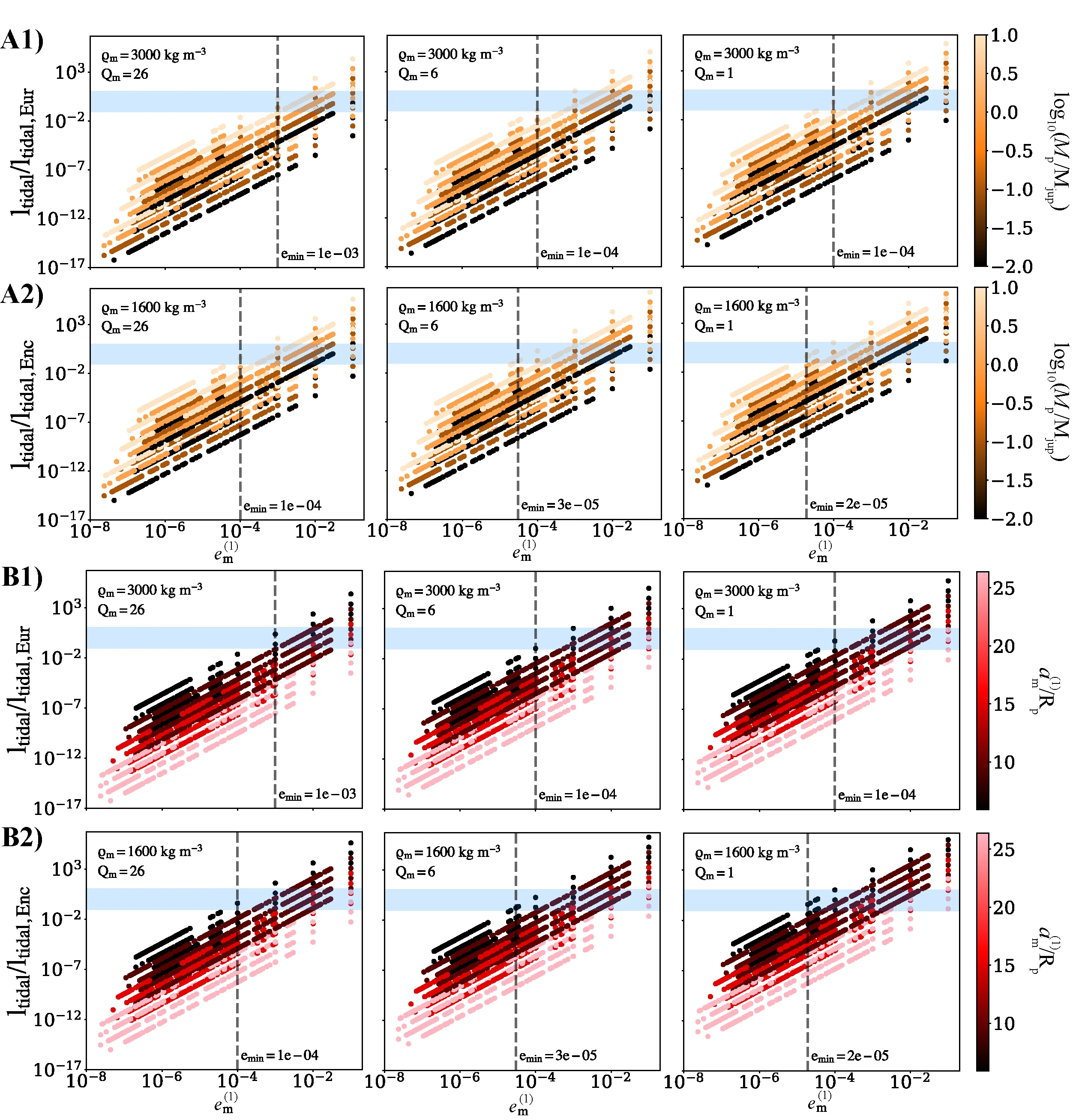
En la galaxia hay una abundancia de planetas errantes, expulsados por explosiones de supernovas. Estos planetas flotantes libres carecen de sol, pero a menudo conservan sus lunas. Las simulaciones muestran: tras la catástrofe, las órbitas de los satélites se vuelven ligeramente alargadas, y esto basta para desencadenar el calentamiento interno. En el 12–15% de los casos, la potencia de ese calentamiento es comparable a la que calienta los océanos de Europa y Encélado. Sorprendentemente, este proceso se atenúa increíblemente despacio: para las lunas situadas a más de diez radios planetarios de distancia, el calentamiento durará más de lo que ha existido el Sistema Solar. De modo que los océanos de agua bajo la corteza helada pueden permanecer líquidos durante miles de millones de años. La próxima vida extraterrestre quizá no se descubra cerca de una estrella, sino en la oscuridad perpetua del espacio interestelar.
Resumen original
tal como lo escribieron los autores, en inglés arXiv:2511.03392
Free-floating planets are thought to be numerous in the Galaxy and may retain their moons after ejection from their natal systems. If those satellites acquire or preserve orbital eccentricity, tidal dissipation could provide a long-lasting internal heat source, potentially creating urable environments (capable of enabling abiogenesis) in the absence of stellar radiation. We explore (i) whether moons remain bound to planets expelled by a core-collapse supernova, (ii) how the explosion reshapes their orbits, and (iii) under which circumstances tidal heating can sustain urable subsurface oceans. We carried out three-dimensional N-body simulations with an 8th-order Runge-Kutta scheme, modelling homologous stellar mass loss for progenitors of 10 M$$_{\odot}$$. Post-explosion orbital elements of single moons and resonant moon systems were analysed, and tidal heating power was estimated with a constant phase-lag model for several tidal dissipation functions and moon densities. All simulated moons survive the supernova and remain bound to their planets. The explosion excites moon eccentricities up to $$\sim7\times10^{-4}$$ and $$\sim3\times10^{-3}$$ for single moons of planets with circular and eccentric orbits, respectively. For resonant pairs, an eccentricity of $$\leq2\times10^{-2}$$ is preserved. The semi-major axis of the moons changes by $$\leq0.2\%$$. For 12-15\% of cases -- preferentially moons at $$a\leq15\,R_{\mathrm{planet}}$$ and with $$e\geq10^{-3}$$ -- the specific tidal heating power lies between 0.1 and 10 times what is estimated on Europa or Enceladus, sufficient to maintain liquid oceans beneath an ice crust. Eccentricity damping timescales exceed the age of the Solar System for $$a\geq10\,R_{\mathrm{planet}}$$, implying billions of years of continuous heating on the moons. Such worlds represent promising targets for future searches for extraterrestrial life.
Puede que haya más planetas errantes en nuestra galaxia que estrellas, lo que significa que las lunas cálidas con océanos en el Universo son inimaginablemente abundantes, como granos de arena en todas las playas de la Tierra.