El nudo solar que se desata solo exprés
En el Sol, con frecuencia se elevan estrechos chorros de plasma, los chorros coronales. Se asemejan a fuentes de gas incandescente que se expulsan desde la atmósfera de la estrella. Uno de estos eventos, ocurrido el 10 de noviembre de 2022, llamó la atención de los científicos: estuvo acompañado de una llamarada de clase C1.1 y presentó un cono inusualmente ancho.
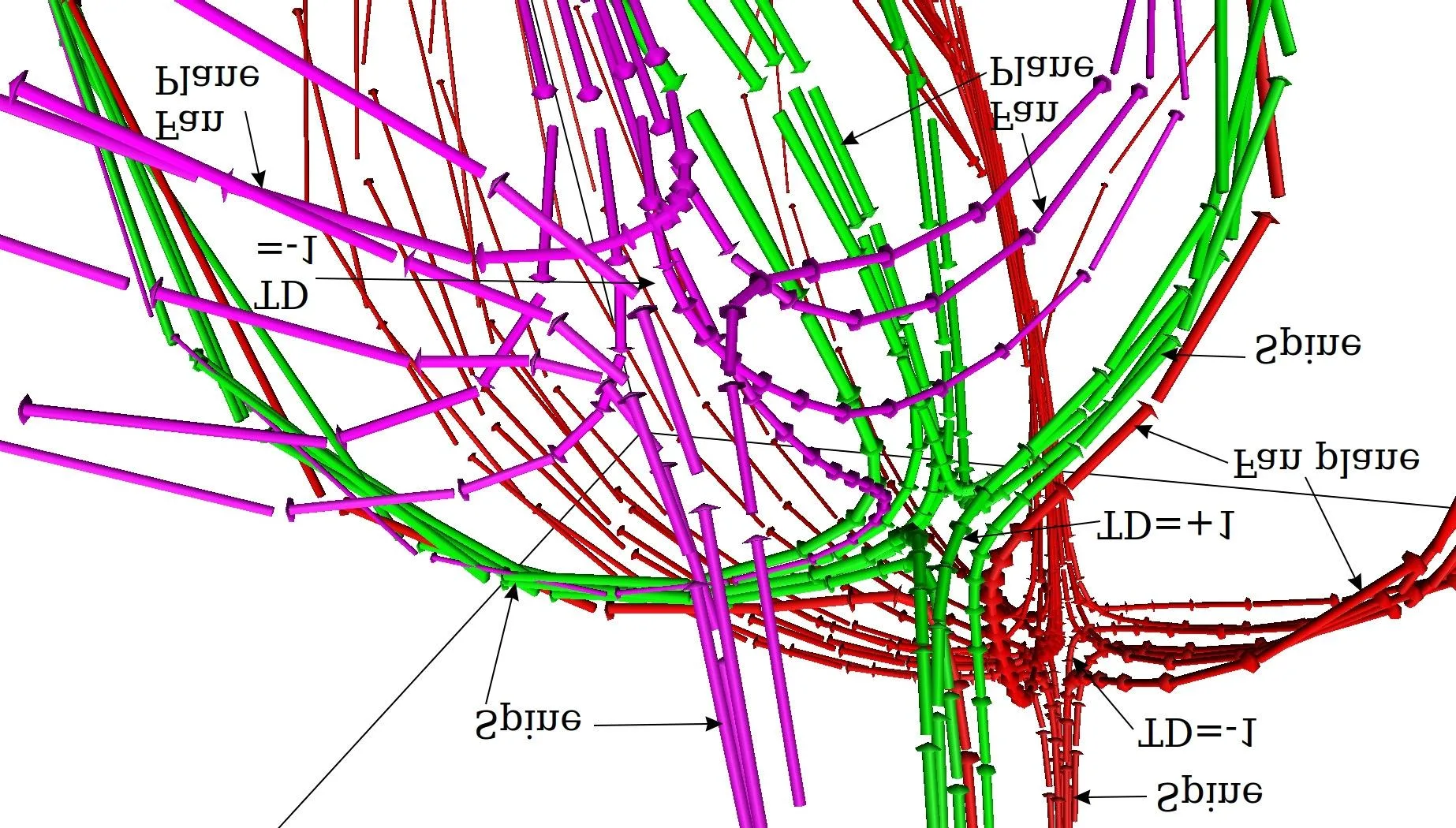
Para entender qué provocó esta fuente, los investigadores construyeron un modelo computacional del campo magnético en la región activa del Sol. En él se detectó un punto especial, un punto nulo tridimensional donde el campo magnético es cero, y una estructura magnética retorcida, un haz. Cuando el haz comenzó a moverse, las líneas magnéticas empezaron a reconectarse: se rompían y se unían de nuevo, liberando energía.
En el modelo, la reconexión generó pares de nuevos puntos nulos que inmediatamente se aniquilaron. Esta cascada fue la que desencadenó simultáneamente la eyección del chorro y la llamarada. Este comportamiento no se había observado antes en detalle, y abre una nueva dirección en el estudio de los chorros solares.
Resumen original
tal como lo escribieron los autores, en inglés arXiv:2602.01742
Coronal jets are collimated plasma eruptions which are ubiquitous in the solar atmosphere. Believed to be triggered by magnetic reconnection, these jets can contribute to various phenomena, including coronal heating and particle acceleration. Coronal jets are a contemporary area of research with their onset mechanism meriting further attention. Importantly, a subclass of jets, the blowout jets, are particularly interesting because of their broad spire, suggesting substantial three-dimensional (3D) reconnection between open and closed field lines involving 3D null points. Consequently, here we explore the onset of a blowout jet associated with Active Region (AR) SPoCA 29093 detected by Spatial Possibilistic Clustering Algorithm (SPoCA). This AR produced a C1.1-class flare on 10 November 2022 and we investigate it using a data-constrained magnetohydrodynamic simulation initiated with a non force-free-field (NFFF) extrapolation of the photospheric magnetic field. Key elements of the extrapolated field lines are the presence of a 3D null and a magnetic flux rope (MFR) co-located with the jet activity region, the evolution of which is further traced in the simulation. The simulation suggests that magnetic reconnection is responsible for the evolution of the MFR, leading to a near-simultaneous onset of the flare and jet as observed by the AIA/SDO. In particular, the simulation shows spontaneous creation and annihilation of 3D null pairs via magnetic reconnection near the jet region. Such spontaneous null pair generation, in principle, can trigger or contribute to coronal jets; opening up a new avenue for further research.
Los chorros coronales pueden acelerar partículas hasta altas energías, contribuyendo al viento solar y al clima espacial.