La luz que se ajusta sola exprés
Cuando dos rayos de luz se encuentran en un cristal, pueden generar un tercer rayo con una frecuencia diferente. Para que este proceso sea eficiente, las ondas deben ir al mismo paso, como dos personas que caminan juntas sin desincronizarse. Antes se usaban dos trucos: o se elegía un cristal con las propiedades adecuadas, o se cortaba en capas finas. Ambos métodos se idearon hace más de sesenta años y cada uno tiene sus limitaciones.
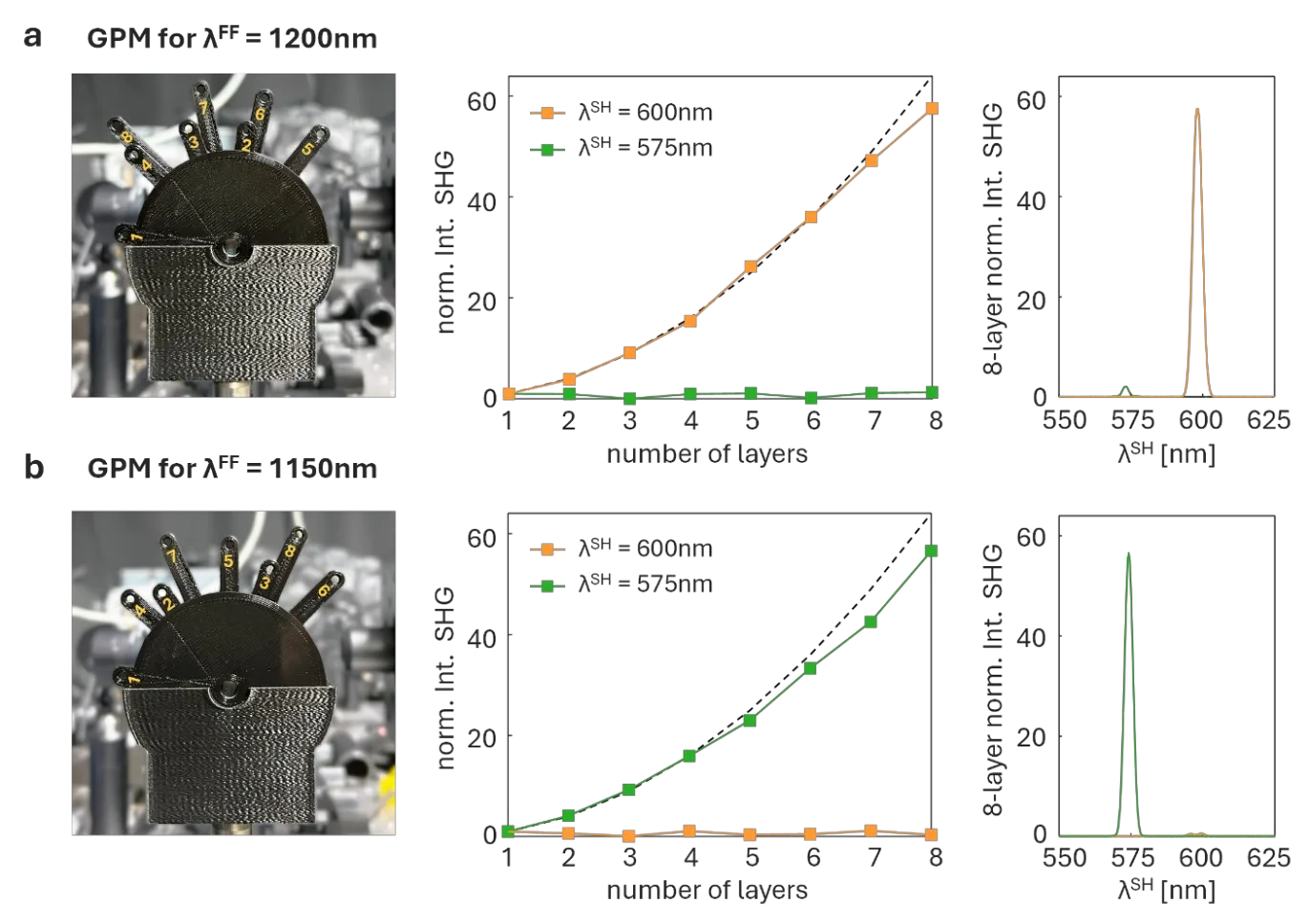
Los autores del estudio proponen una tercera vía. Apilan finas láminas de cristal unas sobre otras y giran ligeramente cada una. Este 'pastel de capas' permite controlar el paso de las ondas de luz sin cambiar el material en sí. En el experimento, apilaron ocho capas y lograron un ajuste casi perfecto del paso. Y con una pila de dos capas pudieron encender y apagar por completo la generación del nuevo rayo.
Este enfoque hace que los dispositivos para mezclar luz sean flexibles: el ajuste se puede modificar sobre la marcha. Esto podría ser útil en láseres, dispositivos cuánticos y nuevos materiales que controlan la luz.
Resumen original
tal como lo escribieron los autores, en inglés arXiv:2602.18418
Phase matching is essential for efficient energy transfer in nonlinear wave-mixing processes. Traditional methods, such as birefringent and quasi-phase matching, have remained conceptually unchanged since their discovery over 60 years ago, each posing inherent constraints and limitations. Here, we demonstrate the concept of geometric phase matching as a new paradigm for tunable nonlinear wave mixing, based on a multilayered platform of nonlinear thin-film crystals. We leverage this concept to experimentally show reconfigurable and spin-controlled phase matching for second-harmonic generation (SHG), opening new avenues for real-time manipulation of nonlinear interactions in photonic devices. We specifically demonstrate full modulation of SHG from a bilayer structure, nearly perfect and tunable geometric phase matching from an eight-layer structure, and polarization tomography that reveals the evolution of the spin dependent interaction. This approach not only expands the design space for nonlinear optical processes but also paves the way for highly robust, tunable and efficient frequency conversion, for next-generation adaptive nonlinear photonic, quantum photonic and nonlinear optical metamaterial technologies based on thin-film crystals.
Una pila de ocho finas láminas de cristal, de grosor menor que un cabello humano, puede reemplazar un voluminoso sistema de lentes y prismas.