Vía Láctea y Andrómeda: fusión con un 90% de probabilidad exprés
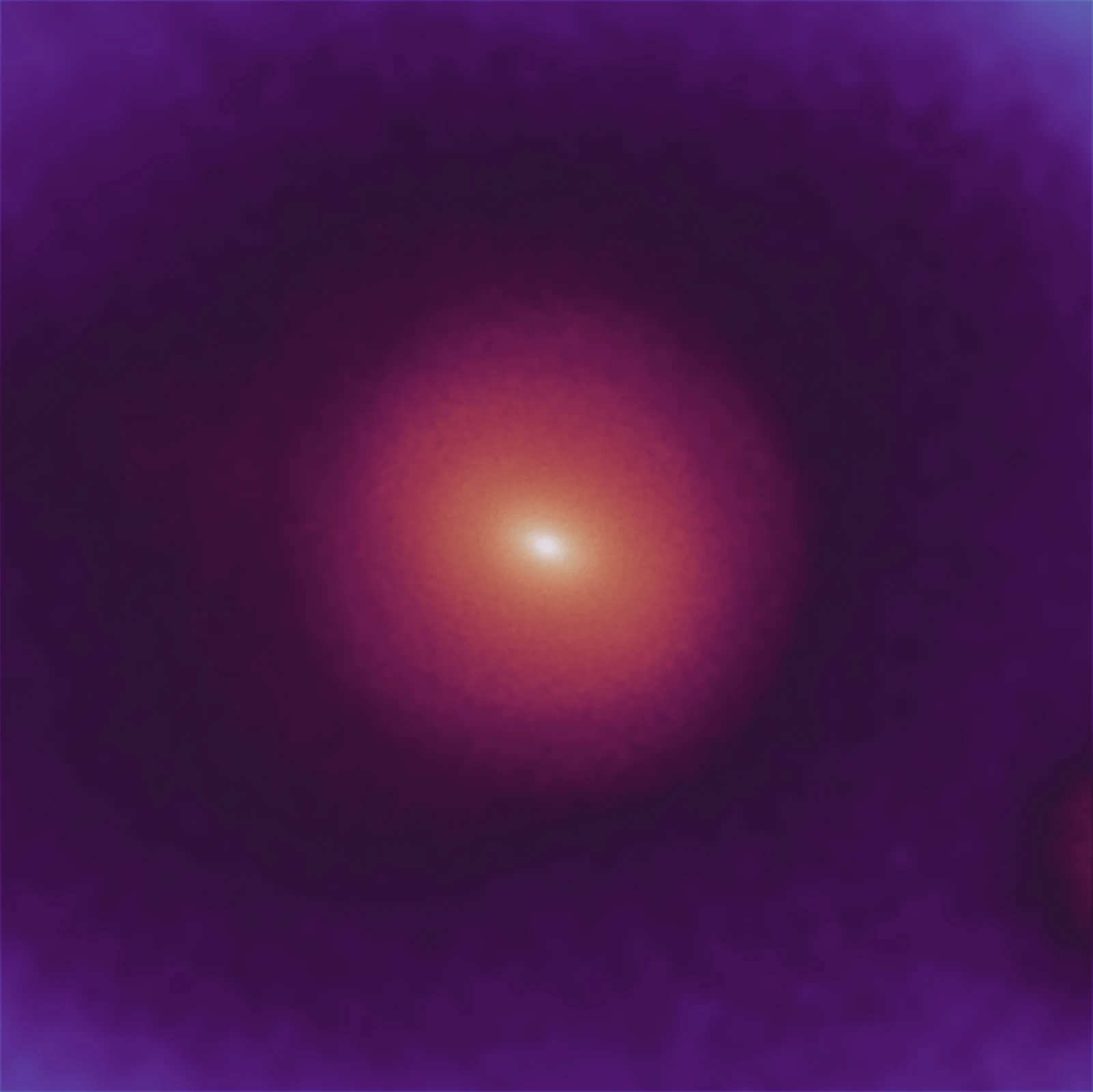
La Vía Láctea y la galaxia de Andrómeda son como dos enormes bandadas de pájaros que se acercan en la inmensidad del cielo. Los nuevos datos del telescopio Gaia muestran que Andrómeda apenas se desvía lateralmente. La probabilidad de que se fusionen es de un contundente 90%. Incluso la más ligera brisa lateral podría haber desviado sus trayectorias, pero los cálculos indican que casi no existe.
La trayectoria también se ve influida por satélites más pequeños: la Gran Nube de Magallanes y la galaxia del Triángulo. Con su gravedad, empujan ligeramente a las protagonistas, como pájaros de bandadas vecinas que ajustan sin querer el rumbo común. Aquí la gravedad no es magia, sino una manifestación de la curvatura del espacio-tiempo, similar a la deformación de una tela tensa bajo el peso de unas bolas. Y la invisible materia oscura añade masa a esa tela, dirigiendo el movimiento.
Dentro de 6500 millones de años, las galaxias se fusionarán en un único sistema. El cielo terrestre cambiará, pero la colisión en sí es segura: las estrellas están tan dispersas que pasan libremente unas junto a otras.
Resumen original
tal como lo escribieron los autores, en inglés arXiv:2603.22863
It has long been predicted that the Milky Way (MW) will eventually merge with Andromeda (M31), a view reinforced by \textit{HST} measurements indicating a small M31 transverse velocity. However, using updated \textit{Gaia}-based proper motions (PMs) and including the dynamical influence of the Large Magellanic Cloud (LMC) and M33, Sawala et al. reported an MW--M31 merger probability of $$\sim$$50\% within 10 Gyr, leaving the fate of the Local Group (LG) uncertain. Adopting their semi-analytic framework, we revisit this problem with the latest and most precise \textit{Gaia}-based PMs for M31 and M33, corrected for systematic offsets in \textit{Gaia} astrometry. In our fiducial model, the MW--M31 merger probability rises to 90\%, with a median merger time of $$6.5_{-1.5}^{+1.3}$$ Gyr, broadly restoring the classical picture. A sensitivity analysis shows that the merger probability depends strongly on the adopted M31 PM through two channels: a direct effect via the radial-tangential balance of the MW-M31 orbit, and a satellite-mediated effect, where the M31 PM fixes the orbital plane and determines how satellite-induced barycentric reflex motions project onto it, either promoting or suppressing a merger. Given this sensitivity, current measurements, while favoring a high merger probability, remain inconclusive, spanning from 64.7\% to 100\% across the 2$$\sigma$$ PM region. Future PM measurements with uncertainty of $$\lesssim2\,\upmu\mathrm{as\,yr^{-1}}$$ will be required to reach a firm conclusion, i.e., to constrain the probability range within 10\% at the 2$$\sigma$$ level.
La fusión de galaxias no destruye, sino que crea: del gas y el polvo nacen millones de nuevas estrellas, como un fuego artificial que dura miles de millones de años.
En la ciencia ficción, como en la serie «Star Trek», estas fusiones a veces se presentan como campos de batalla. Pero en realidad no es un choque, sino una mezcla lenta, como si dos inmensas bandadas de pájaros se unieran en una sola.