Yang Huang

6 articles · 23 co-authors · latest: 2026-09-13
74 citations · h-index 5 · 15 papersData: Semantic Scholar

We have retold 6 papers by this author. 1 of them with a full read. most often about: cosmic dust, interstellar medium, molecular cloud. 23 co-authors across our retellings.

Links in the knowledge graph
Galaxies2026-01-062 minarXiv:2601.02724express
The Milky Way's Dust Settles into Two Layers
Dust in space is not just grime: it's the raw material for future stars and planets. But how it is distributed in our galaxy has long been a puzzle: dust is hard to measure directly, and it blocks the light of distant stars. Now astronomers have peered through this veil using data on five million stars: their brightness, color, and precise positions in the sky.
Galaxies2026-03-141 minarXiv:2603.13860express
Dust Maps of the Magellanic Clouds
Light from a distant star cuts through dust like a flashlight beam through fog. Dust holds back blue rays more than red ones, making the star appear redder than it really is. From this reddening, astronomers gauge how much dust lies in the light's path.
Galaxies2026-03-241 minarXiv:2603.22863express
Milky Way and Andromeda: A 90% Likely Merger
The Milky Way and the Andromeda Galaxy are like two vast flocks of birds drawing together in the celestial expanse. New data from the Gaia telescope shows: Andromeda barely deviates sideways. The chance of their merger is a whopping 90%. Even the gentlest crosswind could steer their paths apart, but calculations say: it’s almost nonexistent.
General Relativity2026-05-271 minarXiv:2605.28376express
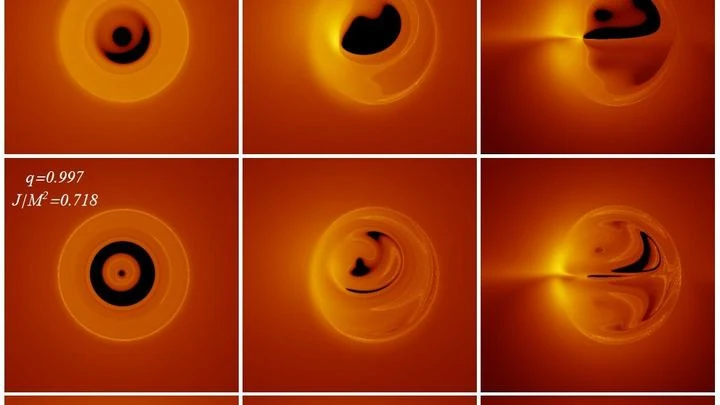
Shadow of a Shaggy Beast: How Scalar Hair Shatters a Black Hole’s Image
A black hole isn’t a perfectly smooth ball. Einstein’s theory allows invisible 'hair' — clumps of scalar field — to swarm around it, warping spacetime. The shadow — the dark region from which light can’t escape — was predicted by Penrose in the 1960s.
General Relativity2026-08-092 minarXiv:2608.08711express
Energy from the void: how a star without a black hole amplifies light
A black hole pulls in anything that gets too close. But if you toss in not one object but a pair, one of them can fly back out, carrying off some of the hole's rotational energy. This trick, devised by Roger Penrose in 1969, works only because a black hole has a horizon — a boundary beyond which nothing returns. Now it turns out the horizon isn't necessary.
Galaxies2026-09-133 minarXiv:2609.14342
A Neural Network Reads the Pulse of Variable Stars
An old lighthouse at the edge of the harbor blinks with the precision of a clockwork mechanism. Every few hours its lamp flares and dims, and sailors recognize that rhythm from afar, using the strength of the light to tell where the shore lies.