Calor al límite: cómo medir un fuego de 3000 grados exprés
Un trozo de metal al rojo vivo en un horno es como una sartén en la cocina: cuanto más fuerte es el calor, más rápido se transmite a la mano si la tocas. Pero a temperaturas en las que el metal ya está cerca de fundirse, medir esa velocidad es muy difícil: los sensores no se adhieren bien, el calor se escapa al aire y la propia muestra brilla y confunde los instrumentos.
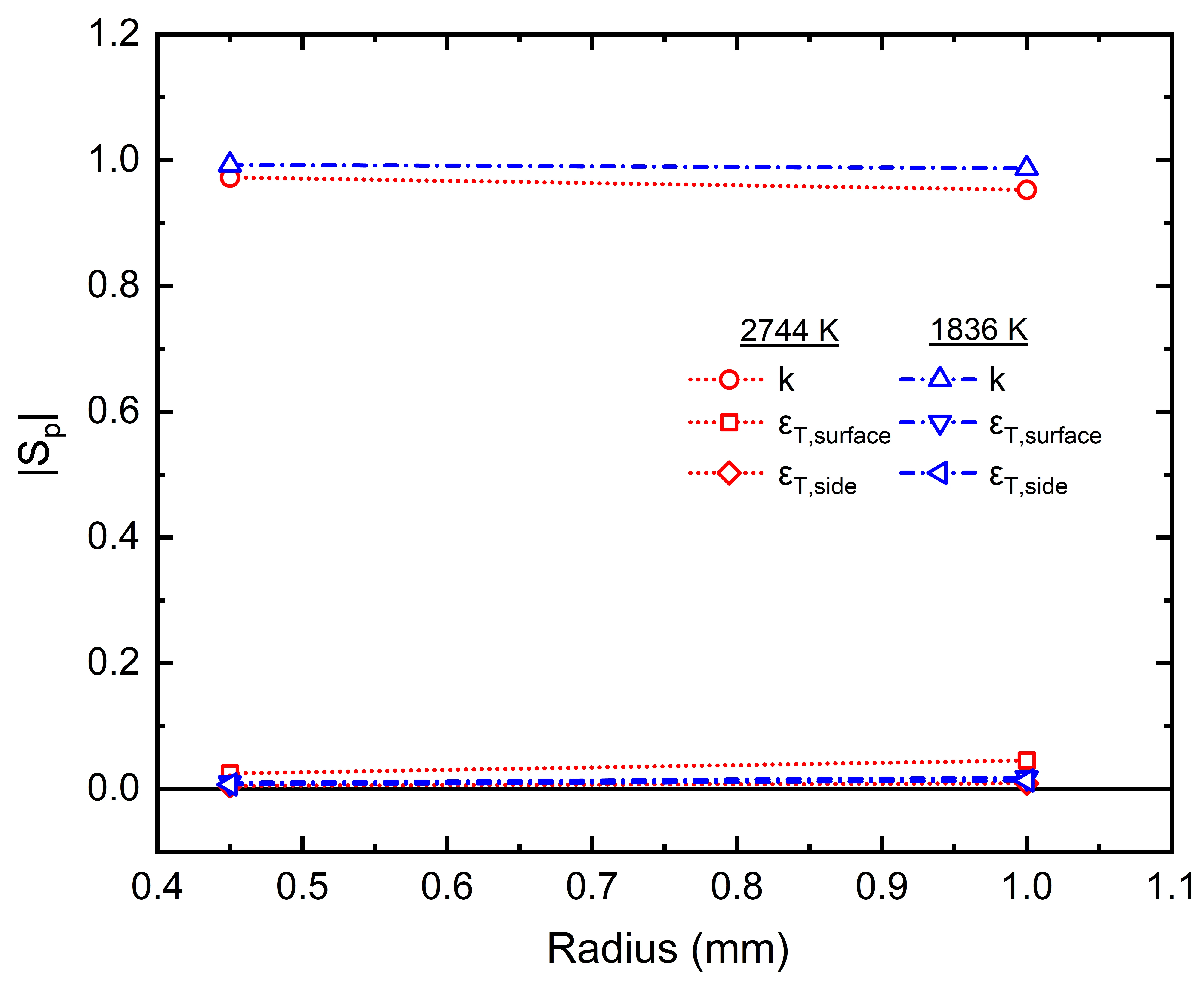
El nuevo método sortea estos obstáculos. Un láser incide en un punto diminuto de la superficie y una cámara infrarroja observa cómo se propaga el calor desde allí. Por la diferencia de temperatura entre el punto de calentamiento y el resto del metal se puede calcular lo bien que el material conduce el calor. Es como estimar la fuerza de una piedra lanzada al agua por las ondas que genera.
El método también permitió medir cómo el molibdeno emite luz en estado sólido y líquido. Estos datos son necesarios para fabricar piezas que trabajan en calor extremo: en aviones hipersónicos, reactores nucleares y en la impresión 3D con láser de metales.
Así, un trozo de metal incandescente deja de ser un misterio: ahora sus propiedades térmicas pueden conocerse con precisión sin tocarlo.
Resumen original
tal como lo escribieron los autores, en inglés arXiv:2604.09873
Advances in next-generation hypersonic hot structures, high heat-flux fusion or fission components, and laser based additive manufacturing depend on reliable solid state thermal conductivity data at high and ultrahigh temperatures, where conventional measurements become increasingly sensitive to contact resistances, uncertain boundary conditions, and nonlinear radiative losses. Building on our initial demonstration of ultrahigh temperature steady-state temperature differential radiometry (SSTDR), we present a substantially more robust platform aimed at making high temperature thermal and radiative property measurements more routine. The method integrates lock-in infrared thermography with a spatially localized, modulated perturbation laser to form a conduction dominant differential observable along with hyperspectral pyrometry and a validated 2D axisymmetric steady state heat transfer model. Using high purity molybdenum as a benchmark, we report solid state thermal conductivity k(T) from 1500 - 3000 K (to the onset of melting) with uncertainties of 7.9-11 % enabled by comprehensive uncertainty propagation, sensitivity analysis, and bounding studies. We additionally provide normal spectral emittance of molybdenum in both solid and liquid states over 500-1000 nm. These advances establish SSTDR as an accurate, non-contact route for closing the high temperature k(T) data gap while simultaneously producing much needed phase dependent radiative property data for melt adjacent and extreme heat-flux applications. Note: This is a shortened abstract; full version in manuscript.
El molibdeno se funde a 2623 °C, más que la temperatura de la superficie de Venus, el planeta más caliente del sistema solar.