La misteriosa huella en la superficie de Titán exprés
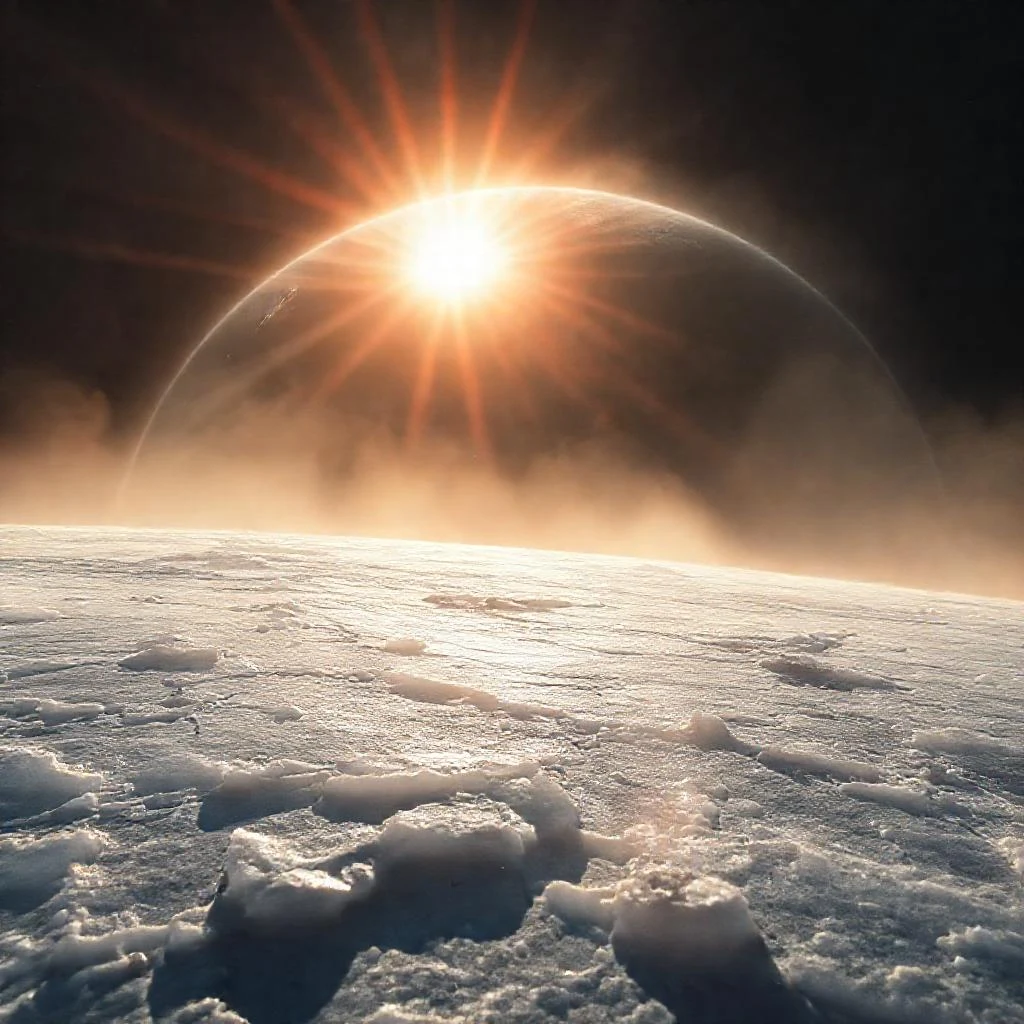
La atmósfera de Titán, descubierto por Christiaan Huygens, es opaca para los telescopios ordinarios. Pero el análisis espectral encuentra 'ventanas' de transparencia — regiones estrechas donde la neblina se abre. El James Webb apuntó a esa ventana y registró una banda oscura — como si la superficie hubiera dejado su 'autógrafo' químico. Esta huella absorbe luz térmica en una frecuencia que no es propia ni del hielo de agua ni del de dióxido de carbono. Sorprendentemente, un autógrafo idéntico, solo que más ancho, se encontró también en Plutón. Ningún laboratorio terrestre ha podido reproducir un patrón similar por ahora. Quizás el frío cósmico da origen a sustancias que aún tenemos que sintetizar. Hallazgos como este convierten los mundos lejanos en capítulos de una única historia química del sistema solar.
Resumen original
tal como lo escribieron los autores, en inglés arXiv:2606.13350
Titan possesses a thick N$$_2$$-CH$$_4$$ atmosphere that makes it difficult to study its surface spectroscopically. The chemical composition of the solid surface of Titan thus remains very uncertain. By leveraging JWST's high sensitivity and large spectral coverage, we searched for any signature from Titan's surface in the broad and less explored 5-$$\mu$$m atmospheric window. We also investigated the JWST spectrum of Pluto which has a thin Titan-like atmosphere. We made selections of JWST NIRSpec and MIRI spectra around Titan's disk center and compared the NIRSpec average spectrum with a radiative transfer model including gas and haze opacity. We detected an unidentified absorption in both NIRSpec and MIRI spectra of Titan centered at 5.113 $$\mu$$m (1956 cm$$^{-1}$$) and 6-7% deep. The width of the feature is 0.024$$\pm$$0.0008 $$\mu$$m (9.2$$\pm$$0.3 cm$$^{-1}$$) in the NIRSpec spectrum recorded on the trailing side and is possibly 25% narrower in the MIRI spectrum of the leading side. This absorption most likely originates from the surface. We could not identify this signature among published laboratory spectra of ices relevant to Titan's atmospheric compounds but present a few plausible candidates. A 4-5% deep absorption is also present in the MIRI spectrum of Pluto but is about 3 times broader than on Titan's trailing side.
Una absorción de solo el 6% es como notar que las gafas de sol más transparentes apenas oscurecen la luz. El James Webb captó esto desde mil quinientos millones de kilómetros de distancia.
En la novela de Arthur C. Clarke 'Tierra Imperial', Titán abastece a la humanidad de metano. Hoy, la ciencia real descubre en él misteriosas huellas químicas que guardan el registro del nacimiento de los planetas.