Por qué incluso un aparato pesado tiembla exprés
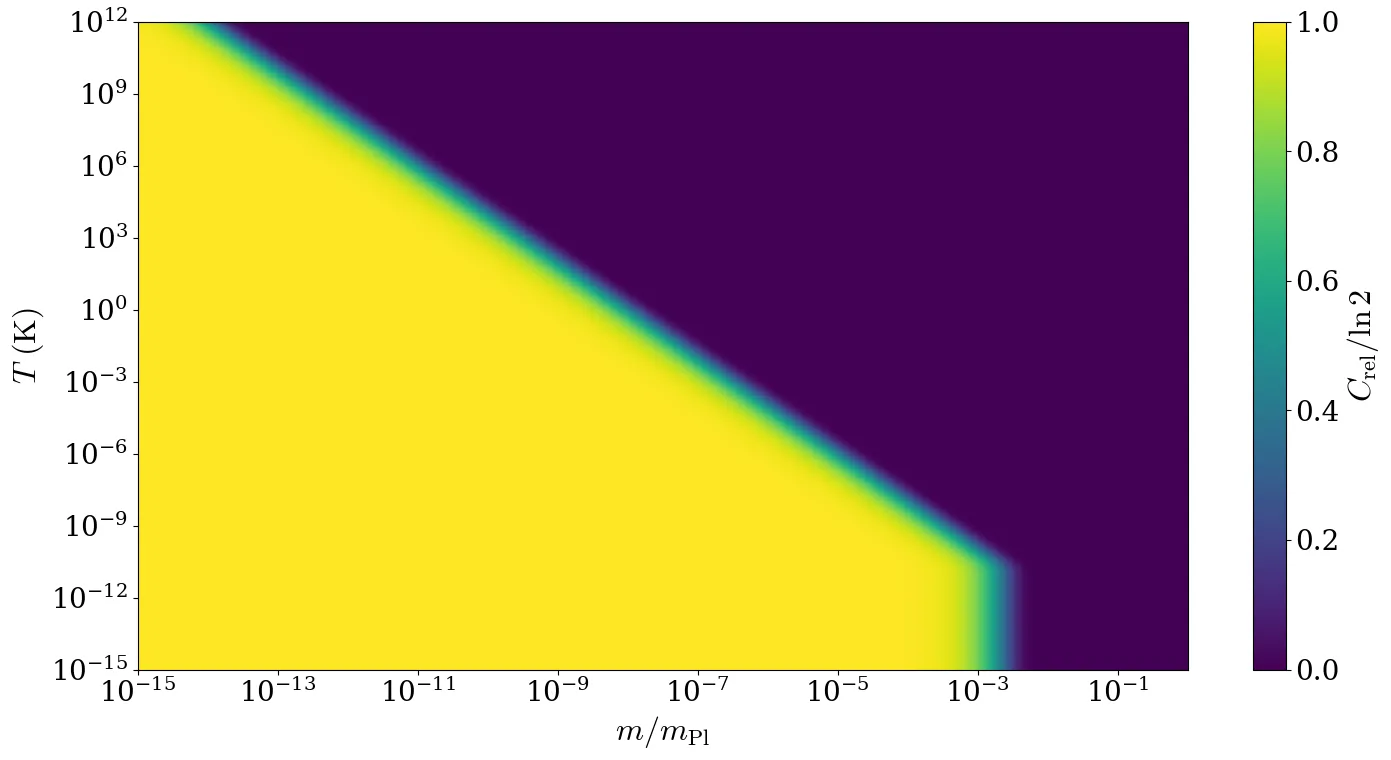
El mundo cuántico ama el equilibrio. Cuando se obliga a una partícula masiva a bifurcarse —a ir por dos caminos a la vez—, algo debe balancearse en respuesta. Ese "algo" resulta ser el propio aparato que dividió a la partícula.
Una plataforma pesada descansa sobre muelles blandos. Si empujas bruscamente un carrito lejos de ella en una dirección, la plataforma se desplaza un poco en la otra. Así ocurre aquí: el aparato que crea la superposición recibe un retroceso microscópico. Su centro de masas se desplaza. Si ese desplazamiento es mayor que la dispersión de la posición del propio aparato en sentido cuántico, la partícula y el aparato se entrelazan. La coherencia cuántica de la partícula se pierde —no por ruido o calor, sino por la propia geometría del experimento.
Los autores dedujeron una regla simple: para conservar la superposición de una partícula con separación $d$, el aparato de masa $M$ debe estar o muy frío o muy firmemente atornillado a la mesa. De lo contrario, su vibración emborronará la imagen. Es curioso que la limitación actúe incluso para partículas mucho más ligeras que la masa de Planck y para aparatos bastante masivos. Por ejemplo, en experimentos de entrelazamiento gravitatorio de dos partículas, el retroceso de los espejos o las trampas puede convertirse en un obstáculo decisivo.
Esto no es una sentencia, sino una guía. Conociendo el límite, se puede calcular de antemano qué mesa, qué enfriamiento y qué rigidez se necesitan para que la danza cuántica tenga lugar.
Resumen original
tal como lo escribieron los autores, en inglés arXiv:2607.08819
Preparing massive particles in coherent spatial superpositions is a central objective of modern quantum science, motivated by applications ranging from fundamental tests of quantum mechanics and gravity to quantum-enhanced sensing. The experimental difficulty of realizing such superpositions is usually attributed to environmental decoherence mechanisms whose impact depends on the details of the experimental implementation. Here we identify a universal constraint arising from momentum conservation and the quantum nature of the preparation apparatus. Any protocol that places a particle of mass $$m$$ in a spatial superposition with separation $$d$$ necessarily entangles the particle with the center-of-mass degree of freedom of the apparatus responsible for the splitting. The resulting recoil displacement, fixed by conservation of the mass dipole moment, reduces the coherence of the particle when the apparatus is not included as part of the quantum system. For an apparatus of mass $$M$$, preserving coherence requires the recoil displacement to remain smaller than the coherence length of the apparatus center-of-mass state, leading to a quantitative bound expressible as a constraint on its temperature and on how rigidly the apparatus is anchored to the laboratory frame. We analyze the implications of this bound for current matter-wave interferometry experiments, proposals for gravitationally mediated entanglement, and tests of quantum mechanics near the Planck scale. Our main result, which may seem counterintuitive, is that the recoil of even heavy macroscopic apparatuses can pose a surprisingly strong constraint on the coherence of spatial superpositions of particles with masses well below the Planck mass. Finally, we discuss why the resulting limitation should be regarded as a conservative estimate and under which conditions it can be interpreted as an instance of false decoherence.
La masa de Planck es de aproximadamente 22 microgramos, la masa de un grano de sal. Toda la mecánica cuántica "pesada" trabaja hasta ahora con masas miles de millones de veces menores.