Миры с вечными океанами магмы экспресс
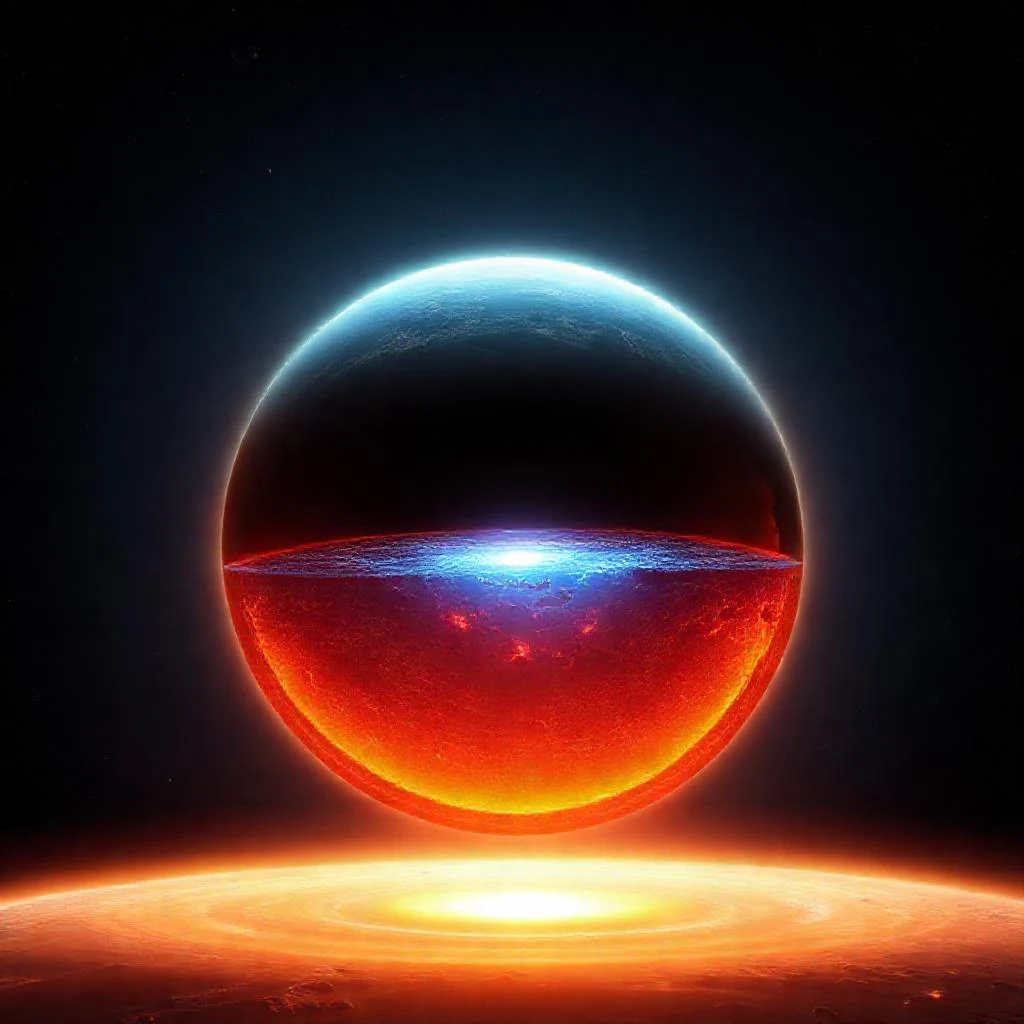
Звезда греет свою планету, как печь — котёл. У большинства субнептунов (миров крупнее Земли, но меньше Нептуна) жара хватает, чтобы под водородным небом вечно бурлил океан расплавленной породы. Компьютерная модель показала: 98% открытых таких планет остаются расплавленными внутри — если они действительно напоминают газовых карликов с лёгкой атмосферой из водорода.
Если внутри планеты много кислорода, а снаружи — углерода, атмосфера тяжелеет и остывает быстрее. Но для большинства миров внутренний жар не угас. Это переворачивает представления: раньше думали, что подобные тела отвердевают за миллиарды лет, а оказалось — их недра пылают до сих пор.
Оригинальная аннотация
как её написали авторы, на английском arXiv:2512.05816
Sub-Neptunes are the most common type of detected exoplanet, yet their observed masses and radii are degenerate with several interior structures. One possibility is that sub-Neptunes have silicate/iron interiors and H$$_2$$-dominated atmospheres ($$\mu$$<3.8 g mol$$^{-1}$$), i.e., they are 'gas dwarfs'. If gas dwarfs have molten interiors, interactions between their magma oceans and atmospheres will produce distinct observational signatures. These signatures may break the degeneracy in interior structure, while providing insight into their interior processes, history, and population trends. We expect all such planets are born molten, but under what conditions do they remain molten today? We use the coupled interior-climate evolution model, PROTEUS, to estimate the 'solidification shoreline': the instellation flux boundary (as a function of stellar $$T_{\rm eff}$$) that separates molten gas dwarfs from solidified ones. Our results show that 98% of detected sub-Neptunes occupy a region of parameter space consistent with their having permanent magma oceans, if they are gas dwarfs. While mantle $$f{\rm O}_2$$ and bulk volatile C/H ratio both influence magma ocean cooling, planets with oxidising mantles and carbon-rich atmospheres are likely to have high mean-molecular weight atmospheres ($$\mu$$>3.8 g mol$$^{-1}$$) and are thus outside the scope of this study. Therefore, most detected sub-Neptunes, if they are gas dwarfs, have permanent magma oceans. This result motivates further research into the interactions between molten interiors and overlying atmospheres, and campaigns to identify unambiguous signatures of these interactions.
Субнептуны — самый распространённый тип планет в нашей Галактике, хотя в Солнечной системе их нет.