Oliver Shorttle

4 articles · 13 co-authors · latest: 2026-05-06
2,732 citations · h-index 32 · 180 papersData: Semantic Scholar

We have retold 4 papers by this author. most often about: exoplanet atmosphere, methane, spectroscopy. 13 co-authors across our retellings.

Links in the knowledge graph
Exoplanets2025-12-051 minarXiv:2512.05816express
Worlds with Eternal Magma Oceans
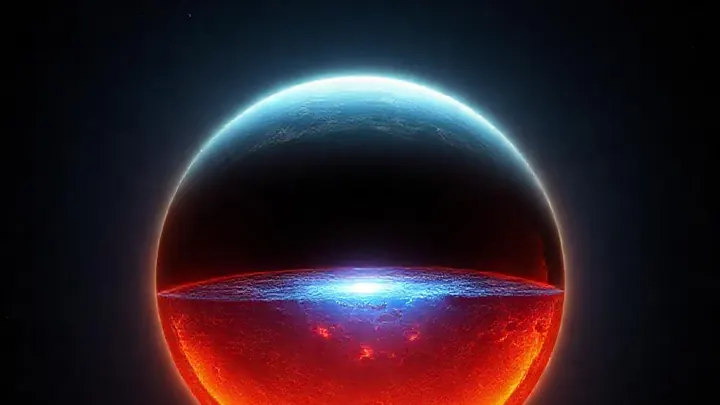
A star warms its planet like an oven warms a kettle. For most sub-Neptunes (worlds larger than Earth but smaller than Neptune), the heat is enough to keep an ocean of molten rock eternally churning beneath a hydrogen sky.

Exoplanets2026-03-182 minarXiv:2603.17961express
Why Earth Didn't Absorb the Gifts from Space
In its youth, Earth resembled a beehive: it grew by sticking together from countless rocky chunks. When the main construction was over, a late swarm of meteorites rained down on the young planet — the so-called late veneer. These impacts, scientists thought, brought platinum, gold, and other rare metals to Earth's upper layers.
Exoplanets2026-03-191 minarXiv:2603.18923express
Cosmic Kitchen: What the Atmosphere of a Distant Planet Is Cooking Up
A telescope stares at a planet 124 light-years away and sees gases in its atmosphere that on Earth are produced by microbes. The immediate thought: life. But it's not that simple. Planet K2-18b is a sphere wrapped in a thick layer of hydrogen. In such a layer, like in a giant chemical flask, reactions take place.
Exoplanets2026-05-061 minarXiv:2605.04840express
Mars's dense layer reveals the fate of rocky planets
If you don’t stir a layered cocktail, the heavy syrup sinks to the bottom. A young planet is much the same — a seething ocean of molten rock. As it cools, minerals crystallize: some, like iron, get heavy and sink, while others float. You’d think a dense layer would pile up at the core.
