Свет, который переключают быстрее собственных колебаний экспресс
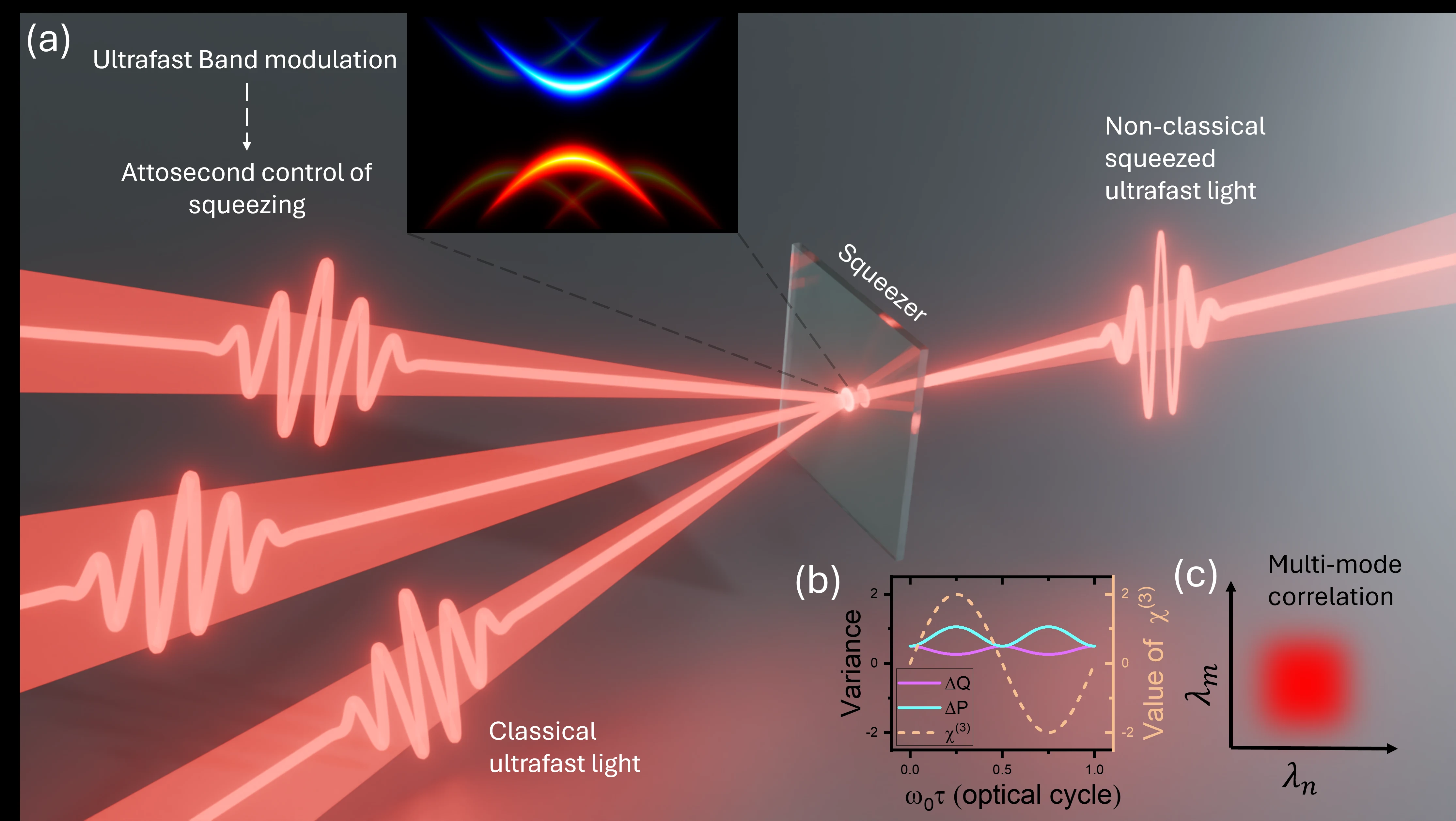
Обычный свет всегда немного дрожит: его яркость и цвет колеблются, как воздух в надутом шарике после толчка. В «сжатом» свете эти колебания перераспределяют — словно шарик сдавливают с одной стороны, делая здесь тоньше, а там толще, но общий объём тот же. Так жертвуют точностью в одном, чтобы выиграть в другом. Это уже позволило детекторам гравитационных волн улавливать колебания в тысячи раз меньше атомного ядра, и услышать столкновения чёрных дыр за миллиарды световых лет.
Теперь физики научились мгновенно менять то, какую часть «шарика» сдавливают. Они посылают на материал две лазерные вспышки с задержкой меньше одного светового колебания — свет не успевает измениться, а вещество уже перестраивается. Это переключение происходит за аттосекунды (миллиардные доли миллиардной доли секунды). Анализ с помощью спектроскопии показывает, как разные цвета такого света связаны между собой, позволяя конструировать идеальные квантовые источники для будущих компьютеров. Такая скорость может в миллиарды раз превзойти быстродействие современных процессоров.
Оригинальная аннотация
как её написали авторы, на английском arXiv:2512.17046
Squeezed light has revolutionized quantum metrology by enhancing interferometry for sensitive applications such as the detection of gravitational waves. Squeezed light has also played a pivotal role in quantum information science with numerous applications in quantum computing and communication. Previously, squeezed light has been primarily generated using nonlinear optical interactions, where control of the degree of squeezing was possible by tuning the nonlinearity of the generating medium using suitable material engineering. Here, we modulate the third-order nonlinear response in dielectrics with strong ultrafast laser fields to control the degree of squeezing on attosecond time scales. We demonstrate the ability to change the ultrafast squeezed light generated in the nonlinear process from amplitude-squeezed to phase-squeezed by controlling the strong-field-driven nonlinear response of the material through a sub-cycle phase delay between the input femtosecond laser pulses. The squeezing of quantum noise is measured using a frequency-resolved balanced homodyne detection scheme capable of extracting the field quadratures in different frequency modes simultaneously. Using this frequency-resolved measurement we extract the complete coherency matrix containing the quantum correlations between field quadratures across different frequency modes of the femtosecond squeezed light pulse. These results have major implications for the development of quantum light sources with unprecedented levels of control over quadrature squeezing, for applications in multimode quantum information processing, and for measuring transient quantum matter correlations via transduction to quantum field correlations in an ultrafast light-matter interaction.
«Сжатый» свет никто не сжимает физически — это лишь хитрое перераспределение естественного шума, при котором снижение помех в одном месте оборачивается их ростом в другом, как у шарика.