Сбивчивый танец двух планет у звезды TOI-4495 экспресс
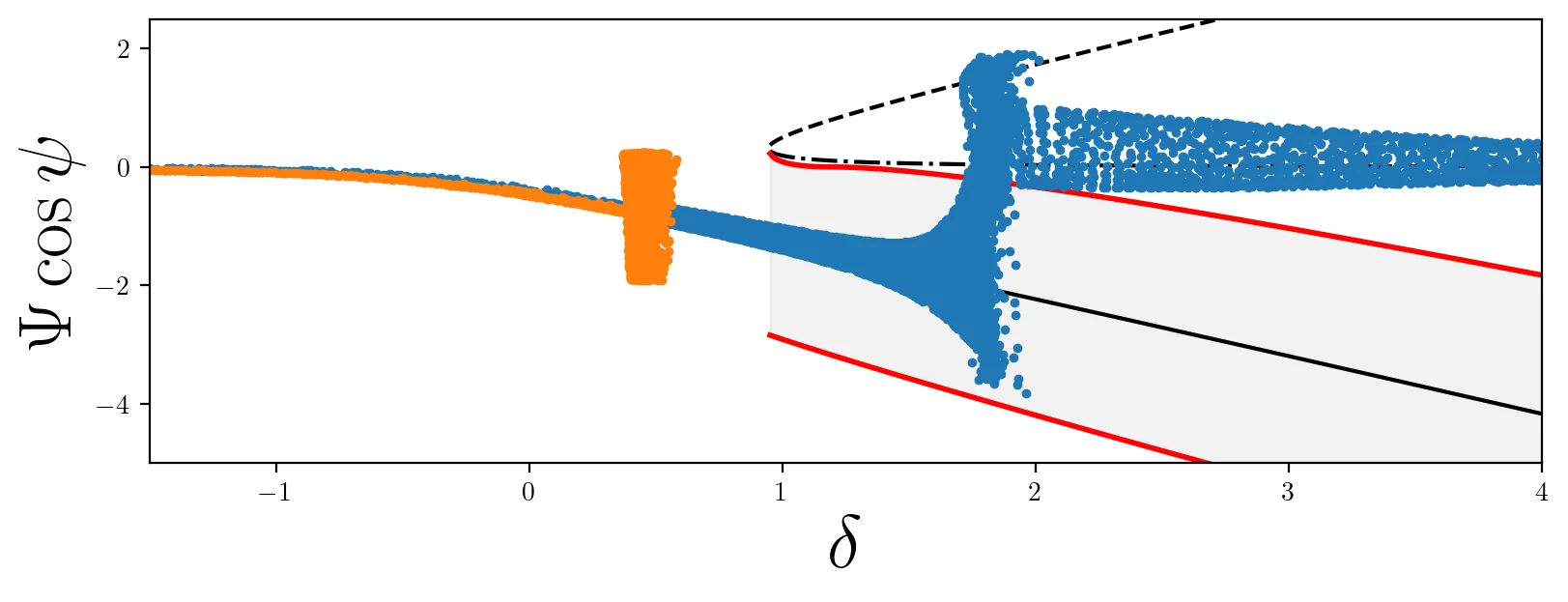
Две планеты у звезды TOI-4495 исполняют сбивчивый танец: пока внутренняя успевает сделать два круга, внешняя — только один. Но ритм нарушен — внутренняя планета то ускоряется, то замедляется, словно партнёрша, спотыкающаяся в па.
Используя транзитный метод — наблюдение за тем, как планеты на миг приглушают свет звезды, — астрономы взвесили эти миры. Идея принадлежит Уильяму Боруцки. Внутренняя планета весит как 7,7 Земель, внешняя — как 23. Обе окутаны толстыми газовыми шубами, а их орбиты почти лежат в плоскости экватора звезды — редкая синхронность.
Причина сбоя, вероятно, скрыта в прошлом: столкновение с кометными роями могло выбить систему из идеального резонанса. Сейчас планеты балансируют на пороге, и любой толчок способен заставить их обменяться энергией, усиливая хаос.
Оригинальная аннотация
как её написали авторы, на английском arXiv:2601.02665v1
We report the discovery of a sub-Neptune and a Neptune-like planet ($$R_b = 2.48^{+0.14}_{-0.10}\,R_\oplus$$, $$R_c = 4.03^{+0.23}_{-0.15}\,R_\oplus$$) orbiting the F-type star TOI-4495. The planets have orbital periods of 2.567 days and 5.185 days, lying close to a 2:1 mean-motion resonance (MMR). Our photodynamical analysis of the TESS light curves constrains the planetary masses to $$M_b = 7.7 \pm 1.4\,M_\oplus$$ and $$M_c = 23.2 \pm 4.7\,M_\oplus$$. The measured masses and radii indicate the presence of volatile-rich gaseous envelopes on both planets. The Rossiter-McLaughlin effect and the Doppler shadow of TOI-4495 c reveal a well-aligned orbit with a projected stellar obliquity of $$\lambda = -2.3^{+8.3}_{-7.8}\,\mathrm{deg}$$. Combined with the low mutual inclination constrained by the photodynamical analysis ($$\Delta I < 8.7\,\mathrm{deg}$$), the planetary orbits are likely coplanar and aligned with the host star's spin axis. We show that the planets are near, but not in, the 2:1 MMR, with a circulating resonant angle. We also find substantial free eccentricity for the inner planet, TOI-4495 b ($$e_b = 0.078^{+0.020}_{-0.013}$$). Given the observed proximity to the 2:1 resonance and the more massive outer planet, TOI-4495 b and c are particularly susceptible to resonant overstability, which can convert resonantly excited eccentricity into free eccentricity. However, additional mechanisms (e.g., planetesimal scattering) may be required to further excite the eccentricity by $$\sim 4\%$$. To prevent tidal damping from reducing the eccentricity below the observed level over the star's lifetime (1.9 Gyr), the reduced tidal quality factor of TOI-4495 b must be $$Q' \gtrsim 10^5$$, consistent with the presence of a thick envelope on the planet.
Орбитальный резонанс 2:1 встречается и в Солнечной системе: спутники Юпитера Ио и Европа движутся в таком же ритме, но без сбоев.