Планетный воздух: рецепт от звезды экспресс
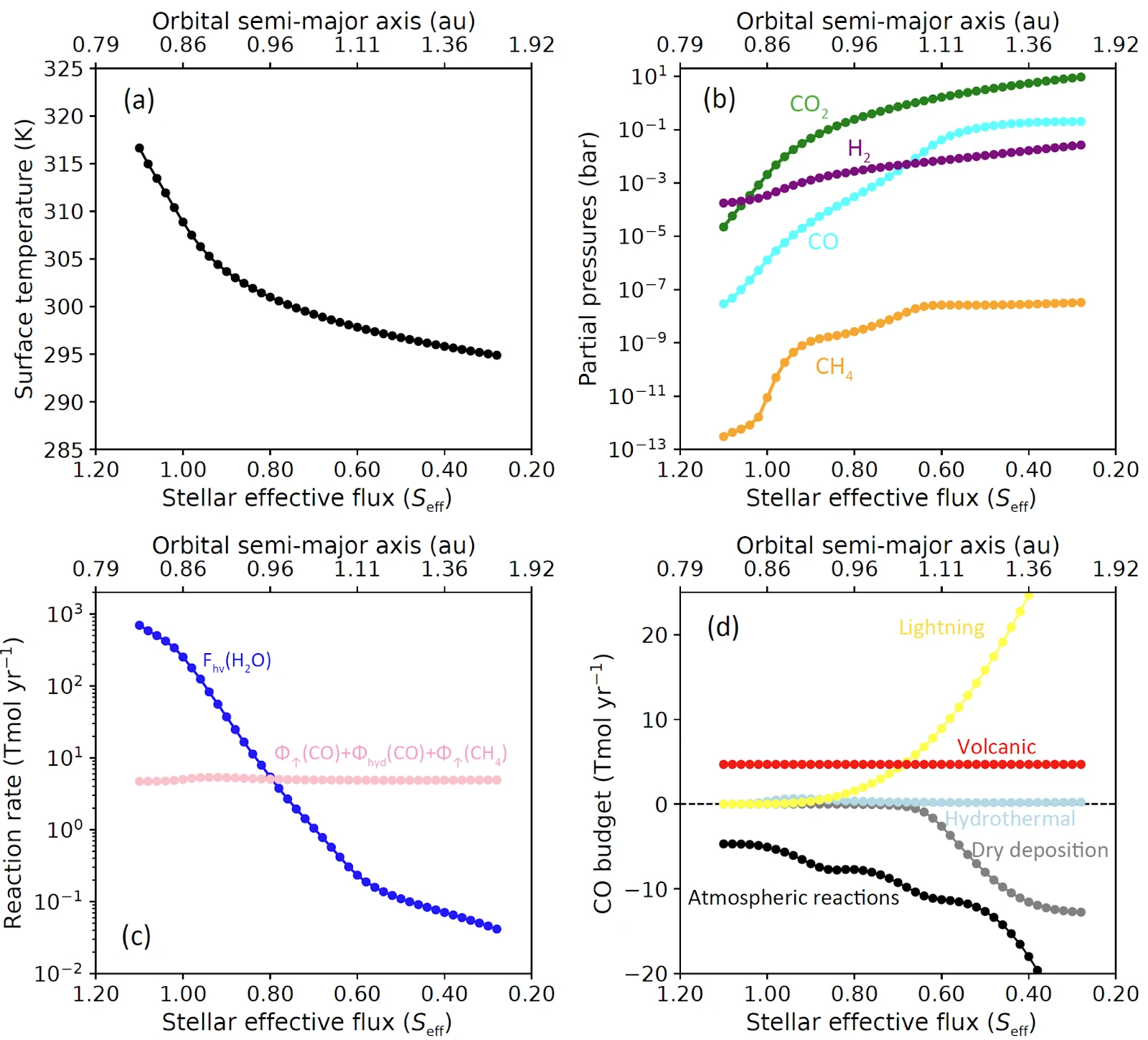
Каменистая планета у другой звезды — как блюдо в печи. Звезда задаёт температуру: чем дальше, тем холоднее. От режима нагрева и типа звезды (вроде Солнца или тусклее) зависит смесь газов с углеродом в воздухе: углекислый, угарный, метан.
Формальдегид — кирпичик для сахаров и аминокислот — лучше всего 'запекается' у горячих звёзд, как раз перед коллапсом. Телескопы, например «Джеймс Уэбб», проанализируют свет далёких миров и найдут места, где рецепт жизни почти сложился.
Оригинальная аннотация
как её написали авторы, на английском arXiv:2601.05480v1
The abundances of atmospheric carbon species--carbon dioxide (CO2), carbon monoxide (CO), and methane (CH4)--exert fundamental controls on the climate, redox state, and prebiotic environment of terrestrial planets. As exoplanet atmospheric characterization advances, it is essential to understand how these species are regulated on habitable terrestrial planets across a wide range of stellar and planetary conditions. Here, we develop an integrated numerical model that couples atmospheric chemistry, climate, and the long-term carbon cycle to investigate the atmospheric compositions of lifeless, Earth-like planets orbiting Sun-like (F-, G-, and K-type) stars. Our simulations demonstrate that CO2, CO, and CH4 generally increase with orbital distance, and that planets near the outer edge of the habitable zone may undergo CO runaway--a photochemical instability driven by severe depletion of OH radicals. The threshold for CO runaway depends strongly on stellar spectral type and is most easily triggered around cooler, lower-mass stars. In contrast, the atmospheric production of formaldehyde (H2CO)--a key precursor for prebiotic organic chemistry--peaks around planets orbiting more massive, UV-luminous stars and is maximized at orbital distances just interior to the CO-runaway threshold. These results establish a quantitative framework linking observable system properties--stellar type and orbital distance--and the atmospheric carbon chemistry of lifeless Earth-like planets, providing new context for interpreting future spectroscopic observations and for evaluating the potential of such planets to sustain prebiotic chemistry.
На безжизненных планетах угарный газ может накопиться до уровней, в сотни раз превышающих земные — и всё из-за особенностей света звезды.