Когда Солнце нырнуло в облако экспресс
Двигаясь по Галактике, Солнечная система иногда ныряет в плотные межзвёздные облака — скопления разрежённого водорода и пыли. Обычно Солнце оберегает нас:
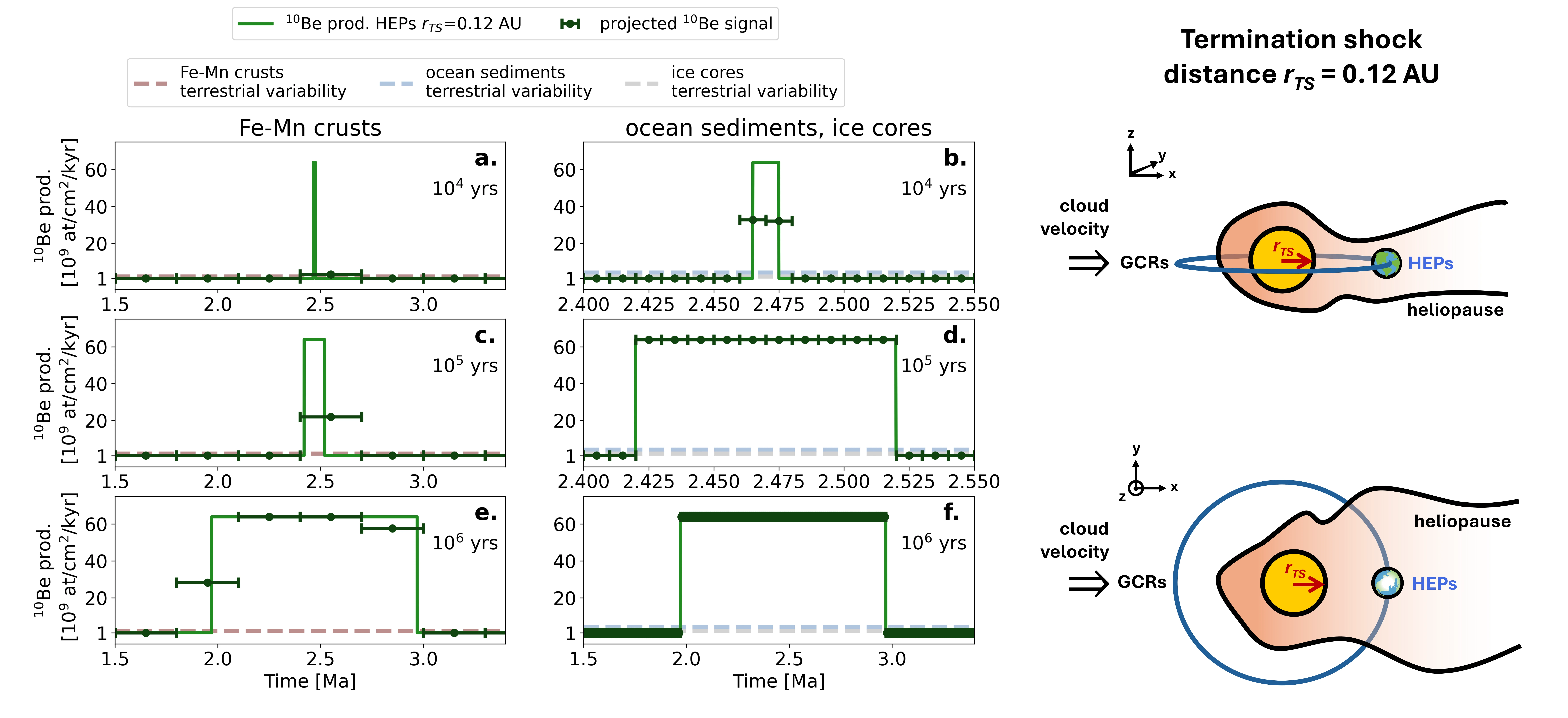
Но массивное облако сдавливает пузырь — тот съёживается, иногда до размеров меньше орбиты Земли, — и планета попадает под ливень частиц из космоса. В воздухе рождается бериллий-10 — радиоактивная разновидность бериллия. Он оседает в океанских осадках и ледяных пластах, как метка о событии. Учёные измерили эту метку и выяснили: крошечные облака почти не видны в морской коре, но ледяные колонки хранят память о них при точных замерах. А всплеск бериллия 10 миллионов лет назад вызван не сверхновой, а проходом сквозь облако.
Оригинальная аннотация
как её написали авторы, на английском arXiv:2601.07983v2
Recent works suggest there are periods when the Sun encountered massive interstellar cold clouds which compressed the heliosphere to within Earth's orbit. This would expose Earth to increased galactic cosmic rays (GCRs) and energetic particles of heliospheric origin (HEPs). We model 10Be production in Earth's atmosphere during possible interstellar cloud encounters and supernovae, and estimate their detectability in marine and ice records of variable temporal resolution. We find that encounters with sub-parsec-scale clouds cannot be detected via 10Be measurements in iron-manganese crusts. GCR signal is not detectable in ocean sediments; only parsec-scale clouds can be detected in iron-manganese crusts. Encounters with sub-parsec-scale clouds can be detected if Earth is exposed to HEPs, or by measuring ice cores with less than or equal to 10 kyr temporal resolution. We find that the peak observed by Koll et al. (2025) 10 Ma cannot be attributed to a supernova, but could be attributed to an interstellar cloud crossing.
Бериллий-10 — космический хронометр: его медленный распад хранит память о солнечных бурях и облачных встречах десятки миллионов лет.