Как найти воду в марсианском камне, не разбив его экспресс
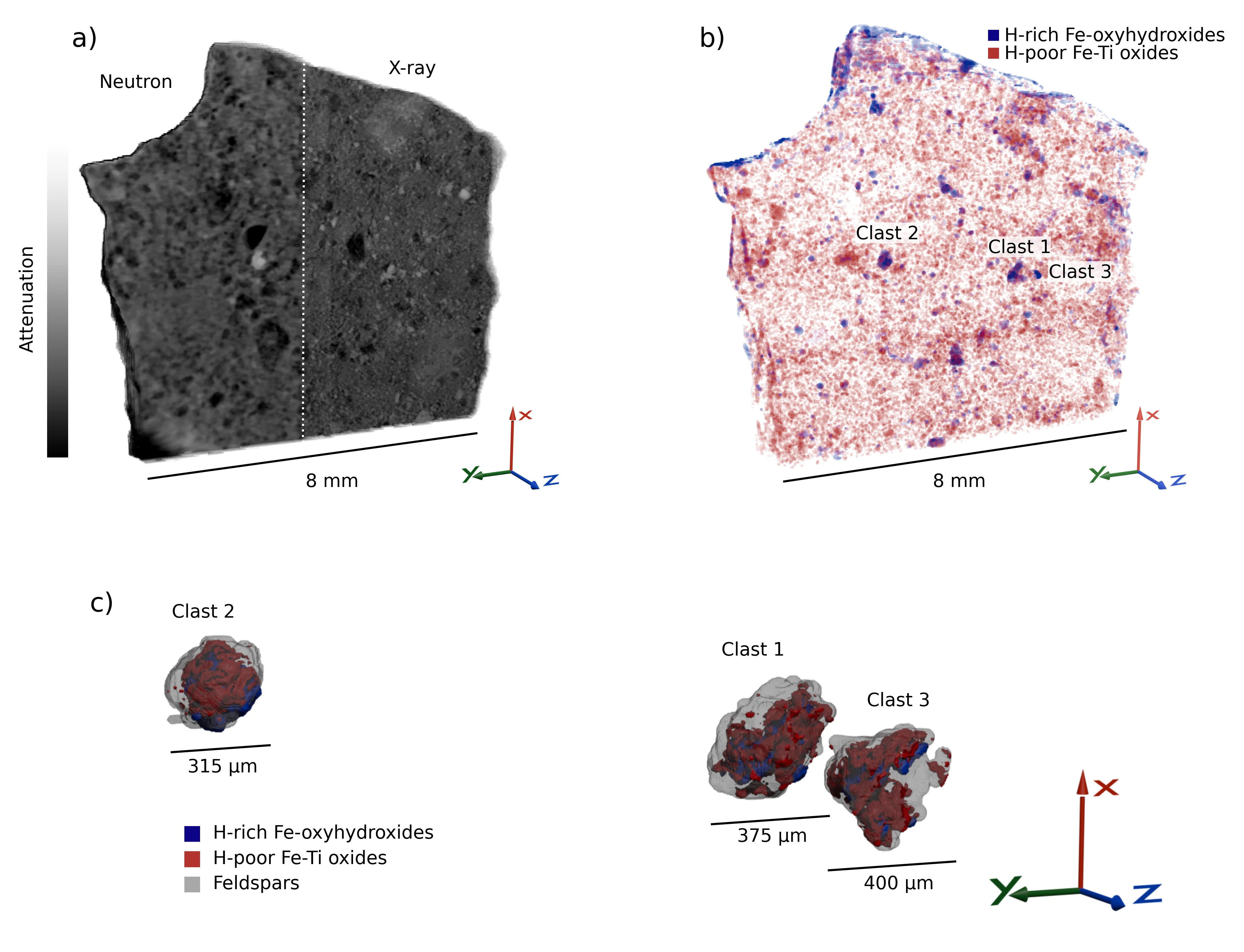
Чтобы узнать, есть ли вода в камне с Марса, не разбивая его, учёные применили просвечивание нейтронами и рентгеном — подобно тому, как в больнице делают снимки. Нейтроны улавливают водород, основу воды, и позволяют построить карту влаги внутри образца. В метеорите NWA 7034, куске марсианской коры, обнаружились минералы, похожие на ржавчину, но пропитанную водой. Эти оксиды железа с водородом действуют как каменная губка: они впитали древнюю воду, когда она просочилась в застывшую лаву. Даже сегодня, спустя миллиарды лет, они удерживают влагу при температурах выше 100°C — вода заперта не только в виде льда, но и внутри камней. Ровер Perseverance находит похожие следы в кратере Езеро, намекая, что ранний Марс был пронизан водными карманами. Такой метод однажды поможет изучать марсианские образцы на Земле, не повредив ни грана, и искать микроскопические улики древней жизни.
Оригинальная аннотация
как её написали авторы, на английском arXiv:2601.08390
The next great leap in Martian exploration will be the return of samples to Earth. To ensure the maximum scientific return from studying these samples, the development and utilisation of nondestructive analytical techniques are essential to enable early three-dimensional characterisation of their interiors. Neutron computed tomography is a powerful method in this context: it is highly sensitive to hydrogen and complements the more conventional X-ray computed tomography. Because the distribution and nature of hydrous phases are central to understanding the habitability, the climatic and geological evolution, and potential biosignatures of Mars, identifying hydrogenbearing phases in Martian crustal rocks is of particular importance. Using the only Martian crustal material available on Earth, the NWA 7034 meteorite and its pairs, we show that combined neutron and X-ray computed tomography enables non-destructive sample-wide mapping of hydrogen and reveals the distribution and petrographic contexts of hydrous phases. We identify hydrogen-rich iron oxyhydroxides within ancient igneous clasts, forming a macroscopic mineralogical water reservoir within the meteorite. These alteration assemblages closely resemble those observed in samples collected by the Perseverance rover in Jezero crater, where hydrated iron oxyhydroxides are also present. This similarity suggests that such phases may represent a widespread near-surface water reservoir on early Mars.
Чтобы «выжать» воду из такой каменной губки, понадобится температура свыше 400°C — на поверхности Марса такого жара не бывает.
Подобно герою «Марсианина», добывающему воду из марсианского грунта, учёные находят скрытую влагу, запертую в минералах.