Как охладить свет до квантового порядка экспресс
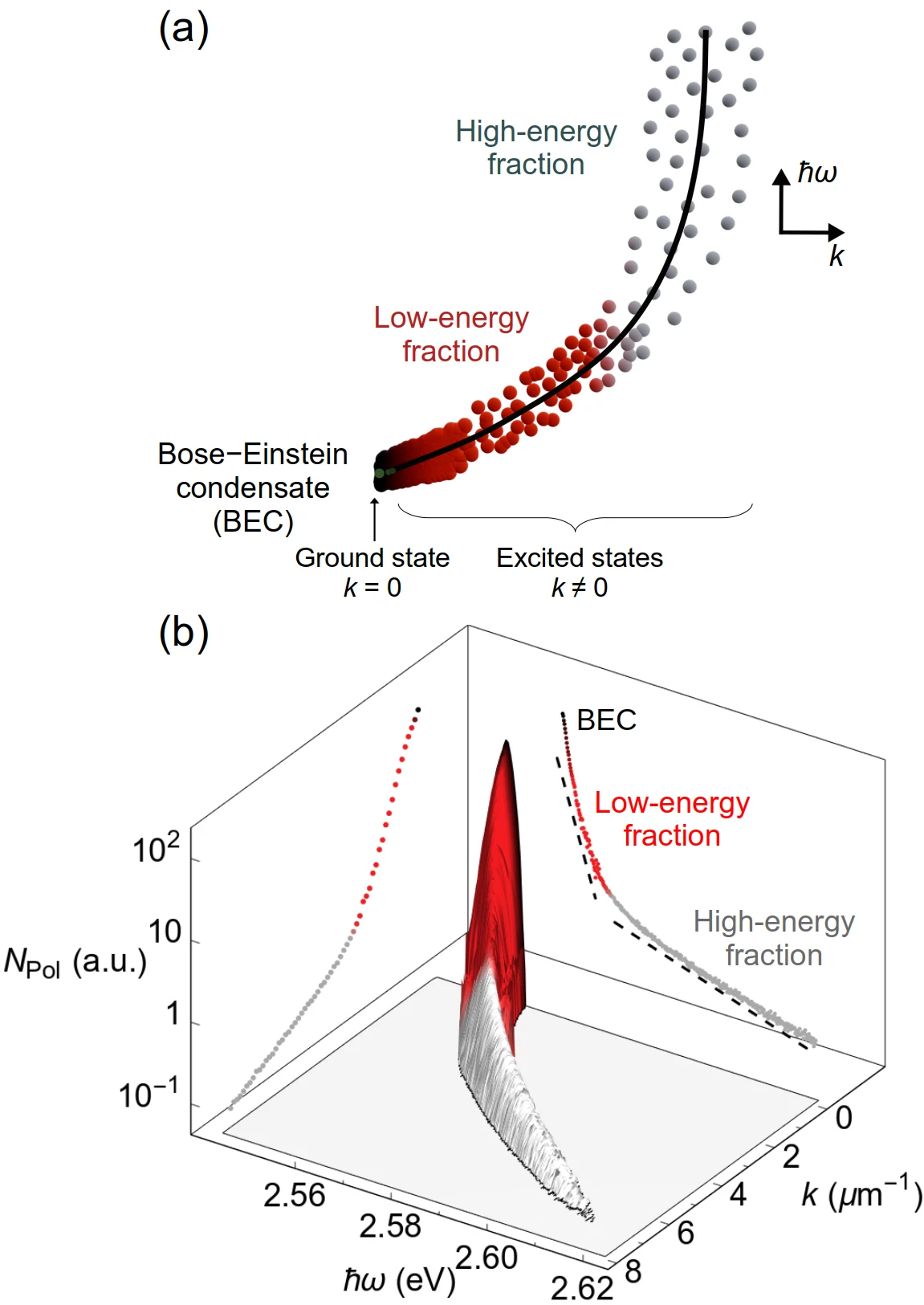
Охлаждение обычно наводит порядок: вода застывает в лёд. Но в квантовом мире порядок принимает неожиданные формы. Экспериментаторы охладили поляритоны — частицы, которые одновременно и свет, и материя, — почти до абсолютного нуля. Вместо простого замерзания облако начало «танцевать», синхронизируя колебания всех частиц в едином ритме. Однако затем танец раздвоился: облако распалось на две области-«танцплощадки» с разным темпом, каждая из которых подчинялась законам, открытым Бозе и Эйнштейном. Самое поразительное — температура этих областей оказалась не следствием нагрева, а прямым отражением числа частиц в каждом сгустке. Чем теснее толпа, тем горячее танец. Этот неожиданный принцип универсален для далёких от равновесия квантовых систем и может найти применение в будущих устройствах, работающих на грани квантовых эффектов.
Оригинальная аннотация
как её написали авторы, на английском arXiv:2601.15080
We report on the experimental observation of stimulated cooling in the non-equilibrium Bose-Einstein condensate (BEC) of weakly interacting exciton-polaritons from approximately room temperature down to 20K. By resolving the condensate in energy-momentum space and performing interferometric measurements, we distinguish the condensate from thermalized particles yet occupying excited states macroscopically. In contrast to the analytical quantum theories of non-equilibrium BEC [Shishkov et al., Phys. Rev. Lett. 128, 065301 (2022)], we observe segmentation of the particle density along the excited states into two fractions both following Bose-Einstein distribution, albeit with different effective temperatures and chemical potentials. Our results indicate that the temperature of the weakly interacting Bose gas is universally set by the density-dependent chemical potential, revealing a defining property of non-equilibrium BECs. Finally, we demonstrate that the stimulated nature of the cooling process directly governs the emergence of quantum coherence of the condensate and shapes the dissipative properties of the excited states.
Поляритоны в миллиарды раз легче атомов, поэтому их охлаждение занимает мгновения даже при относительно «высокой» для квантового мира температуре.