Газовые реки питают будущую звезду экспресс
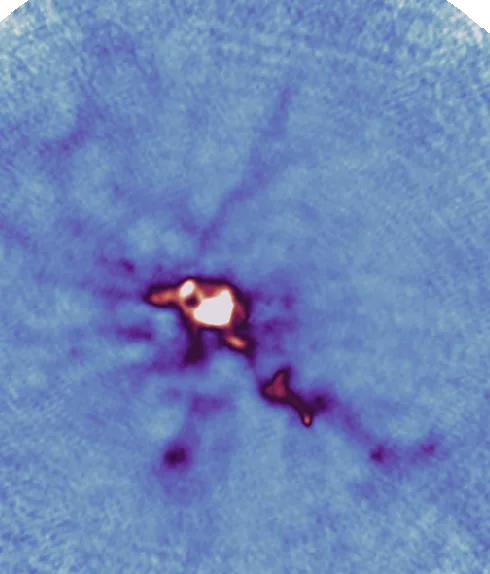
В тёмном облаке G318.049+00.086, где ещё нет ни одной звезды, пыль и газ выстроились в четыре длинные нити. Они сходятся в плотный центральный узел — как четыре реки, впадающие в озеро. По этим нитям к центру течёт газ: скорость потока достигает 10–20 километров в секунду на каждый парсек длины. Это значит, что в узел каждый миллион лет прибывает больше тысячи солнечных масс вещества.
Внутри узла астрономы нашли сгустки — будущие звёзды. У большинства из них профиль излучения перекошен в синюю сторону. Такой перекос возникает, когда внешние слои сгустка падают внутрь, а мы видим только ближнюю к нам половину. Значит, эти сгустки сжимаются под собственной тяжестью. Но несколько сгустков показали красный перекос: их газ, наоборот, расширяется.
Эта картина напоминает соревнование, где выигрывает не самый сильный, а тот, кто оказался в нужном месте. Сгустки на нитях теряют вещество, а узел в центре накапливает его и, скорее всего, породит одну или несколько массивных звёзд. Так рождаются гиганты, которые потом освещают целые скопления.
Оригинальная аннотация
как её написали авторы, на английском arXiv:2602.01238
We present a gas kinematic study of the massive protocluster G318.049+00.086. The protocluster is reported to contain 12 prestellar core candidates and 4 protostellar cores. Filamentary structures are identified using the 1.3 mm dust continuum map, with four of them converge into a dense central region, forming a hub-filament system (HFS). High velocity gradients (10 - 20 km s$$^{-1}$$ pc$$^{-1}$$) derived from PV analysis of H$$^{13}$$CO$$^{+}$$ emission along three of those filaments are suggestive of mass inflow onto the central hub. A mass inflow rate higher than $$10^{3}$$ M$$_{\odot}$$ Myr$$^{-1}$$ along the filaments is indicating that the central hub is capable of forming massive star(s). Investigation of H$$^{13}$$CO$$^{+}$$ and CCH spectral profiles revealed the majority of the cores having the characteristic blue asymmetric line profiles, typical signature of gravitational collapse. The remaining few cores showed red asymmetric profiles, indicative of gas expansion. Also, the derived mass infall rates for the protostellar cores in hub-region is significantly higher in comparison to those located along the filaments. The mass-radius relationship of the cores revealed that the cores with red profiles reside in the massive star formation regime. However, the global velocity gradient along the filaments suggests that these particular cores are losing material to the hub. Our results are supporting a competitive accretion scenario of massive star formation where gas is expected to be funnelled from less gravitationally dominant cores to the cores located at the gravitationally favorable position.
Скорость падения газа в этом облаке такова, что за миллион лет в центр стекает масса, равная тысяче Солнц. Для сравнения: наше Солнце за всю жизнь потеряет лишь малую долю своего вещества.