Застывающий лёд и расширяющийся космос экспресс
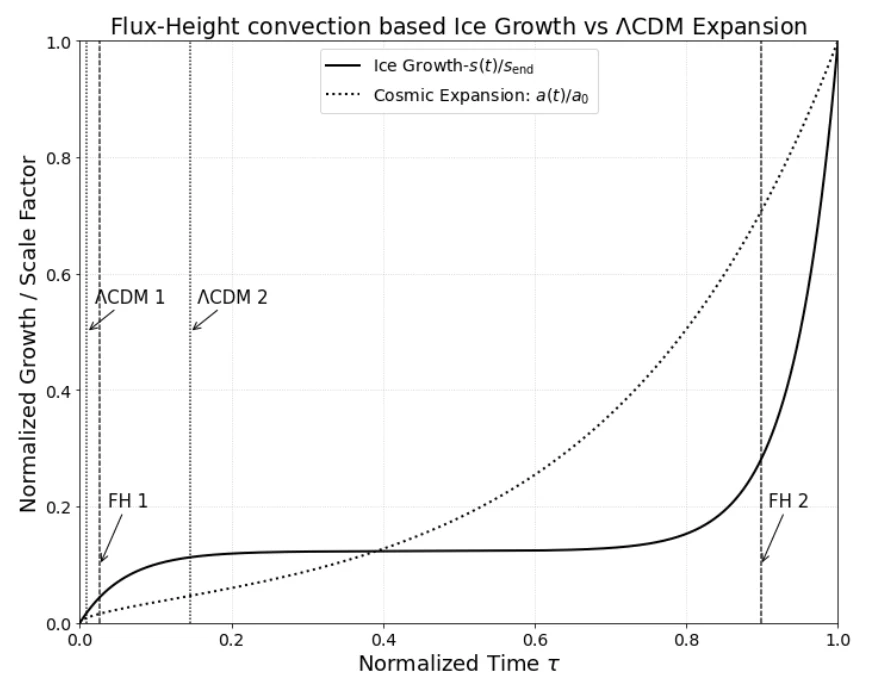
Зимой озеро затягивается льдом — и этот простой процесс оказывается живой моделью расширяющейся Вселенной. Толщина льда нарастает по тому же математическому закону, что и расстояния между далёкими галактиками.
Секрет — в движении воды под ледяной коркой. Когда тёплые слои всплывают, а холодные опускаются, этот круговорот подносит к растущему льду тепло. В уравнениях появляется добавочный член, который ведёт себя точь-в-точь как тёмная энергия — постоянная невидимая сила, заставляющая галактики разбегаться с ускорением. В озере такая «энергия» замедляет рост льда, а в космосе — наоборот, подталкивает расширение.
Удивительно, что формулу для этого сценария впервые записал физик Йозеф Стефан ещё в 1891 году, изучая намёрзание льда на прудах. Теперь то же уравнение лежит в основе моделей, предсказывающих судьбу всего мироздания.
Оригинальная аннотация
как её написали авторы, на английском arXiv:2602.24019
We extend previous conduction-based analogies between ice growth in a lake and cosmological expansion by incorporating buoyancy-driven heat transport. Reformulating the Stefan problem with both conductive and convective fluxes yields an evolution equation for the ice thickness $$s(t)$$ that is structurally analogous to the Friedmann equations for the cosmological scale factor $$a(t)$$. Beyond reproducing radiation-, matter-, and curvature-like behaviors, we introduce a reduced description of convection in which the vertically integrated heat flux reaching the moving ice-water interface is modeled as a power-law function of the instantaneous liquid-layer thickness, generating two additional effective contributions. The first is a constant term, directly analogous to a cosmological constant, arising from the persistence of buoyancy-driven transport under geometric confinement. The second is a $$s^{-1}$$ contribution originating from the coupling between the moving ice boundary and the convective boundary layer. This term reflects the specific reduced flux-height Ansatz adopted, rather than a universal physical prediction. When expressed in Friedmann-like cosmological form, this term entails a fluid with negative energy density and equation-of-state parameter $$w=-2/3$$. In cosmology this term may be an effective one associated to a network of domain walls made of exotic energy/matter, but it might also arise from an energy exchange between cosmological components. Overall, the results should be interpreted as a structural analogy between evolution equations, showing how nonlinear transport mechanisms in a classical moving-boundary problem can reproduce the hierarchy of scaling terms familiar from cosmology within a reduced and analytically tractable framework.
Уравнение Стефана, выведенное для простого льда, сегодня применяют даже при расчёте охлаждения поверхности Марса.