Звезда подмигивает: пыль от столкновения планет экспресс
В созвездии, где рождаются новые звёзды, одна из них ведёт себя как неисправная лампочка: то светит ровно, то вдруг тускнеет в несколько раз. Астрономы следят за звездой Gaia-GIC-1 уже несколько лет и теперь понимают, что её мигание — это тень от огромного облака пыли, которое то и дело проходит перед ней. Пыль не просто космический мусор, а свежие обломки: похоже, совсем недавно там столкнулись две планеты.
Каждые 380 дней облако делает оборот и снова заслоняет звезду. Учёные измерили, что пыли там очень много — по массе как небольшой астероид. И она не разлетается, а держится вместе, словно ком грязи, брошенный в пруд. Это значит, что обломки ещё не успели рассеяться и продолжают сталкиваться между собой, рождая новые частицы.
Такие наблюдения — редкая удача. Обычно мы видим уже готовые планеты, а тут сам процесс их сборки. Возможно, через миллионы лет из этой пыли слепится новая планета, как из теста — пирожок. И тогда звезда перестанет подмигивать.
Оригинальная аннотация
как её написали авторы, на английском arXiv:2603.10952
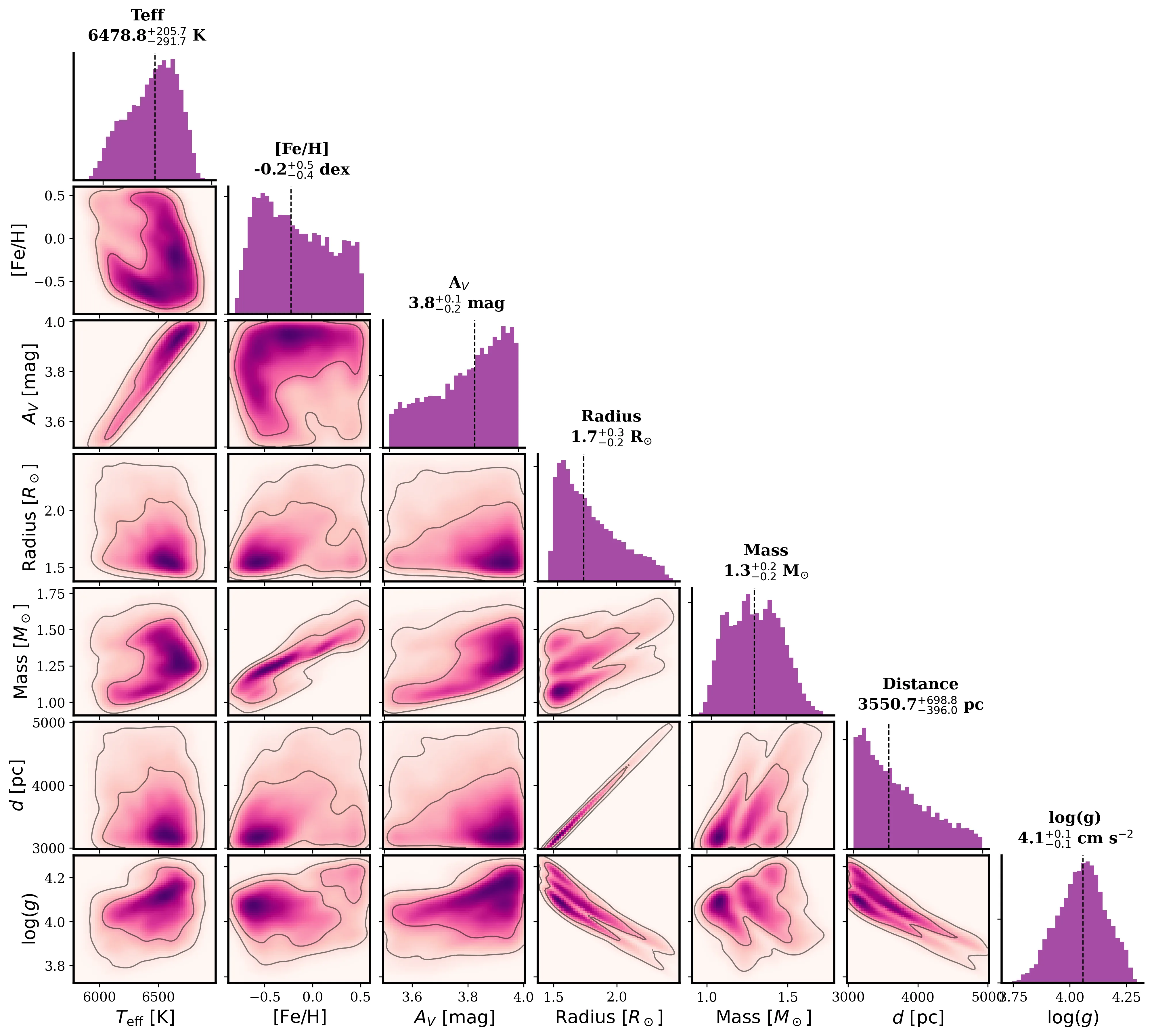
We report the discovery of the optical dipper and low-luminosity infrared stellar transient Gaia20ehk (hereafter, Gaia-GIC-1), which is currently undergoing high-amplitude variability due to transiting dusty material. In this work, we identify Gaia-GIC-1 as a likely young F-type star based on the spectral energy distribution before the onset of the high-amplitude optical variability. We detect a significant periodic modulation of 380.5 days in Gaia-G band before the onset of the infrared brightening, consistent with a $$\sim$$1.1 AU orbit assuming circular orbits and a 1.3 M$$_{\odot}$$ star. The system has remained in an infrared bright state for $$>$$4 years since the last near-infrared detection, confirmed by recent SPHEREx observations, while continuing to undergo large amplitude irregular optical dimming. We measure the dust temperature from the freshly generated debris to be $$\sim$$900 Kelvin based on available WISE photometry, and the dust clump size to have a minimum cross-sectional area of 0.13 AU$$^{2}$$, and the dust mass $$4\times 10^{20}$$ kg. Currently, optical follow-up spectroscopy has not revealed any prominent features in the system, likely due to its highly variable nature. We hypothesize that Gaia-GIC-1 represents debris recently formed in a planetary collision, which produced a clumpy dust cloud on a bound orbit, producing the observed dimming events. The ongoing collisional activity in this system presents a unique opportunity for understanding terrestrial planet formation.
Облако пыли такое плотное, что временами закрывает больше половины света звезды — как если бы кто-то прикрыл фонарь ладонью.