Супервспышки звёзд: отогревают планеты и синтезируют аминокислоты экспресс
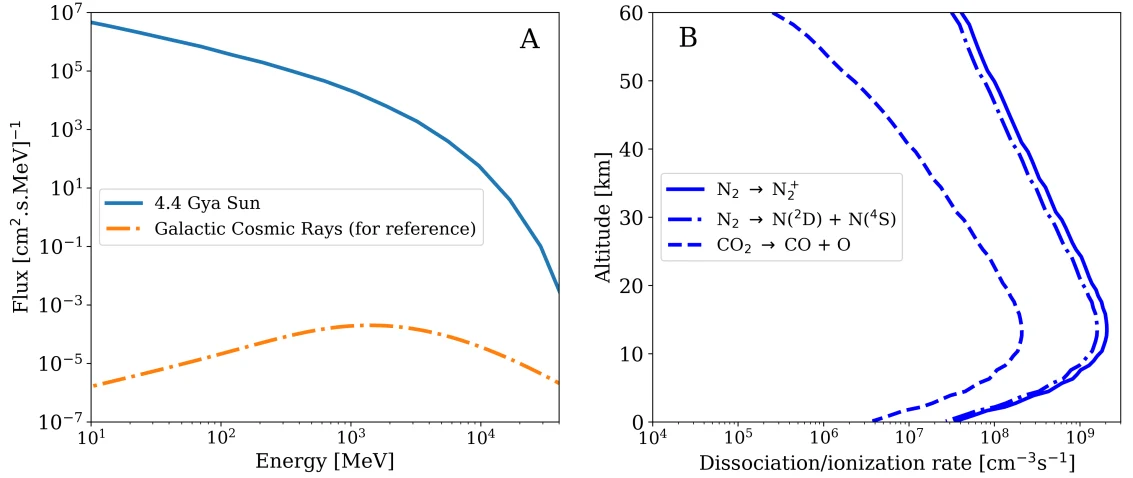
Молодое Солнце светило на 30% тусклее, но океаны не замёрзли. Разгадка — супервспышки: они бомбардировали атмосферу потоками энергичных частиц. Лабораторный опыт повторил это: смесь азота и углекислого газа под ударом частиц дала закись азота и глицин — строительный блок белков. Атмосфера здесь — кастрюля, а звёздные частицы — повар, готовящий из простых газов «бульон» для климата и жизни. Каждая мощная вспышка могла производить до 20 миллиардов килограммов закиси азота в год — достаточно, чтобы создать плотную «крышку» для планетарной кастрюли.
Закись азота — парниковый газ в 300 раз сильнее CO2. Он удерживал тепло слабого Солнца, не давая Земле замёрзнуть. Этот же механизм расширяет обитаемую зону для каменистых экзопланет — там, где обычного тепла недостаточно. Попутно рождаются аминокислоты, кирпичики жизни. Так космическая буря, обычно видящаяся угрозой, возможно, и запустила химию жизни на Земле.
Оригинальная аннотация
как её написали авторы, на английском arXiv:2603.18206
The emergence of habitable conditions on the early Earth and on rocky exoplanets requires persistent energy sources that can drive both prebiotic chemistry and climate warming under magnetically active young G to M stars. To quantify the contribution of stellar energetic particle (StEP) events associated with superflares to the atmospheric chemistry of young planets with primitive atmospheres, we carried out a suite of laboratory proton irradiation experiments on mildly reduced gas mixtures. We present first proton irradiation experiments of $$N_{\mathrm{2}}$$/$$CO_{\mathrm{2}}$$ rich gas mixtures that yield abundant nitrous oxide ($$N_{\mathrm{2}}O$$) at mixing ratios up to 1000 ppmv, together with amino acid precursors including glycine, corresponding to global production rates of order $$2\times10^{10}$$ kg/yr on the early Earth. Our photochemical modeling of StEP driven proton irradiation reproduces the experimentally inferred $$N_{\mathrm{2}}O$$ production rates and provides self-consistent atmospheric $$N_{\mathrm{2}}O$$ profiles. We then use these profiles of $$N_{\mathrm{2}}O$$ as input to a 3D global climate model to evaluate the radiative and climatic impact of StEP generated $$N_{\mathrm{2}}O$$ in primitive atmospheres representative of the early Earth and young rocky exoplanets. Our results show that frequent StEP events can help alleviate the faint young Sun paradox on the early Earth and can maintain temperate surface conditions on young rocky exoplanets beyond the outer edges of habitable zone, while simultaneously enhancing the buildup of prebiotic molecules. Together, these processes may constitute a robust pathway toward early planetary habitability.
Каждая мощная вспышка на молодой звезде могла производить до 20 миллиардов килограммов закиси азота в год — этого хватило бы, чтобы согреть атмосферу целой планеты.
Идея обогрева планеты парниковыми газами знакома по трилогии Кима Стэнли Робинсона «Красный Марс». Только там инженеры-люди, а здесь — сама звезда.